

You’ve just finished tightening that leaking tap or replacing a section of pipe under the sink. The water’s running, nothing’s dripping, and you’re feeling pretty proud. But will that DIY plumbing repair hold up in six months? A year? Or will you wake up to a flooded kitchen because a connection failed overnight?
This article walks Sydney and greater NSW homeowners through the warning signs that reveal whether your DIY fix is genuinely sound or quietly failing. You’ll learn what to check, why certain mistakes cause long-term damage, and when it’s time to call a licensed plumber.
Key Takeaways
- Most DIY plumbing failures stem from overtightened fittings, mismatched materials, or skipped isolation valves.
- Early warning signs include slow leaks, water stains, pressure drops, and unusual noises in your pipes.
- Compliance with Australian Standards (AS/NZS 3500) and NSW Fair Trading rules protects your home, your Sydney Water connection and your insurance cover.
- Professional diagnosis using CCTV and pressure testing catches hidden issues before they escalate.
- Antons Plumbing & Gas (NSW Lic. 210933C) offers same-day service across Sydney, fixed-rate pricing in AUD, and a lifetime labour warranty.
Why DIY Plumbing Repair Mistakes Happen in the First Place
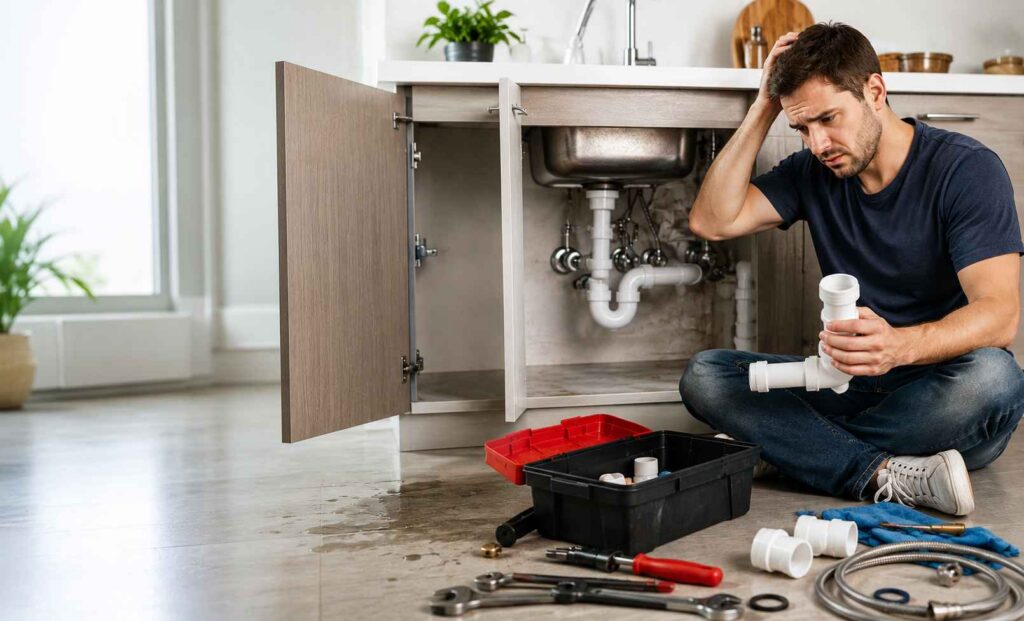
Homeowners tackle plumbing jobs for good reasons. You want to save money, you enjoy hands-on projects, or you think the fix looks simple enough from a YouTube video. The problem isn’t your intention. It’s that plumbing systems in Sydney homes are more complex than they appear, especially in older properties with clay pipes, mixed materials, and varying water pressure zones across suburbs.
Common DIY errors include overtightening connections until washers crack, using the wrong sealant for the pipe material, and forgetting to turn off the water supply before starting work. These mistakes don’t always show up immediately. A fitting might hold for weeks before vibration or thermal expansion causes it to fail. That’s when a small leak becomes a burst pipe, and your insurance company starts asking whether the work was done by a licensed plumber.
We see these issues regularly during emergency callouts across Sydney. A homeowner replaces a kitchen sink trap with parts from a hardware store, mixes plastic and metal fittings without the correct transition couplings, and six months later the joint corrodes and floods the cabinet. The repair itself might have cost around $50 (AUD) in parts, but the water damage and mould remediation bill can run into thousands.
How to Spot Warning Signs of a Failing DIY Plumbing Repair
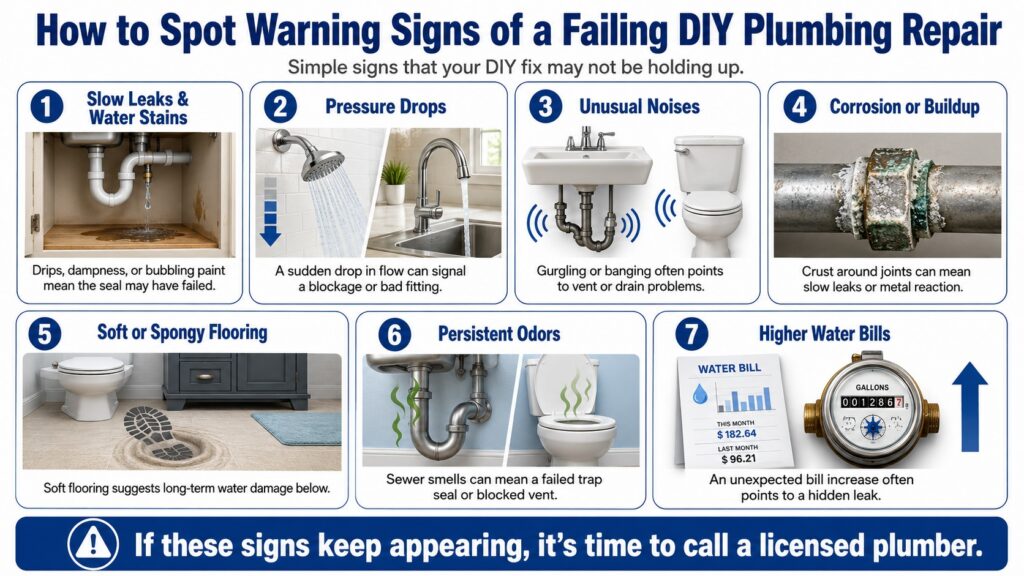
You don’t need a plumbing licence to check whether your DIY fix is holding up. Start by looking for these telltale signs that something’s going wrong beneath the surface.
1. Slow Leaks and Water Stains
Check under sinks, around toilet bases, and near any connection you’ve worked on. Even a tiny drip can leave a water stain on timber or cause paint to bubble. If you see discolouration or feel dampness when you press a finger against the cabinet floor, your seal or washer has failed.
2. Pressure Drops When Multiple Taps Run
Turn on the shower, then open the kitchen tap. If the shower pressure drops noticeably, you might have a partial blockage or a kinked pipe from your recent work. Pressure changes also signal that a fitting isn’t seated properly, restricting flow.
3. Unusual Noises After You Flush or Drain
Gurgling sounds in your sink or toilet mean air is trapped in the drain line. This often happens when a DIY drain snake or pipe cleaner pushes debris sideways instead of clearing it, or when you’ve installed a trap without the correct slope. Banging noises (water hammer) suggest you’ve removed or damaged an air chamber or pressure arrestor.
4. Visible Corrosion or Mineral Buildup
White or green crust around a joint tells you dissimilar metals are reacting, or that a slow leak is evaporating and leaving minerals behind. Corrosion weakens fittings over time, and the joint will eventually rupture under normal water pressure.
5. Soft or Spongy Flooring Near the Repair
If the floor feels soft when you step near the toilet or under the vanity, water has been seeping into the subfloor for weeks or months. This is a serious structural issue that requires immediate attention, not just a plumbing fix.
6. Persistent Odours That Won’t Clear
Sewer gas smells mean your trap has lost its water seal, or a vent pipe is blocked. DIY repairs that skip proper venting or use the wrong trap configuration let gases back into your home, which is both unpleasant and a health risk.
7. Higher Water Bills Without Increased Usage
A sudden jump in your Sydney Water bill often points to a hidden leak. Even a small drip can waste hundreds of litres per week, and you won’t see it if it’s inside a wall cavity or under a slab.
If any of these signs sound familiar, it’s time to call a licensed Sydney plumber, like our team at Antons Plumbing & Gas (NSW Lic. 210933C), before a small fault turns into an expensive claim.
Common DIY Plumbing Repair Mistakes That Shorten Lifespan
Understanding why repairs fail helps you decide whether to attempt the fix yourself or call a professional. Here are the mistakes we encounter most often when inspecting failed DIY work across Sydney.
- Overtightening fittings: Plastic threads strip, brass cracks, and rubber washers deform when you crank down too hard with a wrench. Hand-tight plus a quarter turn is usually enough for compression fittings.
- Mixing incompatible materials: Joining copper to galvanised steel without a dielectric union causes galvanic corrosion. PVC and ABS require different solvents. Using the wrong glue means the joint never fully bonds.
- Skipping the isolation valve: Forgetting to turn off the water before you start leads to flooding mid-repair, but it also means you can’t isolate the section later if something goes wrong. Every fixture should have its own isolation valve.
- Using chemical drain cleaners repeatedly: Caustic liquids eat through old pipe walls, especially if the blockage is only partial and the chemical sits in one spot. A DIY drain snake or pipe cleaner is safer, but only if you know how to avoid puncturing the pipe.
- Ignoring venting requirements: Drains need air to flow properly. If you extend a drain line without adding a vent, you’ll get slow drainage, gurgling, and siphoned traps that let sewer gas into your home.
- Relying on tape and sealant alone: Thread tape (PTFE) is a lubricant and gap-filler, not a structural seal. If the threads are damaged or the fitting is misaligned, tape won’t save you.
- Choosing the wrong pipe size: Reducing pipe diameter to make a connection easier starves fixtures downstream and increases pressure, which stresses other joints in the system.
These common mistakes show why some DIY plumbing repairs fail much sooner than expected. What appears to be a quick fix can shorten the lifespan of the plumbing system if the repair is not done with the right method and materials. By understanding these risks, homeowners can make better decisions about when to attempt a repair and when it is safer to call a licensed plumber.
When to Call a Licensed Plumber Instead of DIY
Some jobs are straightforward enough for a competent homeowner. Replacing a tap washer, tightening a loose toilet seat, or clearing a minor blockage with a plunger usually won’t cause long-term problems if you follow basic steps. But other tasks carry real risk, both to your property and to your legal standing.
You should call a licensed plumber when the work involves gas, when it affects your main water supply, Sydney Water connection or sewer line, when you need to modify pipe routes or sizes, or when the job requires a compliance certificate for insurance or council approval. In New South Wales, only licensed plumbers (like our team at Antons Plumbing & Gas, NSW Lic. 210933C) can legally perform work on water supply, drainage, and gas systems. DIY work that breaches the Plumbing Code of Australia can void your insurance and leave you liable for damage to neighbouring properties.
We also recommend calling a professional when you’re not sure what’s causing the problem. A slow drain might be a simple hair clog, or it could be tree roots invading your sewer line 10 metres away. A CCTV drain inspection shows exactly what’s happening inside the pipe, so you’re not guessing or making the problem worse with a DIY drain snake.
Professional Diagnosis Tools That Homeowners Don’t Have
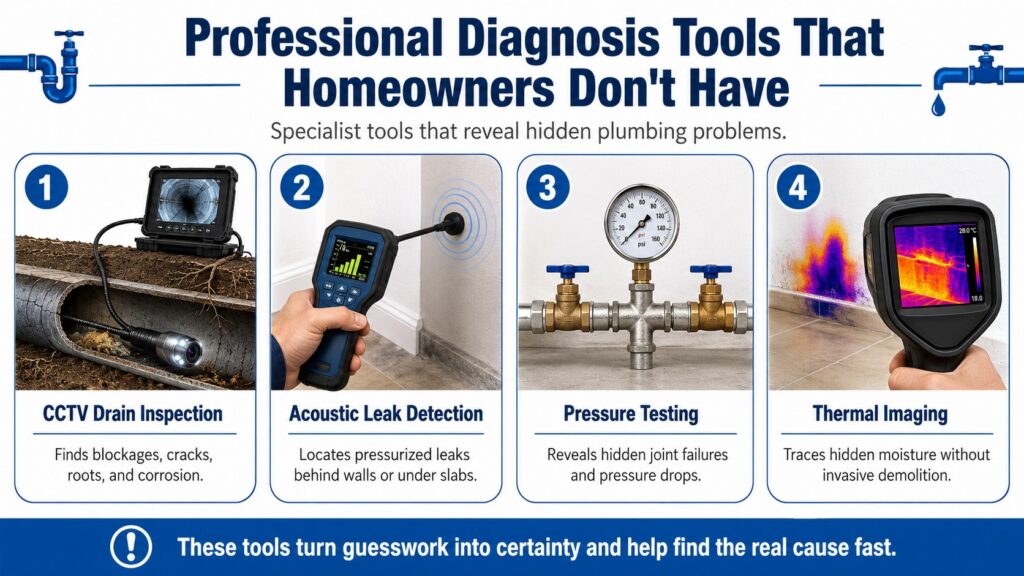
One reason licensed plumbers catch problems early is that we use diagnostic tools you won’t find in a home toolkit. These tools reveal what’s happening inside walls, under slabs, and deep in drain lines.
- CCTV drain inspection: A flexible camera on a cable travels through your pipes, recording video of blockages, cracks, root intrusion, and corrosion. We can pinpoint the exact location and depth of a problem, so you’re not digging up your entire yard on a guess.
- Acoustic leak detection: Sensitive microphones pick up the sound of water escaping under pressure, even when the leak is inside a concrete slab or behind tiles. This saves you from demolishing half your bathroom to find a pinhole leak.
- Pressure testing: We isolate sections of your plumbing, pressurise them, and monitor for pressure drops. A failing joint or hidden crack shows up immediately, before it turns into a burst pipe.
- Thermal imaging: Infrared cameras detect temperature differences caused by water leaks, helping us trace hidden moisture paths without invasive investigation.
These tools turn guesswork into certainty. When you attempt a DIY repair without knowing the full picture, you might fix the symptom but miss the root cause. That’s why we often see the same property multiple times: the homeowner patches a leak, but the underlying issue (say, high water pressure or a corroded section of pipe) causes another failure a few months later.
What Compliance and Standards Mean for Your DIY Work
In Australia, plumbing and drainage work must comply with the Plumbing Code of Australia (which references AS/NZS 3500) and your state’s specific regulations. For New South Wales, that means following the Plumbing and Drainage Act and obtaining any required approvals from NSW Fair Trading.
Sydney Water also sets requirements for any work connecting to the water and wastewater network, including notifications for certain jobs near or affecting shared infrastructure. Unauthorised alterations to a metered connection or non-compliant DIY work can result in penalties as well as insurance issues.
When you do DIY plumbing, you’re responsible for ensuring the work meets these standards. If it doesn’t, and something goes wrong, your home insurance may refuse to cover the damage. If your faulty repair causes a flood that damages a neighbour’s property, you could be personally liable for their losses.
Licensed plumbers carry insurance and provide compliance certificates for work that requires them (such as backflow prevention device installation, hot water system replacement, and gas appliance connections). These certificates prove the work was done correctly and protect you in the event of a claim.
We’ve seen homeowners lose tens of thousands of dollars (AUD) because a DIY hot water install wasn’t compliant, the unit failed, and the insurer walked away. The cost of hiring a licensed plumber upfront is almost always less than the cost of fixing non-compliant work after a failure.
Real-World Example: A Failed DIY Repair and the Aftermath
A homeowner in Sydney’s Inner West replaced a section of galvanised pipe under their kitchen sink with a piece of PVC, using rubber couplings and hose clamps. The repair held for about eight months. Then, during a cold snap, the metal and plastic expanded at different rates, the clamps loosened, and the joint separated overnight. The homeowner woke to find two centimetres of water across the kitchen and hallway, with water seeping into the floorboards and down into the ceiling of the room below.
The insurance assessor noted that the repair didn’t comply with AS/NZS 3500 (which requires proper transition fittings for dissimilar materials) and that the work wasn’t done by a licensed plumber. The claim was denied. The homeowner paid for water extraction, floor replacement, ceiling repair, and mould remediation out of pocket. The total bill exceeded $15,000 (AUD).
If the homeowner had called a licensed plumber initially, the repair would have cost a few hundred dollars (AUD) and been covered by a lifetime labour warranty. The lesson: short-term savings can lead to long-term financial pain.
How Antons Plumbing & Gas Fixes Failed DIY Repairs
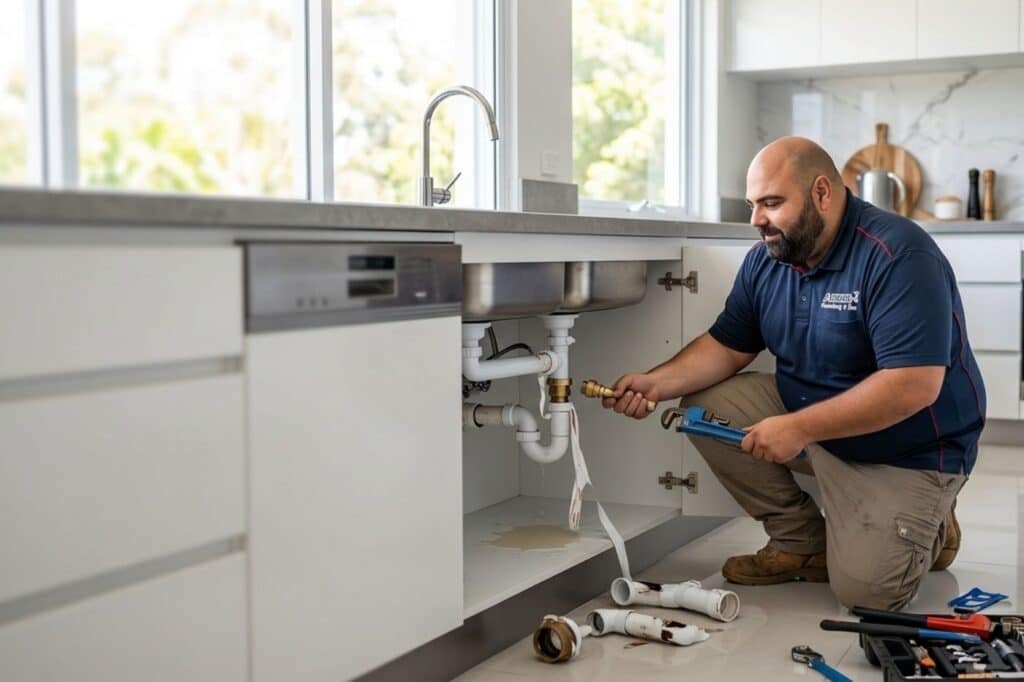
When you call us to repair a DIY job that’s gone wrong, we start with a thorough inspection. We don’t just patch the visible problem. We check the entire section of plumbing to make sure there are no other weak points waiting to fail. If you’ve mixed materials, we’ll replace the transition with the correct fittings. If you’ve overtightened a connection, we’ll assess whether the pipe or fixture body is damaged and needs replacement.
We document our findings with photos and written reports, so you understand exactly what went wrong and what we’re doing to fix it. Our quotes are fixed-rate in AUD, so you know the cost upfront with no surprises. And because we’re licensed and insured (NSW Lic. 210933C), the work comes with a lifetime labour warranty. If something fails due to our workmanship, we’ll come back and fix it at no charge.
Our team operates across Sydney Metro, including Inner West, Eastern Suburbs, North Shore, Northern Beaches, Hills District, Western Sydney, South-Western Sydney, and Sutherland Shire. We offer same-day service for urgent repairs, and our 24/7 emergency line (0493 824 176) means you’re never stuck waiting when a pipe bursts at midnight. From 7am to 3pm on weekdays (excluding public holidays), there’s no call-out fee, so you’re only paying for the work itself.
Conclusion
DIY plumbing can work for simple tasks, but the margin for error is slim. One overtightened fitting or mismatched material can turn a quick fix into a costly disaster. Regular checks help you spot warning signs early, and calling a licensed Sydney plumber when you’re unsure protects your home, your insurance, and your wallet. Our team is ready to help, day or night.
Antons Plumbing & Gas brings over 25 years of experience to diagnose issues DIY fixes often miss. Our licensed plumbing services ensure repairs last, backed by a lifetime labour warranty. Get started with same-day service today.
Related Articles
- How to Fix a Leaking Water Heater Supply Line Connection
- Why Your Faucet Drips When Turned Off and What to Do
- Sink Only Drains When Garbage Disposal Runs? Here’s Why
FAQs
What Are Common DIY Plumbing Repair Mistakes?
Common DIY plumbing repair mistakes include improper sealing of joints, using the wrong type of materials, neglecting to turn off the water supply, and underestimating the complexity of the problem. These can lead to further damage and costly repairs. Trusting experienced professionals like Antons Plumbing & Gas ensures that the job is done correctly the first time.
How Can I Avoid Mistakes When Doing DIY Plumbing Repairs?
To avoid mistakes during DIY plumbing repairs, take the time to research the issue thoroughly, use quality materials, and follow manufacturer instructions. If you’re unsure about any step, it’s wise to consult with a licensed plumber. Our team at Antons Plumbing & Gas is always available to provide guidance and support.
What Should I Know Before Attempting DIY Plumbing Repairs?
Before attempting DIY plumbing repairs, understand the scope of the problem and assess your skill level. Familiarise yourself with local plumbing codes and safety regulations. If the task seems too complex or risky, it’s best to call in professionals like Antons Plumbing & Gas, who have over 25 years of experience.
What Tools Do I Need for DIY Plumbing Repairs?
Essential tools for DIY plumbing repairs typically include a pipe wrench, pliers, a basin wrench, screwdrivers, a hacksaw, and Teflon tape. Having the right tools can make a significant difference in the repair process. However, for more intricate issues, it’s often better to rely on experts like our team at Antons Plumbing & Gas.
When Should I Call a Professional Plumber Instead of Doing It Myself?
You should call a professional plumber when the problem is beyond your expertise, such as major leaks, burst pipes, or complex installations. Additionally, if you’re facing repeated plumbing issues, it’s a sign that a professional diagnosis is needed. Antons Plumbing & Gas is here to provide safe, reliable solutions whenever you need them.
Do You Service My Sydney Suburb?
Yes. Antons Plumbing & Gas services the Sydney Metro area, including the Inner West, Eastern Suburbs, North Shore, Northern Beaches, Hills District, Western Sydney, South-Western Sydney, and Sutherland Shire. Call 0493 824 176 to confirm coverage for your address and book a visit.
Are You Licensed to Work in NSW?
Yes. Antons Plumbing & Gas holds NSW Licence 210933C, so every plumbing and gas fitting job we carry out is fully compliant with the Plumbing Code of Australia, AS/NZS 3500, and NSW Fair Trading requirements.
Can You Fix a DIY Plumbing Repair That Has Already Failed?
Absolutely. We regularly repair failed DIY jobs across Sydney, from leaking joints to full pipe replacements. We inspect the whole system, not just the visible fault, and quote a fixed rate in AUD before we start.
Is There a Call-Out Fee for Emergency Plumbing in Sydney?
There’s no call-out fee from 7am to 3pm on weekdays, excluding public holidays. Outside those hours our 24/7 emergency line (0493 824 176) is available for urgent DIY-repair failures and burst pipes.
Do You Offer Fixed-Rate Quotes Before Starting Work?
Yes. Every job is quoted at a fixed rate in AUD before we begin, so you know the cost upfront with no surprises, whether we’re fixing a failed DIY repair or installing a new fixture.
What Warranty Do You Offer on Repairs?
All workmanship carried out by Antons Plumbing & Gas is backed by a lifetime labour warranty. If something fails because of our work, we’ll come back and fix it at no charge.
How Quickly Can a Sydney Plumber Attend After a Failed DIY Repair?
We offer same-day service across Sydney for urgent repairs, plus a 24/7 emergency line for burst pipes and major leaks so you’re never left waiting.
Do You Provide Compliance Certificates for Sydney Water and NSW Fair Trading?
Yes. For work that requires it, such as backflow prevention devices, hot water system replacements, and gas connections, we provide the compliance certificates needed for insurance, council, and Sydney Water requirements.
Can a Failed DIY Repair Void My Home Insurance?
It can. If non-compliant DIY work causes damage, insurers can deny the claim because the repair wasn’t carried out by a licensed plumber. Booking a licensed inspection now can prevent a much larger, uninsured bill later.
How Do I Book a Same-Day Plumber in Sydney?
Simply call 0493 824 176 or use our online booking link to arrange a same-day visit. Tell us what you DIY’d and where it’s leaking, and we’ll bring the right parts and tools the first time.
Do You Handle Both Plumbing and Gas Fitting Work?
Yes. Antons Plumbing & Gas is licensed for both plumbing and gas fitting work across Sydney, so we can safely take over any DIY project that has strayed into gas-related territory.
What Should I Do Right Now If My DIY Repair Is Leaking?
Turn off the water at the nearest isolation valve or the main shutoff, mop up standing water to limit damage, and call our 24/7 line on 0493 824 176. We’ll talk you through immediate steps and get a licensed plumber to you fast.
Do You Work on Weekends and Public Holidays?
Yes. Our emergency line operates 24/7, including weekends and public holidays, for Sydney homeowners dealing with a failed repair or sudden leak.
Will You Inspect the Whole System, Not Just the Failed Repair?
Yes. We use CCTV drain inspection, acoustic leak detection, and pressure testing to check the surrounding plumbing, so we catch any other weak points before they cause a repeat callout.
How Much Does It Cost to Fix a Failed DIY Plumbing Repair?
Costs vary depending on the extent of the damage and materials involved. We always provide a fixed-rate quote in AUD upfront after inspecting the job, so there are no surprises before we start work.