

When you notice a water heater leaking rusty water from top, it is more than a minor inconvenience. Rusty water pooling around the top of your hot water system can indicate corrosion near the inlet pipes, temperature and pressure relief valve, anode rod port or storage tank connections, and the leak may quickly worsen from a slow drip into a damaging flood inside your Sydney home.
This guide walks you through the most common reasons rusty water appears at the top of a water heater, how to tell whether the rust lives in your tank or your pipes, and when professional inspection is non-negotiable. You will also learn simple checks you can perform today and the steps licensed plumbers take to diagnose and fix the problem for good. As Antons Plumbing & Gas is a fully licensed Sydney plumbing business (NSW Licence 210933C), any repair or replacement work is carried out to NSW Fair Trading and Sydney Water requirements.
Key Takeaways
- Rusty water leaking from the top usually means corrosion around fittings, valves, or the anode rod port.
- Testing hot versus cold water at separate taps helps you pinpoint whether rust originates in the heater or your household plumbing.
- Shutting off water and power (or gas) immediately prevents further damage when a leak is active.
- Replacing an expired anode rod and flushing sediment annually can extend tank life and slow corrosion.
- Professional inspection is essential when rust appears alongside leaks, because tank failure can happen without warning. In NSW, hot water system installation and replacement work legally must be carried out by a licensed plumber.
Why Water Heaters Leak Rusty Water From the Top
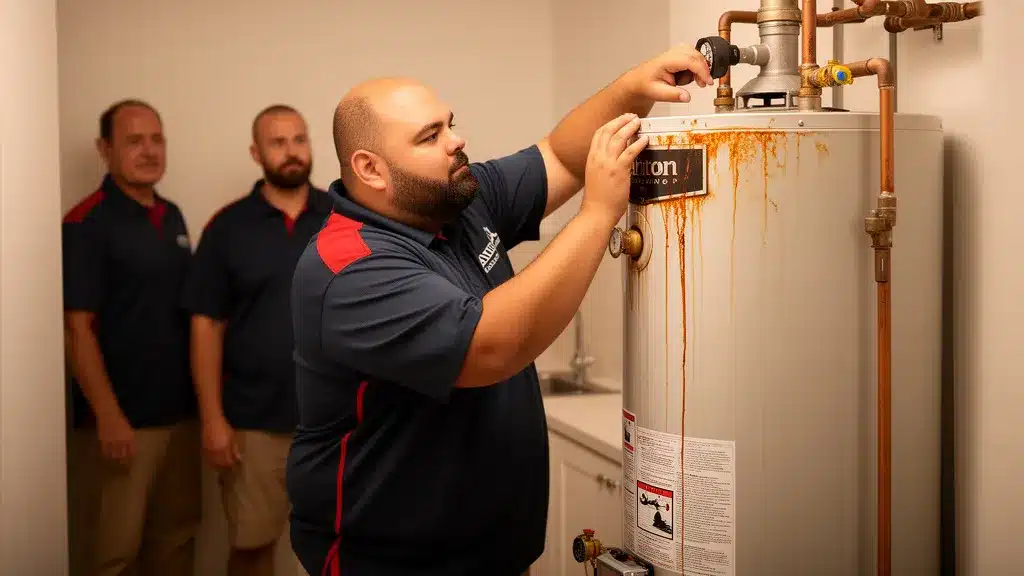
Leaks at the top of a storage water heater almost always point to corrosion around threaded connections, valve bodies, or the sacrificial anode rod. Steel tanks are protected by a glass lining and a magnesium or aluminium anode rod that corrodes in place of the tank walls. Once that rod is consumed or the lining cracks, oxygen-rich water attacks bare steel and forms rust. When rust accumulates at joints where dissimilar metals meet—brass fittings against steel nipples, for example—galvanic corrosion accelerates and welds can weaken.
Hard water, high temperature settings above 60 degrees Celsius, and poor ventilation in laundries or under-house areas all speed up the process. Budget units with thinner steel or inconsistent welding are especially vulnerable, and this is a common call-out we see across Sydney suburbs from Parramatta to the Northern Beaches.
Corroded Inlet and Outlet Connections
The cold water inlet and hot water outlet sit at the top of every storage heater. Over time, mineral deposits and electrolytic action eat through the threads where brass or copper pipes screw into steel ports. You will see rust staining around the hex nut or feel moisture when you touch the base of the pipe. Tightening the connection may stop a minor weep, but if rust has thinned the metal, the fitting will need to be cut out and replaced with dielectric unions that isolate dissimilar metals.
Failed Temperature and Pressure Relief Valve
The T&P valve is a safety device mounted near the top or side of the tank. It opens automatically if temperature exceeds 99 degrees Celsius or pressure climbs above 1000 kilopascals. Sediment, scale, or a worn rubber seat can prevent the valve from sealing completely, allowing hot water to seep out and streak the tank with rust. Testing the lever once a year flushes debris and confirms the valve moves freely. If water continues to dribble after you release the lever, the valve must be replaced—never plug or cap a T&P valve, as this breaches AS/NZS 3500 plumbing standards and creates a serious safety hazard.
Degraded Anode Rod Port
The anode rod threads into a port at the very top of the tank. As the rod sacrifices itself, rust and scale build up around the threads. When you go to remove an old rod, the port can crack or the threads strip, leaving a gap that leaks rusty water. Inspecting and replacing the anode every three to five years prevents this scenario. If the port is already damaged, a professional can sometimes install an expansion anode through the hot outlet or recommend tank replacement if the steel is too far gone.
Leaking Expansion Tank or Pressure-Limiting Valve
Many Sydney homes have an expansion tank bolted to the cold inlet to absorb thermal expansion in closed plumbing systems, a requirement that is common under Sydney Water backflow prevention rules. The rubber diaphragm inside can rupture, causing the tank to fill with water and weep at the threaded nipple. Similarly, a pressure-limiting valve installed upstream can drip rusty water if its spring weakens or sediment jams the seat. Both components are straightforward to test—press the Schrader valve on an expansion tank to check for water spray, and listen for hissing at the pressure valve when you turn on a tap.
Electrolysis and Dissimilar-Metal Corrosion
Connecting copper pipe directly to a steel tank creates a galvanic cell. Electrons flow from the less noble metal—usually steel—causing it to corrode faster. Dielectric unions or plastic-lined nipples break that electrical path. If your installer skipped those fittings, rust will form at every joint. You might also see green or white crust on copper pipes nearby, another sign of stray current. Replacing short nipples with proper isolation fittings stops the reaction and extends tank life.
How to Tell if Rust Comes From Your Water Heater or Your Pipes
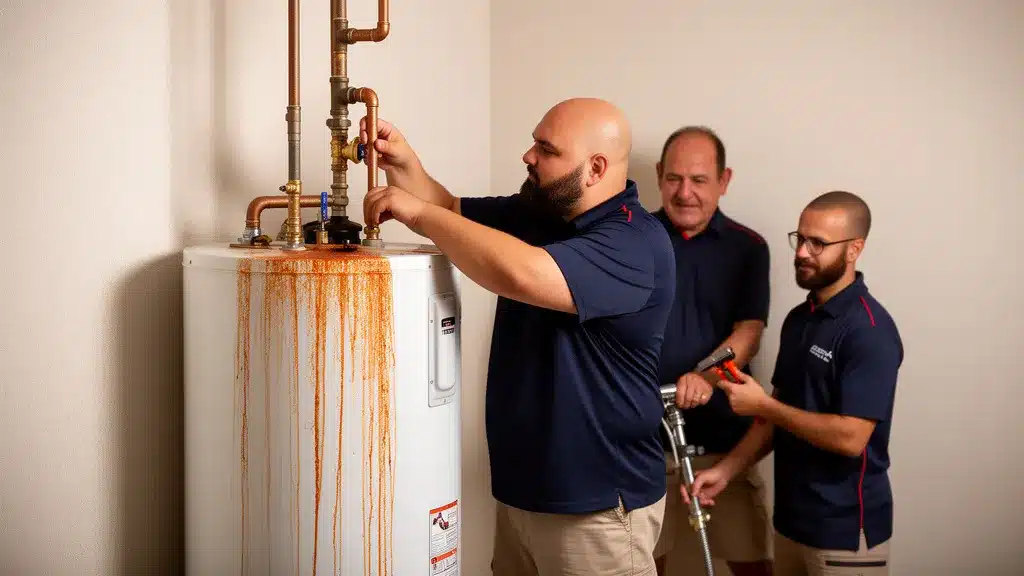
Rusty hot water does not always mean your tank is dying. Galvanised steel pipes installed in older Sydney homes—common in suburbs with pre-1980s housing stock—corrode from the inside, shedding flakes of iron oxide that turn water brown. Distinguishing between pipe rust and tank rust saves you from replacing a heater that still has years of service left. The test is simple and takes less than five minutes.
Run the cold tap at your kitchen sink for two minutes and collect a glass of water. Then run only the hot tap for two minutes and collect a second glass. Compare the colour under good light.
| Observation | Likely Source | Next Step |
|---|---|---|
| Both cold and hot water are rusty | Galvanised supply pipes | Inspect and replace corroded sections of plumbing |
| Only hot water is rusty | Water heater tank or anode rod | Check anode rod condition and tank interior |
| Rust clears after a few minutes of running hot water | Sediment in tank bottom | Flush tank and test again |
| Rust appears with visible leak at top fittings | Corroded valve or connection at heater | Tighten or replace leaking component |
If only your hot water runs rusty and you see moisture or staining around the top of the heater, the tank or its fittings are the problem. When both hot and cold water show discolouration, your supply pipes need attention. A licensed plumber can use a borescope or drain a sample from the tank drain valve to confirm sediment levels and check for internal rust.
Immediate Steps When You Discover a Rusty Leak at the Top
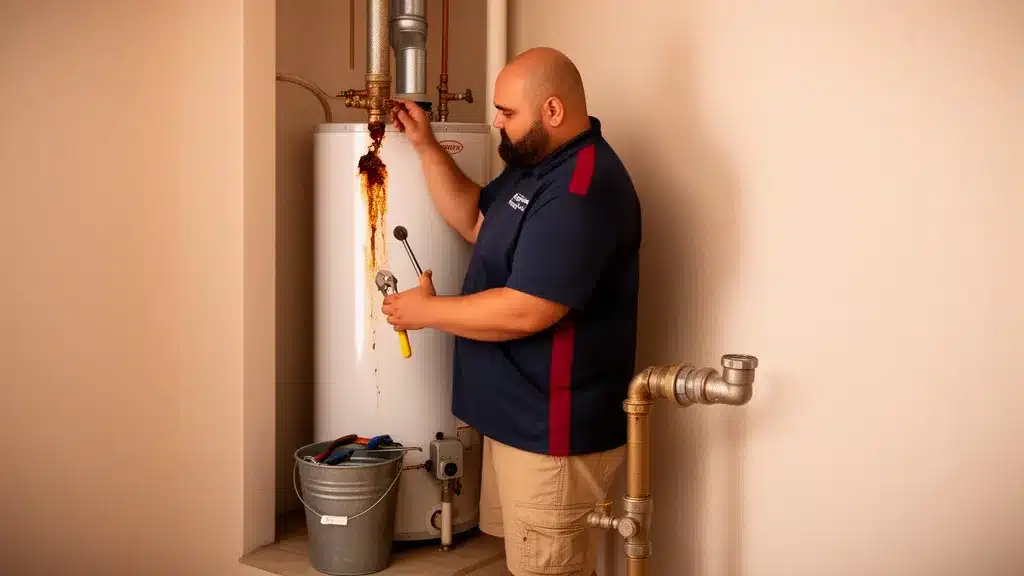
A small drip today can become a steady stream overnight. Rust weakens metal quickly, and water under mains pressure will find every thin spot. Taking action within the first hour limits damage to flooring, cabinetry, and electrical circuits. Follow these steps in order to protect your home while you arrange professional repair.
1. Turn Off the Water Supply
Locate the isolation valve on the cold water pipe entering the top of the heater. Turn the handle clockwise until it stops. If the valve is stiff or leaking at the packing nut, close your property’s main stop tap instead. Shutting off the water stops new flow into the tank and reduces pressure at the leak point.
2. Switch Off Power or Gas
For electric storage heaters, flip the dedicated circuit breaker in your switchboard to the off position. Never touch the heater or wiring if water has pooled on the floor. For gas units, turn the control dial to the pilot or off position and close the manual gas valve on the supply line if you can reach it safely. This prevents dry firing and eliminates ignition sources near a potential water spill.
3. Drain Enough Water to Stop the Leak
Attach a garden hose to the drain valve at the base of the tank and run it to a floor drain, laundry tub, or outside area (never into the stormwater system, per Sydney Water rules). Open the valve and let five to ten litres flow out. Lowering the water level below the leak point stops the drip and gives you time to inspect the fitting. Leave a bucket under the leak in case residual water continues to seep.
4. Inspect the Leak Source
Wipe the area dry with a rag and watch for new moisture. Check the T&P valve discharge tube, the cold inlet and hot outlet unions, the anode rod hex head, and any expansion tank connections. Rust stains, white crust, or green corrosion mark the trouble spot. Take a photo with your phone so you can show your plumber exactly what you see.
5. Call a Licensed Hot Water Specialist
Even if the leak has stopped, corroded fittings rarely heal themselves. A qualified plumber will assess whether a valve replacement, new dielectric unions, or full tank replacement is the safest and most cost-effective path. Under NSW regulations, hot water system repairs and replacements involving gas or new plumbing work must be carried out by a licensed plumber—Antons Plumbing & Gas holds NSW Licence 210933C. Our team offers same-day service across Sydney, with no call-out fee between seven in the morning and three in the afternoon on weekdays.
Common Causes of Corrosion in Gas and Electric Water Heaters
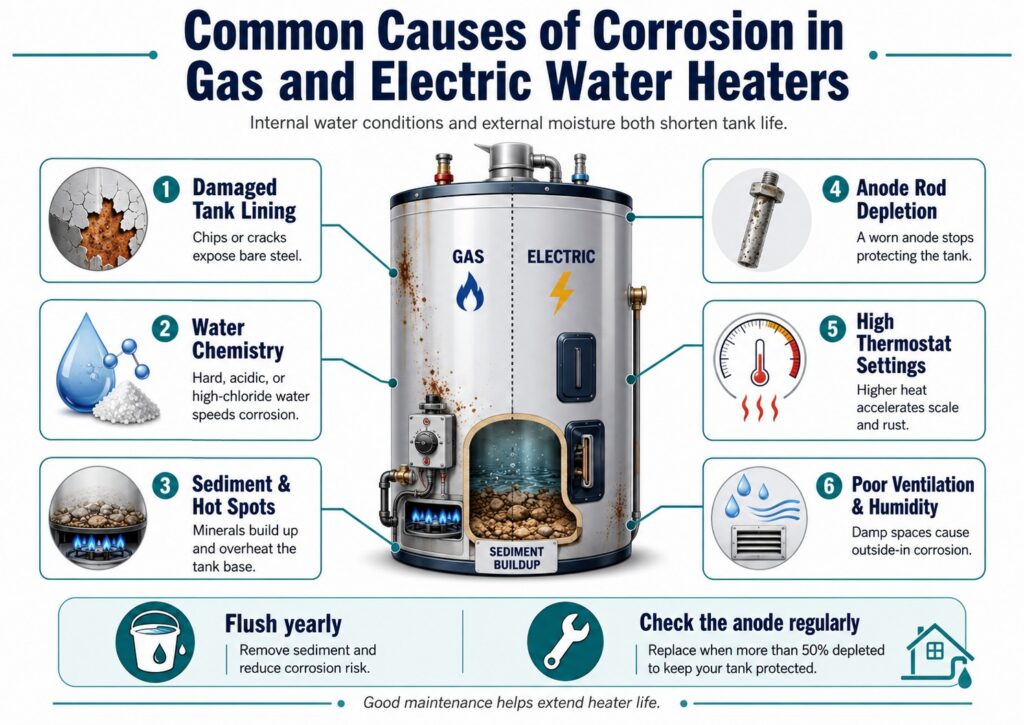
Both gas and electric storage heaters use steel tanks lined with vitreous enamel or glass. The lining is baked on at high temperature, but any chip, crack, or manufacturing flaw exposes bare metal to water. Once oxygen reaches steel, rust spreads under the lining like a blister. Gas heaters sit in garages or external cupboards where temperature swings and humidity are higher, accelerating corrosion. Electric units often live in confined laundry cupboards with poor airflow, trapping moisture against the tank shell.
Water chemistry plays an equally important role. Sydney Water supplies vary slightly by suburb—some areas have moderately hard water with calcium and magnesium, while others have slightly acidic water that eats through protective oxide layers. High chloride levels near the coast can pit stainless steel and attack welds, which is why coastal Sydney properties often see hot water systems corrode faster than those further inland.
Sediment Build-Up and Hot Spots
Minerals settle at the bottom of the tank and form an insulating layer. In gas heaters, this sediment sits directly above the burner, creating a hot spot that cracks the glass lining. In electric units, the lower element cycles more often to push heat through the sediment, overheating the steel. Both scenarios expose metal and start the rust cycle. Flushing the tank every twelve months removes sediment before it hardens into scale.
Anode Rod Depletion
The sacrificial anode rod is designed to corrode so the tank does not. Magnesium rods work well in soft to moderately hard water, while aluminium or powered anodes suit harder water. Once the rod is reduced to a thin wire or the core wire is exposed, the tank itself becomes the anode. Checking the rod every three years and replacing it when more than 15 centimetres of core wire is visible can double the life of your heater.
High Thermostat Settings
Running your heater above 65 degrees Celsius accelerates every chemical reaction inside the tank. Scale forms faster, the anode corrodes more quickly, and the glass lining experiences greater thermal stress. Most households find 60 degrees a safe compromise—it delivers comfortable hot water, inhibits legionella bacteria in line with NSW Health guidance, and reduces energy bills. If you need hotter water for a commercial dishwasher or sanitising, consider a tempering valve at the outlet rather than raising the entire tank temperature.
Poor Ventilation and Humidity
Heaters installed in damp under-house areas or poorly sealed external cupboards rust from the outside in. Condensation on the tank shell mixes with dust to form a corrosive paste. Ensuring adequate ventilation, sealing gaps around doors, and painting any exposed steel with rust-inhibiting primer all help. If your laundry or garage floods during heavy Sydney storms, raising the heater on a concrete plinth keeps the base dry and makes future maintenance easier.
Maintenance Tips to Prevent Rusty Leaks at the Top of Your Water Heater
Preventive maintenance costs a fraction of emergency replacement and keeps your system compliant with Australian Standards. A well-maintained storage heater in Sydney can deliver fifteen years of service, while a neglected unit may fail in eight. The tasks below take less than an hour per year and catch problems before they become leaks.
- Flush sediment every twelve months. Connect a hose to the drain valve, open it fully, and let water run until it flows clear. This removes mineral build-up that causes hot spots and corrosion.
- Test the T&P valve annually. Lift the lever for three seconds and release. Water should gush out and stop cleanly. If it drips afterwards, replace the valve immediately.
- Inspect the anode rod every three to five years. Unscrew the hex head at the top of the tank and pull the rod out. Replace it if the core wire is exposed or the rod diameter is less than 12 millimetres.
- Check all top connections for moisture. Run your hand around inlet and outlet unions, the T&P valve body, and any expansion tank fittings. Tighten any weeping joints and replace corroded washers or O-rings.
- Lower the thermostat to 60 degrees Celsius. This reduces scale formation, slows anode consumption, and cuts energy use without sacrificing comfort.
- Ensure dielectric unions are installed. If copper pipes connect directly to steel ports, have a plumber retrofit dielectric unions or plastic-lined nipples to stop galvanic corrosion.
Our team provides scheduled hot water system inspections across Sydney, checking anode condition, testing valves, and flushing sediment as part of a fixed-rate service. We document our findings with photos and date tags, so you have a clear maintenance record for insurance and future buyers. Book your annual check by calling 0493 824 176 or using our online form.
When to Repair and When to Replace a Rusty Water Heater
Not every rusty leak means you need a new tank. If the leak is confined to a replaceable component—T&P valve, inlet union, or anode rod port—and the tank itself shows no external rust or bulging, repair is usually the best choice. A skilled plumber can swap out valves, install new dielectric fittings, and test the system for less than the cost of a new heater. You gain another few years of service and avoid the disruption of a full replacement.
Replacement becomes necessary when rust has compromised the tank structure. Look for these warning signs during your inspection.
| Sign | What It Means | Recommended Action |
|---|---|---|
| Rust stains on the tank body | External corrosion; internal rust likely present | Replace the heater |
| Bulging or distorted tank panels | Pressure build-up from scale or failing T&P valve | Replace immediately for safety |
| Pooling water with no visible leak point | Pinhole leaks in the tank floor or seams | Replace the heater |
| Heater age over twelve years with rusty water | Tank lining and anode likely exhausted | Plan replacement within six months |
| Repeated valve or fitting leaks | Threads stripped or ports corroded | Replace if repair costs exceed half of new unit price |
When replacement is the safer option, we guide you through tank sizing, energy ratings, and installation requirements under AS/NZS 3500 plumbing standards, as well as Sydney Water and NSW Fair Trading requirements for notifiable plumbing work. We remove the old unit, upgrade any non-compliant pipework, fit the new heater with proper strapping and overflow protection, and test every connection before we leave. Our work is backed by a lifetime labour warranty, and we supply a compliance certificate for your records, which is lodged as required with Sydney Water. Same-day installation is available across the Inner West, Eastern Suburbs, North Shore, Northern Beaches, Hills District, and Western Sydney—ring 0493 824 176 to arrange a free on-site quote.
Why You Should Never Ignore Rusty Water Leaking From the Top
A slow drip feels easy to ignore when life is busy. You might place a towel under the heater and promise yourself you will call someone next week. That delay can cost you thousands. Rust does not pause or reverse—it accelerates. Once a pinhole opens in a fitting or tank seam, water pressure widens the gap. A drip becomes a trickle, then a stream. If the tank ruptures while you are at work or asleep, two hundred litres or more can flood your laundry, kitchen, or garage in minutes.
Water damage to timber floors, cabinetry, and electrical wiring often exceeds the cost of a new heater several times over. Insurance claims require proof of reasonable maintenance, and a documented history of ignored leaks can reduce or void your payout. Beyond property damage, a failing heater poses safety risks. A blocked T&P valve combined with a faulty thermostat can turn the tank into a pressure vessel, with the potential for violent rupture. Scalding water and steam can cause severe burns, and the force of a tank explosion can demolish walls.
Professional inspection gives you certainty. Our licensed plumbers assess the condition of your tank, test safety devices, measure anode wear, and provide a written report with clear options. If repair is viable, we quote a fixed price and complete the work the same day. If replacement is safer, we explain why and show you the corroded components so you understand the risk.
You make the decision with full information, no pressure, and no hidden fees. Call us on 0493 824 176 any time—we are available 24 hours a day, 7 days a week, across all Sydney suburbs.
Why You Should Never Ignore Rusty Water Leaking From the Top
A slow drip feels easy to ignore when life is busy. You might place a towel under the heater and promise yourself you will call someone next week. That delay can cost you thousands of dollars. Rust does not pause or reverse—it accelerates. Once a pinhole opens in a fitting or tank seam, water pressure widens the gap. A drip becomes a trickle, then a stream. If the tank ruptures while you are at work or asleep, two hundred litres or more can flood your laundry, kitchen, or garage in minutes.
Water damage to timber floors, cabinetry, and electrical wiring often exceeds the cost of a new heater several times over. Insurance claims require proof of reasonable maintenance, and a documented history of ignored leaks can reduce or void your payout. Beyond property damage, a failing heater poses safety risks. A blocked T&P valve combined with a faulty thermostat can turn the tank into a pressure vessel, with the potential for violent rupture. Scalding water and steam can cause severe burns, and the force of a tank explosion can demolish walls.
Professional inspection gives you certainty. Our licensed plumbers (NSW Licence 210933C) assess the condition of your tank, test safety devices, measure anode wear, and provide a written report with clear options. If repair is viable, we quote a fixed price and complete the work the same day. If replacement is safer, we explain why and show you the corroded components so you understand the risk.
You make the decision with full information, no pressure, and no hidden fees. Call us on 0493 824 176 any time—we are available 24 hours a day, 7 days a week, across all Sydney suburbs.
How Antons Plumbing & Gas Diagnoses and Fixes Rusty Water Heater Leaks
Our diagnostic process follows Australian Standards and focuses on root causes, not quick patches. When you book a hot water service call, we arrive with a full toolkit, replacement valves, dielectric unions, anode rods, and testing equipment. The first step is a visual inspection of the entire heater—top, sides, base, and all pipework within one metre. We photograph any rust stains, moisture, or corrosion and note the heater’s make, model, and age.
Next, we test water quality at the nearest tap, checking for rust in both hot and cold lines. We drain a sample from the tank drain valve to assess sediment levels and look for metal flakes. If the anode rod is accessible, we remove it to measure remaining material. We test the T&P valve by lifting the lever and observing flow and shut-off. We check the expansion tank air pressure and inspect all threaded connections for tightness and corrosion. Finally, we measure inlet water pressure and verify that any pressure-limiting valve is set correctly.
Once we have identified the leak source, we present you with a clear explanation and a fixed-price quote for repair or replacement. If a valve or fitting is the problem, we can usually complete the repair within an hour. If the tank itself is corroded, we discuss your options—new electric, gas, heat pump, or solar—and provide upfront pricing in AUD for supply and installation.
We never start work without your approval, and we never add surprise charges. Every job is completed to AS/NZS 3500 plumbing standards, tested under full pressure, and backed by our lifetime labour warranty. We clean up, dispose of old parts responsibly, and leave your space as tidy as we found it.
Choosing the Right Replacement Water Heater for Sydney Homes
When rust forces replacement, you have an opportunity to upgrade to a more efficient, longer-lasting system. The right choice depends on your household size, fuel availability, roof space, and budget. Our team will measure your existing heater, check your switchboard capacity or gas meter size, and recommend systems that meet your needs without oversizing or underperforming.
- Electric storage heaters suit homes without natural gas. Choose a model with two elements for faster recovery and a high-quality vitreous enamel lining. Expect a lifespan of ten to fifteen years with proper maintenance.
- Gas storage heaters deliver faster recovery and lower running costs if you have natural gas connected. Look for a five-star energy rating and a stainless steel burner. These units work well for larger families and perform reliably even during power outages.
- Instantaneous gas heaters provide endless hot water and take up minimal space. They are ideal for units, townhouses, and homes where tank placement is difficult. Running costs are lower than storage systems, and there is no standby heat loss.
- Heat pump water heaters use electricity to move heat from the air into the water, delivering three times the efficiency of a standard electric element. They require outdoor installation with good airflow and are eligible for government rebates in New South Wales.
- Solar hot water systems combine roof-mounted collectors with a storage tank. They cut energy bills by up to 70 percent and qualify for federal and NSW state incentives. A gas or electric booster ensures hot water on cloudy days.
We supply and install leading brands that meet Australian Standards, including Rheem, Rinnai, Dux, Aquamax, and Bosch. Every installation includes new isolation valves, compliant overflow piping, strapping where required, and a tempering valve if your system exceeds 60 degrees at the tap. We provide a written quote in AUD before we start, complete the work in a single visit, and issue a compliance certificate on the day. For expert advice on the best replacement for your home, call 0493 824 176 or request a quote online.
Protecting Your Home From Future Hot Water Leaks
Once your heater is repaired or replaced, a few simple habits will protect your investment and keep your home safe. Set a calendar reminder to test the T&P valve every twelve months—lift the lever, let water flow for a few seconds, and check that it stops cleanly when you release it. Flush the tank annually by opening the drain valve and running water until it flows clear. This takes ten minutes and prevents the sediment build-up that causes rust and inefficiency.
Inspect the area around your heater every few months. Look for moisture on pipes, rust stains on the tank body, or pooling water on the floor. Catch a small leak early and you avoid major damage. If your heater is in a confined space, improve ventilation by adding a vent or leaving the door ajar. Lower humidity means less external corrosion.
Consider upgrading to a leak detection system if your heater sits above living areas or near electrical panels. Wireless sensors placed under the heater send an alert to your phone the moment moisture appears, giving you time to shut off the water before a flood starts. These devices cost less than a single insurance excess and deliver peace of mind.
Finally, keep a record of all maintenance and repairs. Note the date you replaced the anode rod, flushed the tank, or had a plumber inspect the system. This documentation proves due diligence to insurers and helps future owners understand the heater’s service history. Our team provides a detailed report and date tag after every service visit, so you always know when the next check is due.
Conclusion
Rusty water leaking from the top of your heater signals corrosion that will only worsen without professional attention. Testing your water, shutting off supply and power, and calling a licensed plumber protects your home and keeps your family safe. Antons Plumbing & Gas delivers same-day hot water repairs and replacements across Sydney, backed by 25 years of experience, upfront pricing, and a lifetime labour warranty. Call 0493 824 176 now or book online to fix the problem before it floods your home.
Antons Plumbing & Gas provides expert hot water system repairs across Sydney Metro for rusty leaks and burst tanks. Our licensed specialists diagnose the cause and deliver same-day solutions with upfront pricing. Call 0493 824 176 to get started today.
Related Articles
- Shower Leaks When Switching to Handheld Wand: Causes and Fixes
- Water Leaking Through Ceiling: Is It a Plumbing Emergency?
- Toy Flushed Down Toilet? What to Do Before It Becomes a Bigger Blockage
- Shower Leak Repair Cost in Sydney: 2026 Prices and Quote Guide
FAQs
What causes a water heater to leak rusty water?
A water heater can leak rusty water due to several factors, including rust and corrosion inside the tank, sediment build-up, or a failing anode rod. Over time, these issues can compromise the integrity of the tank, leading to leaks. At Antons Plumbing & Gas, our experienced, licensed technicians can diagnose the root cause and recommend the best course of action to restore your hot water system.
Is rusty water from a water heater dangerous to drink?
Rusty water from a water heater is generally not dangerous to drink, but it indicates corrosion and potential issues with your unit. While it may not pose an immediate health risk, it can affect the quality of your water and may signal the need for repairs or replacement. Our team can assess your situation and ensure your water supply remains safe and clean.
How do I fix a leaking water heater?
Fixing a leaking water heater often involves identifying the source of the leak, which can be due to faulty connections, rust, or a damaged tank. Depending on the severity, you may need to tighten fittings, replace parts, or consider a full replacement. Our licensed plumbers at Antons Plumbing & Gas (NSW Licence 210933C) can provide a thorough inspection and reliable solutions tailored to your needs.
Can a water heater leak from the top?
Yes, a water heater can leak from the top, often due to loose or damaged connections, faulty valves, or condensation. Addressing these issues promptly is important to prevent further damage. Our experienced team is well-equipped to handle such leaks and ensure your hot water system functions properly.
When should I replace my water heater if it’s leaking?
If your water heater is leaking and the tank is rusted or corroded, it may be time for a replacement. Other signs include age (typically over ten to fifteen years), frequent repairs, or significant water loss. At Antons Plumbing & Gas, we can help you evaluate your options and find a reliable, energy-efficient replacement that fits your budget and needs.
How much does it cost to get a plumber to inspect a rusty hot water system in Sydney?
Every home is different, so we provide an obligation-free, fixed-price quote in AUD once we have inspected your system in person. There is no call-out fee for bookings between 7am and 3pm on weekdays. Call 0493 824 176 for a straightforward quote before any work begins.
Do I need a licensed plumber to repair or replace a hot water system in NSW?
Yes. Under NSW law, plumbing and gas fitting work—including hot water system repairs and replacements—must be carried out by a licensed plumber, and much of this work must be lodged as notifiable work with Sydney Water. Antons Plumbing & Gas holds NSW Licence 210933C, so every job we complete meets these requirements.
Is Antons Plumbing & Gas fully licensed and insured?
Yes. We operate under NSW Licence 210933C and carry full insurance, so you can book with confidence knowing the work is compliant, safe, and backed by our lifetime labour warranty.
Do you offer same-day hot water repairs in Sydney?
Yes, in most cases we can attend the same day you call, including emergency callouts. Call 0493 824 176 and we will give you a realistic arrival window based on your suburb.
What Sydney suburbs do you service?
We service the Inner West, Eastern Suburbs, North Shore, Northern Beaches, Hills District, and Western Sydney, along with many suburbs in between—see our suburb pages linked throughout this article for specific areas.
Do you charge a call-out fee for hot water leaks?
There is no call-out fee for bookings between 7am and 3pm on weekdays. Ask our team about after-hours arrangements when you call to book.
Can I get an emergency plumber if my hot water system floods overnight?
Yes, we offer 24-hour, 7-day emergency service across Sydney. If your tank has ruptured, shut off the water and power (or gas) first, then call 0493 824 176 immediately.
Will repairs to my hot water system be compliant with Sydney Water and NSW regulations?
Yes. All work is completed to AS/NZS 3500 plumbing standards and relevant Sydney Water and NSW Fair Trading requirements. We lodge notifiable work where required and supply you with the paperwork.
Do you provide a compliance certificate after replacing a hot water system?
Yes, we issue a compliance certificate on the day of installation, which is important for insurance purposes and for any future sale of your property.
What brands of hot water systems do you install?
We supply and install leading brands including Rheem, Rinnai, Dux, Aquamax, and Bosch, matched to your household size, fuel type, and budget.
Are there rebates available for heat pump or solar hot water systems in NSW?
Heat pump and solar hot water systems can be eligible for government rebates in New South Wales. Ask our team when you book a quote and we will let you know what may apply to your installation.
How quickly can you get a plumber to my house in Sydney?
Response times depend on your location and the time of day, but we prioritise active leaks and hot water outages. Call 0493 824 176 and we will confirm the soonest available slot.
Do you offer warranties on your hot water repairs?
Yes, our repair and installation work is backed by a lifetime labour warranty, in addition to the manufacturer’s warranty on any new parts or units supplied.
How do I book a hot water repair with Antons Plumbing & Gas?
Simply call 0493 824 176 or use our online booking form. Let us know you have rusty water leaking from the top of your heater and we will arrange an inspection, often the same day.
What should I do right now if my hot water heater is leaking rusty water?
Turn off the cold water isolation valve, switch off the power or gas, drain a little water to relieve pressure, and take a photo of the leak. Then call 0493 824 176—our licensed Sydney team can talk you through next steps and arrange an inspection.
Can I claim insurance for water damage caused by a rusty hot water tank?
Possibly, but insurers generally expect evidence of reasonable maintenance. Keeping records of anode checks, T&P valve tests, and any plumber inspections—like the reports we provide after every service—supports a smoother claim.