

Picture this: your kitchen tap starts gushing water at 2am, and you’re scrambling to find the stop tap while water spreads across the floor. An isolation valve could have saved you from this nightmare by letting you stop the flow right at the source. These small but mighty fittings give Sydney homeowners control during plumbing emergencies without shutting off water to the entire home.
This guide walks you through everything you need to know about isolation valves in plain English, with NSW plumbing rules and Sydney Water context built in. You’ll discover what they are, where to find them, how to use them safely, and when to call in a licensed Sydney plumber from our team at Anton’s Plumbing & Gas (NSW Lic. 210933C).
Key Takeaways
- Isolation valves let you stop water flow to specific fixtures without affecting your whole house.
- You’ll typically find them near sinks, toilets, washing machines, and outdoor taps.
- Turn valves clockwise to close and anticlockwise to open – but never force a stuck valve.
- Test your isolation valves every six months to make sure they’ll work when you need them.
- Call a licensed Sydney plumber (like Anton’s Plumbing & Gas, NSW Lic. 210933C) if valves are seized, leaking, or missing entirely.
What Is an Isolation Valve and How It Works in Your Plumbing
An isolation valve is a shut-off device that stops water flow to a specific section of your plumbing system. Unlike your stop tap (main water shut-off valve) that controls water to your entire property, isolation valves work at the fixture level. They’re strategically placed between your main water supply and individual taps, toilets, appliances, and other water-using fittings.
The isolation valve meaning becomes clear when you understand its primary purpose: giving you precise control over water flow. When you turn the valve handle or lever, an internal mechanism either blocks or allows water passage through the pipe.
Most isolation valves operate on a simple quarter-turn system. A 90-degree turn of the handle switches the valve from fully open to fully closed. Some older valves require multiple turns, similar to a garden tap, but the principle remains the same – clockwise closes, anticlockwise opens.
The Little Valve That Lets You Stop a Plumbing Emergency Fast
When a pipe bursts, a tap won’t stop running, or you are trying to safely dissolve hair in drain buildup, every second counts. The difference between minor water damage and a major insurance claim often comes down to how quickly you can stop the flow. Most Sydney homeowners know where their stop tap is, but using it means no water anywhere in the house until repairs are complete.
Isolation valves change this equation completely. These compact shut-off points let you isolate the problem area while keeping water flowing to the rest of your home.
Think of isolation valves as circuit breakers for your plumbing system. Just like you can turn off power to one room without affecting the whole house, isolation valves let you control water flow to individual fixtures and appliances. This targeted control prevents water damage and keeps your household comfortable during repairs.
How Isolation Valves Differ From Main Shut-Off Valves
Your main shut-off valve, or stop tap, typically sits near your Sydney Water meter or where the water line enters your property – often in a meter box near the front boundary. It controls water flow to your entire property and usually requires a water meter key or special tool to operate. Isolation valves, by contrast, are designed for regular homeowner use with simple hand operation. Under NSW plumbing regulations, any permanent alterations to pipework downstream of the meter must meet AS/NZS plumbing standards and, for larger jobs, be carried out or signed off by a licensed plumber.
| Aspect | Isolation Valve | Shut-Off Valve (Stop Valve) |
|---|---|---|
| Primary purpose | To isolate a section of the system for maintenance or repair | To stop water flow to a fixture, appliance, or whole building |
| Typical use | Used along pipe runs to section off branches or equipment | Used at fixtures (toilets, taps, hot water systems) or as a main shut-off |
| How often it’s operated | Infrequently – usually only during repairs or changes | More frequently – for servicing fixtures, emergencies, or seasonal use |
| Common types | Ball valves, gate valves | Angle stop valves, straight stop valves, ball-type shut-off valves |
| Flow characteristics | Usually full-bore (especially ball type) for minimal pressure loss | May be slightly more restrictive, especially older compression-style stops |
| Location in system | On branch lines, before/after key components (meters, pumps, heaters, etc.) | Under sinks, behind toilets, on appliance connections, at the main entry |
| Control style | Lever or wheel handle; often quarter-turn ball valves | Small handle/knob, lever, or screwdriver slot |
| Main vs local control | Often for segment/zone control of the system | Often for fixture-level or building-level control |
| Installation priority | Used where future maintenance is expected or critical | Required/strongly recommended at every fixture and at the main inlet |
| Are they different things? | “Isolation valve” is more about function (isolating a section) | “Shut-off valve” is more about everyday use (turning water on/off) – but in homes, a shut-off valve is usually also an isolation valve |
The isolation valve vs shut-off valve comparison also reveals differences in size and installation location. Stop taps handle high water pressure and volume, so they’re larger and more robust. Isolation valves are smaller, more accessible, and positioned for convenience during maintenance or emergencies.
Where to Find Isolation Valves Around Your Home
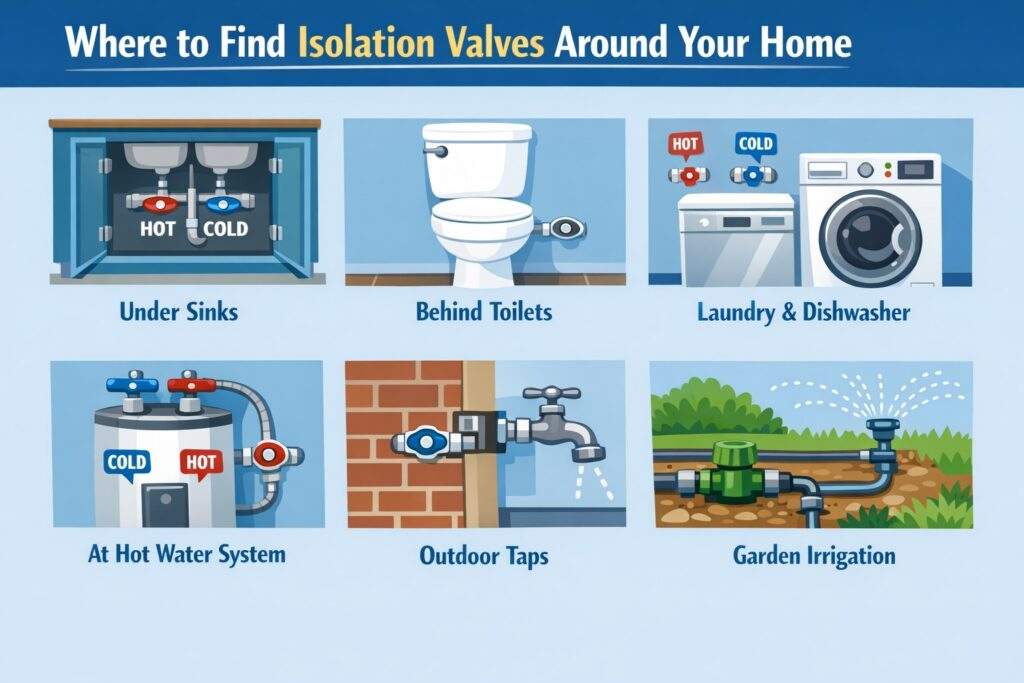
Knowing where the isolation valve is located in your home could save you thousands of dollars in water damage repair costs. Modern plumbing installations across Sydney include isolation valves at most fixtures, but older homes – think Federation cottages and post-war houses common across the inner west and eastern suburbs – might have fewer shut-off points. Let’s explore the most common locations so you can map out your home’s isolation valve system.
Under Kitchen and Bathroom Sinks
Open the cabinet doors under your sinks and look at the back wall. You’ll typically find two isolation valves – one for hot water and one for cold water. These valves usually have oval-shaped handles and sit on the supply lines leading up to your tap.
Behind and Beside Toilets
Most toilets have a single isolation valve on the cold water supply line, which is useful when checking how to fix a toilet that won’t flush without shutting water off to the whole home. Look low on the wall behind or beside your toilet cistern. The valve often has a football-shaped handle and connects to a flexible supply line running to your toilet.
Near Washing Machines and Dishwashers
Laundry isolation valves are usually mounted on the wall behind your washing machine. You’ll see hot and cold water valves, often with red and blue handles respectively. Dishwasher valves might be under your kitchen sink or in an adjacent cabinet.
At Hot Water Systems
Your hot water system should have a hot water shut off valve on the inlet or outlet line so the unit can be isolated safely during repairs or maintenance, which can help during servicing if you notice issues like cloudy hot water from tap fixtures. These valves let you service the unit without draining your entire plumbing system. Look for gate valves or ball valves near the top of your hot water unit.
On Outdoor Taps and Garden Systems
External taps often have isolation valves inside your home, which is handy for isolating leaks, working on renovations, or protecting pipework during the occasional cold snap in Sydney’s cooler outer suburbs and the Blue Mountains. Check your garage, subfloor area, or utility room for valves controlling outdoor water points. Garden irrigation systems typically have isolation valves at the main connection point, especially when installing a drainage system in your yard or upgrading outdoor water control.
Start your search in the most obvious places – anywhere water enters an appliance or fixture. Look for small handles, levers, or knobs along the water supply lines.
How to Use an Isolation Valve Safely

Learning how to use an isolation valve properly protects both your plumbing and your safety. These valves are designed for homeowner operation, but incorrect use can cause leaks, damage, or complete valve failure. Follow these guidelines to operate isolation valves safely and effectively.
1. Turn Off the Water Supply
Before working on any plumbing fixture, locate and close the appropriate isolation valve. Turn the handle clockwise (remember: “righty-tighty, lefty-loosey”) until it stops. Don’t overtighten – hand pressure should be sufficient for most valves.
2. Test the Valve Operation
After closing the valve, turn on the fixture to confirm water flow has stopped. You might see a small amount of water initially – this is normal as the pipes drain. If water continues flowing strongly, the valve isn’t working properly.
3. Complete Your Repair or Maintenance
With water flow stopped, you can safely repair taps, replace washers, or investigate why a shower head won’t stop dripping before calling a licensed plumber. Keep towels handy to catch any residual water from the pipes.
4. Restore Water Flow Gradually
When your work is complete, turn the isolation valve anticlockwise to restore water flow. Open it slowly to avoid water hammer – that banging sound when water suddenly rushes through pipes.
5. Check for Leaks
After reopening the valve, inspect all connections for leaks. Look around the valve itself, pipe joints, and the fixture you worked on. Small drips now can become major problems later.
The golden rule of valve operation is never force a stuck or resistant valve. If a valve won’t turn easily, stop and call for professional help rather than risk breaking the valve or pipe.
When Not to Use Isolation Valves
Do not use isolation valves if the valve is corroded or seized, because forcing it can snap the handle, crack the valve body, or damage connected pipework and make the leak worse. If you smell gas anywhere near the valve or appliance, don’t touch anything – leave the area safe, avoid sparks, and call a licensed gas fitter immediately, as gas isolation must be handled professionally. Under NSW law, gas fitting work can only be carried out by a licensed gas fitter – DIY gas isolation work is both unsafe and illegal. Also avoid operating valves connected to a hot water system’s pressure relief components, since these are safety-critical parts and incorrect handling can create dangerous pressure issues or void compliance with Australian Standards and Sydney Water requirements.
Regular Testing and Maintenance of Isolation Valves
Test your isolation valves every six months by turning them fully off and back on to prevent seizing and confirm they’ll operate properly in an emergency. This quick check helps break up minor mineral buildup and lets you spot early warning signs like stiffness, dripping at the spindle, or valves that won’t fully shut. If a valve feels stubborn or leaks after testing, label it and arrange professional attention sooner rather than waiting until you urgently need it.
When to Call Antons Plumbing & Gas Instead of Relying on an Isolation Valve Alone

Isolation valves are great for stopping water quickly during minor issues, but there are times when relying on a valve alone isn’t enough and professional help prevents bigger damage. If a problem keeps returning, the valve won’t shut off fully, or you suspect a leak in a wall behind older pipework, the risk of making things worse increases fast. Calling Anton’s Plumbing & Gas early can stop a small leak or faulty fitting from turning into a burst pipe, water damage, or a costly repair job.
One clear sign is seized or corroded valves, which are common in older Sydney homes where valves haven’t been operated for years – forcing them can snap handles, crack valve bodies, or stress connecting pipes. Another issue is missing isolation valves around appliances and outdoor fixtures, which leaves you with no control except shutting off the whole house at the stop tap. If you notice leaking valve bodies (drips at the handle or joints), it usually means the valve is failing and should be replaced before it worsens.
Gas isolation is a separate category where DIY isn’t safe or legal – gas isolation valves require a licensed gas fitter, and Anton’s Plumbing & Gas (NSW Lic. 210933C) handles gas work to Australian Standards and issues the compliance paperwork required in NSW. Work on pipework connected to the Sydney Water network should also be carried out or checked by a licensed plumber to keep your property compliant. If you’re renovating or want better emergency readiness, system-wide valve upgrades (main zone valves, fixture valves, and accessible shut-offs) make future maintenance and emergencies far easier to manage. For same-day support across Sydney, call 0493 824 176 to book valve inspections, replacements, or an isolation system upgrade backed by a lifetime labour warranty.
Conclusion
Understanding isolation valves transforms you from helpless bystander to confident homeowner during plumbing emergencies. These simple devices give you precise control over water flow, preventing damage and reducing repair stress. Regular testing ensures your valves work when needed, while a professional upgrade from a licensed Sydney plumber provides long-term peace of mind.
When isolation valve issues arise, Anton’s Plumbing & Gas offers expert leak detection and pipe repairs across Sydney Metro. Our licensed team (NSW Lic. 210933C) provides same-day service with upfront pricing in AUD, helping Sydney homeowners compare plumber near me prices before booking urgent plumbing help. Learn more about our comprehensive plumbing solutions today.
Related Articles
- Rheem Water Heater Pilot Light Problems: Causes and Easy Fixes
- Why Is My Hot Water White but Cold Water Is Clear?
FAQs
What Is An Isolation Valve In Plumbing And Why Would I Need One?
An isolation valve lets you shut off water to one fixture or section of plumbing without turning off the water to the whole home. This is helpful during tap repairs, toilet repairs, hot water system work, leak checks, or emergency plumbing situations. Anton’s Plumbing & Gas can check whether your isolation valves are working properly and advise where extra valves may be useful.
Where Can I Find Isolation Valves In My Home?
Isolation valves are typically located near water fixtures, such as sinks, toilets, and hot water systems, as well as along the main pipeline. They may be found in cabinets under sinks or in utility areas. If you’re unsure about their location or condition, our team at Anton’s Plumbing & Gas can assist with a comprehensive inspection.
What Is The Difference Between An Isolation Valve And The Stop Tap (Main Shut-Off Valve)?
The stop tap controls water to the entire property, while an isolation valve controls water to one fixture, appliance, or section of pipework. This means a plumber can work on one area without disrupting water use in the rest of the home. Knowing the difference can save time during leaks, repairs, or maintenance.
How Can I Tell If An Isolation Valve Is Open Or Closed?
For most lever-style isolation valves, the handle is open when it runs in the same direction as the pipe and closed when it sits across the pipe. Some older valves may have round handles that need to be turned clockwise to close and anticlockwise to open. If the valve is stiff, leaking, or hard to move, do not force it – Anton’s Plumbing & Gas can check or replace it safely.
When Should I Use An Isolation Valve Instead Of Turning Off The Stop Tap?
Use an isolation valve when the problem is limited to one fixture, such as a leaking tap, running toilet, faulty dishwasher connection, or hot water system repair. This lets the rest of the home keep using water while that specific area is shut off. If there is a major leak or you cannot find the correct valve, turning off the stop tap may be safer until a plumber arrives.
How Much Does It Cost To Replace An Isolation Valve In Sydney?
Costs depend on the valve type, its location, and accessibility, so we don’t quote a figure until we’ve seen the job. Anton’s Plumbing & Gas provides upfront pricing in AUD before any work begins, so you always know the cost before we start. Call 0493 824 176 for a straightforward quote.
Do I Need A Licensed Plumber To Replace An Isolation Valve In NSW?
Minor, like-for-like isolation valve replacements can sometimes be done by a handy homeowner, but any work involving new pipework, gas isolation, or connections to the Sydney Water network should be carried out by a licensed plumber to meet NSW regulations. Anton’s Plumbing & Gas (NSW Lic. 210933C) can handle the job correctly and provide compliance documentation where required.
Can Anton’s Plumbing & Gas Fix A Stuck Or Seized Isolation Valve Same Day?
In many cases, yes. We offer same-day service across Sydney Metro for seized, leaking, or failed isolation valves so you’re not left without safe control over your water supply. Call 0493 824 176 to check availability for your suburb.
What Suburbs In Sydney Does Anton’s Plumbing & Gas Service?
We service homes and businesses across Sydney Metro. If you’re unsure whether your suburb is covered, give us a call on 0493 824 176 and we’ll confirm availability and the next possible appointment time.
Is Emergency Isolation Valve Repair Available After Hours?
Yes, burst pipes and failed valves don’t wait for business hours. Anton’s Plumbing & Gas offers emergency plumbing support, so if an isolation valve fails or you can’t stop water flow to a fixture, call 0493 824 176 straight away.
Do You Offer Upfront Pricing Before Starting Isolation Valve Work?
Yes. We always confirm pricing in AUD before starting any isolation valve repair, replacement, or upgrade, so there are no surprises on your invoice.
What Happens If My Isolation Valve Fails And Floods My Home – Is This Covered By Sydney Water?
Sydney Water is generally responsible for the network up to your property’s water meter; plumbing and fittings beyond the meter, including isolation valves inside your home, are the homeowner’s responsibility. If a valve fails and causes damage, it’s best to get a licensed plumber out promptly and speak with your home insurer. Anton’s Plumbing & Gas can inspect, repair, and document the issue for your records.
How Do I Book An Isolation Valve Inspection With Anton’s Plumbing & Gas?
You can book online through our booking page or call 0493 824 176 directly. Let us know if it’s urgent and we’ll prioritise getting a licensed plumber to you.
Do You Provide A Compliance Certificate For Gas Isolation Valve Work?
Yes. Any gas isolation valve work we complete is carried out by a licensed gas fitter and documented with the appropriate compliance certificate required under NSW regulations.
What Warranty Do You Offer On Isolation Valve Replacements?
Anton’s Plumbing & Gas backs isolation valve replacements and system upgrades with a lifetime labour warranty, giving you confidence the job’s been done properly.
Can You Install Additional Isolation Valves During A Bathroom Renovation?
Absolutely. If you’re renovating, it’s a great time to add isolation valves at every fixture so future repairs and emergencies are easier to manage. Mention this when you book so we can quote it alongside your renovation plumbing.
How Quickly Can A Licensed Plumber Attend A Burst Pipe Emergency In Sydney?
We aim to respond quickly to burst pipes and valve failures across Sydney Metro. Call 0493 824 176 as soon as you notice the issue so we can give you an accurate arrival estimate for your area.
Do Older Sydney Homes Need Isolation Valve Upgrades?
Many older Sydney homes, including Federation and post-war properties, were built with fewer isolation valves than modern homes. If your place is missing valves at key fixtures, or existing ones are seized, Anton’s Plumbing & Gas can recommend and install an upgraded isolation valve layout.
What Payment Options Do You Accept For Plumbing Repairs?
We keep payment straightforward with upfront AUD pricing agreed before work starts. Ask our team about available payment options when you book on 0493 824 176.
Is There A Call-Out Fee For Isolation Valve Assessment?
Call us on 0493 824 176 and we’ll walk you through how our pricing works for an isolation valve assessment before you book, so there are no surprises.