

If a water heater bursts in an apartment, immediately shut off the water supply, isolate the electricity or gas, warn nearby occupants and contact the landlord, strata manager and a licensed plumber. Acting quickly can limit flooding, reduce electrical or gas hazards and prevent water from damaging neighbouring units.
This guide walks tenants, property owners, and strata managers through the critical first actions after a burst, explains why tanks rupture, outlines damage-control techniques, and clarifies insurance and compliance considerations under NSW rules. You’ll also learn when to call a licensed Sydney plumber for same-day emergency repairs.
Key Takeaways
- Turn off water at the isolation valve or main shut-off immediately to stop flooding from a burst hot water system.
- Cut power at the switchboard for electric units and close the gas shut-off valve for gas water heaters to prevent fire or explosion risk.
- Document the scene with photos and video, then notify your landlord or strata manager without delay.
- Remove standing water quickly using towels, buckets, or a wet vacuum to minimise structural damage and mould growth.
- Call a licensed Sydney plumber (Anton’s Plumbing & Gas, NSW Lic. 210933C) for same-day inspection, safe disconnection, and compliant replacement of the failed unit.
Quick Answer: When a water heater bursts in an apartment, turn off the water at the isolation valve or main shut-off, then switch off the dedicated electrical circuit or close the gas valve if it is safe to do so. Notify neighbours, the landlord or strata manager, photograph the damage and begin removing standing water without entering areas affected by electricity or gas. Call a licensed plumber immediately to disconnect the failed unit, assess the damage and arrange a compliant repair or replacement.
Why a Water Heater Burst in Apartment Happens
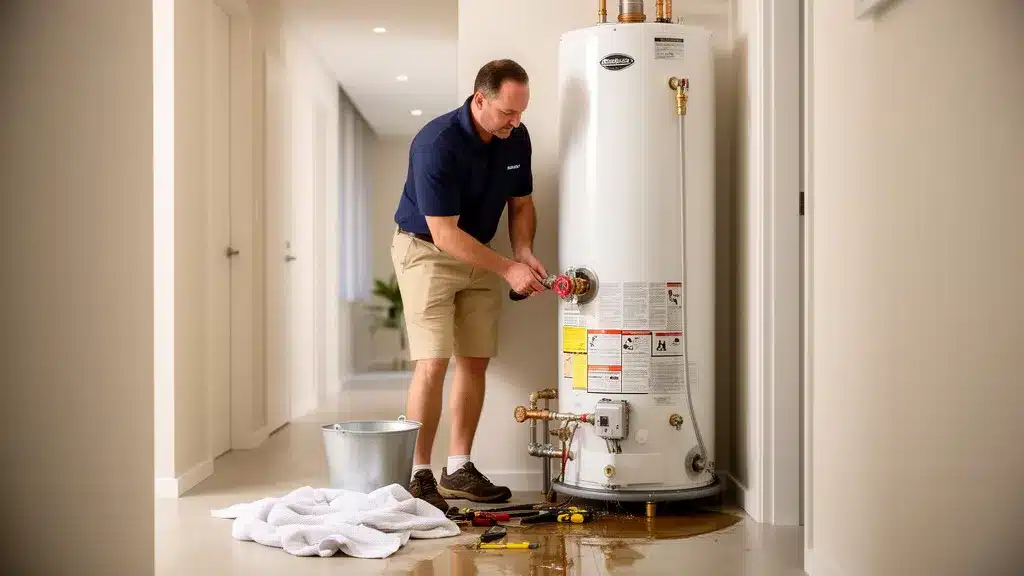
Most Sydney apartment hot water systems are tank-style units—either electric storage tanks or gas storage heaters from brands like Rheem or Rinnai. Over time, internal pressure, corrosion, and sediment buildup weaken the steel tank until it ruptures. Once the tank wall splits, hundreds of litres of scalding water flood out in seconds, often with enough force to knock over furniture or punch through plasterboard.
Excessive internal pressure is the leading trigger. Every hot water system includes a temperature and pressure relief valve designed to vent steam and hot water if the tank overheats or pressure climbs too high. When that valve fails, sticks shut, or is blocked by sediment, pressure can exceed the tank’s design limit. High thermostat settings—above 60°C for residential use—accelerate the risk, as do closed-system plumbing configurations where thermal expansion has nowhere to go.
Sediment accumulation at the tank bottom acts like an insulating blanket, forcing the heating element or gas burner to work harder and overheat localised spots on the steel. Over years, those hot spots corrode faster, thinning the tank wall until it gives way. Rust and corrosion are inevitable in steel tanks, especially if the sacrificial anode rod—a magnesium or aluminium bar that attracts corrosive minerals—has not been inspected or replaced every five years. Once the anode is consumed, rust attacks the tank directly.
Age is another factor. Most tank-style systems carry a manufacturer’s warranty of five to ten years, but many units remain in service for 15 to 20 years. Older tanks are statistically far more likely to burst. Improper installation—such as missing expansion valves, incorrect pressure settings, or undersized relief valves—can shorten a tank’s lifespan dramatically. Regular maintenance, including annual flushing to remove sediment and periodic anode checks, helps prevent catastrophic failure, but many apartment systems receive minimal attention until they leak or burst.
Immediate Safety Steps When Your Hot Water System Bursts
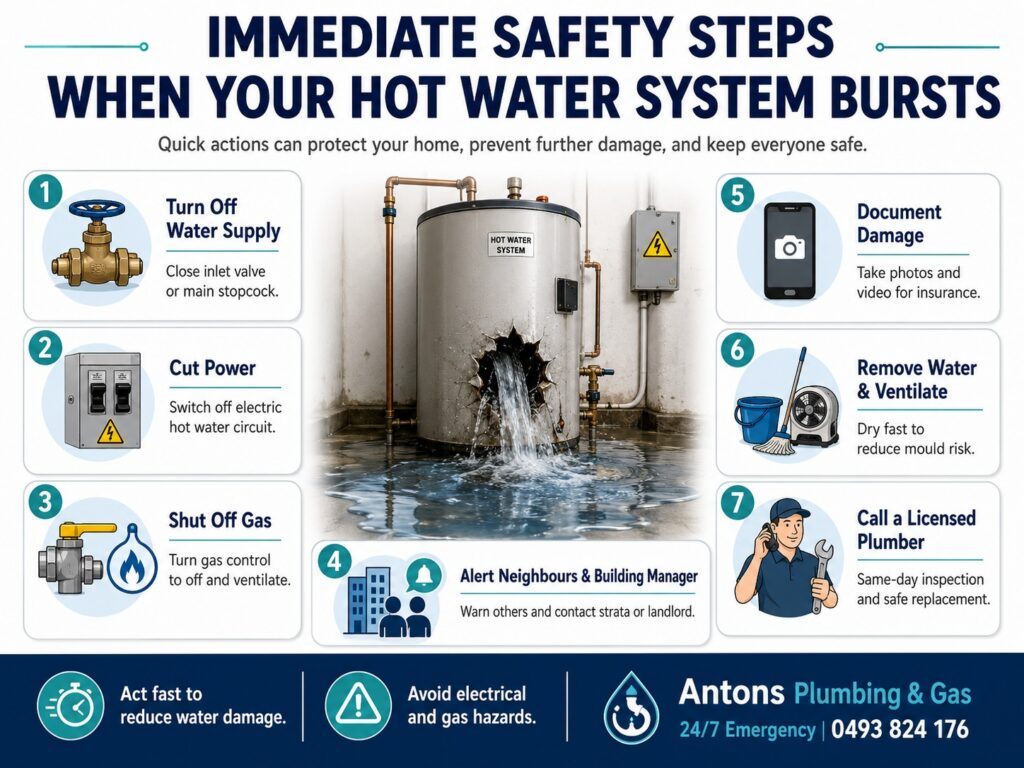
The moment you notice water pooling around your hot water unit, hear a loud bang, or see steam escaping, your first priority is to stop the flow and eliminate electrical or gas hazards. Acting fast in the first few minutes protects your unit, your neighbours, and your building’s structure.
1. Turn Off the Water Supply
Locate the cold-water isolation valve on the inlet pipe leading into the top of the tank. Turn it clockwise until fully closed. If you cannot find the isolation valve or it is seized, shut off the main water supply to your apartment at the meter or stopcock. In most Sydney properties, Sydney Water owns and maintains the water meter and the mains supply up to your property boundary, while the isolation valves, internal pipework, and the hot water system itself are the responsibility of the owner, strata scheme, or landlord. Stopping the inflow halts additional flooding and drops pressure inside the tank.
2. Cut Electrical Power to Electric Units
For electric hot water systems, go to your switchboard and switch off the dedicated circuit breaker labelled “hot water” or “HWS.” Never touch the unit, wiring, or any pooled water while power is on. If water has reached electrical outlets or appliances, avoid that area entirely until power is isolated.
3. Close the Gas Shut-Off Valve for Gas Water Heaters
If you have a gas hot water system—such as a Rheem gas hot water system or Rinnai gas heater—turn the gas control knob to “Off” or rotate the inline gas valve a quarter turn until the handle is perpendicular to the pipe. Gas leaks combined with hot water can create fire or explosion risks, so ventilate the area by opening windows and doors, and do not use lighters, matches, or electrical switches nearby.
4. Alert Neighbours and Building Management
Water from an upper-floor burst can seep through floors and ceilings into units below. Knock on doors or send a quick message to warn neighbours, and contact your building manager, strata committee, or landlord immediately. Quick notification allows others to move valuables and helps coordinate emergency response.
5. Document the Damage With Photos and Video
Before you start cleanup, take clear photos and short videos of the burst tank, water pooling, damaged belongings, and any visible cracks or rust on the unit. Capture serial numbers, brand labels, and installation dates if readable. This evidence supports insurance claims and clarifies liability between tenant, owner, and strata.
6. Begin Water Removal and Ventilation
Use towels, mops, buckets, and a wet-dry vacuum to remove standing water as quickly as possible. Pull up soaked rugs and move furniture away from wet areas. Open windows and run fans or a dehumidifier to promote air circulation and reduce humidity. Mould can begin growing within 24 to 48 hours, so speed matters.
7. Call a Licensed Sydney Plumber for Same-Day Inspection
A burst tank requires professional assessment, safe disconnection, and compliant replacement. Our team at Antons Plumbing & Gas (NSW Lic. 210933C) provides 24/7 emergency response across Sydney with no call-out fee from 7 am to 3 pm on weekdays. We’ll isolate the failed unit, check for structural or gas safety issues, and present clear options for repair or replacement. Call 0493 824 176 anytime for same-day service.
Taking these steps in order minimises water damage, protects occupants, and sets the stage for a smooth insurance claim and repair process.
Who Is Responsible for a Burst Hot Water System in an Apartment?
Liability for a burst hot water system depends on ownership structure, lease terms, and strata by-laws. In New South Wales, the default rule is that an owner is responsible for fixtures and fittings within their lot, while common property—including shared plumbing infrastructure—falls to the owners corporation or strata scheme. A hot water unit installed inside your apartment is typically the owner’s responsibility, but if the burst results from a defect in common-property pipework or a shared system, strata may bear the cost.
Tenants are generally not liable for normal wear-and-tear failures or manufacturing defects. If you rent and the tank bursts due to age, corrosion, or a faulty relief valve, your landlord must arrange and pay for repairs. You are expected to notify the landlord or property manager promptly and take reasonable steps to prevent further damage—such as turning off water and mopping up. Failure to report the burst quickly or leaving water to pool for days can shift some liability to the tenant under the Residential Tenancies Act 2010 (NSW).
Landlords and owners must ensure hot water systems are safe, compliant, and maintained. That includes periodic servicing, anode replacement, and timely repairs. If an owner ignores maintenance warnings and the tank bursts, they cannot typically recover costs from the tenant. Strata schemes must maintain common property and any shared hot water plant, such as a central gas hot water system serving multiple units. When a burst originates in common pipework or a shared boiler, the owners corporation arranges repairs and may levy a special contribution if reserve funds are insufficient.
Insurance coverage varies. Landlord insurance and strata building insurance usually cover sudden, accidental water damage, including burst tanks, but may exclude gradual leaks or lack of maintenance. Tenants should hold contents insurance (sometimes called renters insurance) to protect personal belongings, as neither the landlord’s nor the strata’s policy will reimburse your furniture, electronics, or clothing. Always check policy wording and excess amounts, and provide your insurer with the documentation you collected immediately after the burst.
Preventing Future Water Heater Bursts in Your Apartment
Regular maintenance and proactive monitoring can extend your hot water system’s lifespan and reduce the chance of a catastrophic rupture. Even if you rent, understanding these prevention steps helps you spot warning signs and request timely landlord action.
- Annual flushing to remove sediment: Draining a few buckets of water from the drain valve at the tank base every 12 months flushes out mineral deposits and rust particles that insulate the heating element and accelerate corrosion.
- Anode rod inspection every five years: The sacrificial anode rod attracts corrosive minerals, protecting the steel tank. Once consumed, the tank corrodes rapidly. A licensed plumber can inspect and replace the anode during a service visit.
- Temperature setting at 60°C or below: Scalding-hot settings above 60°C increase internal pressure and speed up corrosion. For residential use, 60°C balances legionella control with safety and efficiency.
- Test the temperature and pressure relief valve annually: Lift the lever on the TPR valve briefly to ensure it releases water. If it sticks, leaks continuously, or fails to operate, replace it immediately. A faulty relief valve is a primary cause of tank rupture.
- Install an expansion valve in closed systems: If your apartment has a backflow prevention device or check valve on the main supply (common in newer Sydney builds under Sydney Water’s plumbing requirements), thermal expansion has nowhere to go. An expansion valve or expansion tank absorbs pressure spikes and protects the hot water tank.
- Replace tanks older than 15 years: Even well-maintained tanks corrode internally over time. If your unit is approaching or past 15 years, plan a proactive replacement before a burst forces an emergency repair.
Our team at Antons Plumbing & Gas offers fixed-rate hot water servicing, anode replacement, and compliant system installations across Sydney. We’ll assess your current unit, check relief valves and expansion devices, and recommend a maintenance schedule tailored to your system and water quality. Proactive servicing costs far less than emergency flood cleanup and a rushed replacement.
Choosing a Replacement Gas or Electric Hot Water System
After a burst, you’ll need to decide whether to replace like-for-like or upgrade to a more efficient model. Tank-style systems remain popular in Sydney apartments due to lower upfront cost and simple installation, but modern options include continuous-flow gas units, heat-pump systems, and solar-boosted tanks.
| System Type | Pros | Cons | Best For |
|---|---|---|---|
| Electric storage tank | Low purchase cost, simple wiring, compact | Higher running cost, limited hot water capacity, slower recovery | Small apartments, single occupant, off-peak tariff available |
| Gas storage tank (Rheem, Rinnai) | Faster recovery, lower running cost than electric, reliable | Requires gas connection, venting, and compliance certificate | Multi-occupant apartments, consistent hot water demand |
| Continuous-flow gas (instantaneous) | Endless hot water, compact wall-mount, energy-efficient | Higher upfront cost, requires adequate gas pressure and flow rate | Space-constrained units, high usage, modern builds |
| Heat-pump electric | Very low running cost, eligible for rebates, eco-friendly | High purchase price, needs outdoor space, slower in cold weather | Ground-floor or balcony install, environmentally conscious owners |
When selecting a replacement, consider your apartment’s gas availability, electrical capacity, installation space, and strata by-laws. Some buildings restrict gas appliances or require specific venting arrangements. Continuous-flow units must be installed by a licensed gas fitter and tested to AS/NZS 5601 standards, with a compliance certificate issued on completion. Our qualified team handles end-to-end supply, installation, and certification, ensuring your new system meets all NSW regulations and strata requirements.
We work with trusted brands including Rheem, Rinnai, Dux, and Bosch, and we’ll walk you through warranty terms, expected lifespan, and running-cost estimates. Pricing varies based on unit size, fuel type, and installation complexity, so we provide a clear, upfront quote in AUD after inspecting your space and existing plumbing. Same-day installation is often possible for straightforward replacements, minimising downtime and inconvenience.
What to Expect During Emergency Hot Water Repairs
When you call Anton’s Plumbing & Gas for a burst hot water system, our plumber will arrive on-site as quickly as possible to assess the situation and make the area safe. We check that the water supply, power, or gas has been properly isolated and look for immediate hazards such as pooled water near electrical fittings or gas odours. Once the area is safe, we inspect the failed unit to identify the likely cause, such as corrosion, pressure-valve failure, sediment build-up, or an installation issue.
After the inspection, we document the condition of the system, including the brand, model, visible damage, and any issues that may be relevant for insurance, strata, landlords, or property managers. If the unit can be repaired safely, such as when a relief valve is leaking on an otherwise sound system, we explain the repair option, expected lifespan, and cost before starting work. If the tank has burst or is beyond economical repair, we provide replacement options suited to your property, hot water needs, space, and budget.
Once you approve the work, we arrange the installation, remove the old tank, check the surrounding pipework, install the new unit, and test the system for leaks and correct operation. For gas hot water systems, we complete the required safety checks and compliance steps before handover. Before leaving, we clean the work area, explain the controls and maintenance tips, and provide relevant documentation such as warranty details, compliance certificates, and labour warranty information.
Insurance, Documentation, and Strata Considerations
A water heater burst in an apartment often triggers multiple insurance policies: the owner’s landlord or contents policy, the tenant’s contents insurance, and the strata building insurance. Understanding which policy covers what can speed up your claim and reduce out-of-pocket costs.
Strata building insurance typically covers structural damage to common property and the building fabric—walls, ceilings, floors, and shared plumbing. If water from your burst tank damages the unit below or seeps into common corridors, the strata insurer usually pays for drying, repairs, and repainting of those areas. The strata may then seek recovery from the unit owner if negligence or lack of maintenance caused the burst.
Landlord insurance covers the owner’s fixtures, fittings, and liability. If the hot water system bursts and damages the owner’s property—such as built-in cabinetry, flooring, or the tank itself—the landlord’s policy should respond. Many policies also provide temporary accommodation coverage if the unit becomes uninhabitable. Owners should notify their insurer within 24 hours and provide photos, plumber reports, and repair quotes.
Contents insurance protects the tenant’s personal belongings and liability. If your furniture, clothing, electronics, or other possessions are damaged by the flood, your contents policy reimburses you up to the sum insured, minus any excess. Tenants are not liable for the burst itself unless they caused it through misuse or failed to report a known leak. Always document your losses with photos and receipts, and lodge your claim promptly.
Strata managers play a coordinating role. Notify your strata committee or building manager immediately so they can alert affected neighbours, arrange emergency drying if needed, and liaise with the strata insurer. Provide copies of your plumber’s report and compliance certificates for strata records, especially if by-law amendments or building upgrades are required. Clear communication between tenant, owner, and strata reduces disputes and ensures repairs proceed smoothly.
Why Choose Antons Plumbing & Gas for Burst Hot Water Emergencies
When your hot water system bursts, you need a licensed Sydney plumber who responds fast, works safely, and delivers compliant, long-lasting repairs. Our family-owned team, fully licensed as Anton’s Plumbing & Gas (NSW Lic. 210933C), brings over 25 years of hands-on experience to every emergency call, combining technical skill with clear communication and respect for your home.
We offer true 24/7 emergency service across the greater Sydney region, with same-day response standard and no call-out fee from 7 am to 3 pm on weekdays. Whether you’re in the Inner West, Eastern Suburbs, North Shore, Northern Beaches, Hills District, Western Sydney, or Sutherland Shire, we’ll arrive promptly with the tools, parts, and expertise to stop the flood and assess your options.
All our work complies with NSW Fair Trading licensing (NSW Lic. 210933C) and relevant Australian Standards, including AS/NZS 3500 for plumbing and AS/NZS 5601 for gas fitting. We issue Certificates of Compliance for every gas installation, document our findings with photos and written reports, and provide upfront, fixed-rate pricing in AUD with no hidden charges. You’ll know the cost before we start, and we’ll explain every step in plain English.
We don’t just swap out the failed unit and leave. We inspect your existing plumbing for code violations, check relief valves and expansion devices, test water pressure, and recommend preventive measures to avoid future bursts. Our goal is a root-cause solution, not a quick patch. We use quality parts from trusted brands like Rheem, Rinnai, Dux, and Bosch, and we back our workmanship with a lifetime labour warranty, so you can feel confident long after we’ve finished.
From burst pipe repairs and leak detection to full hot water system replacements, bathroom renovations, and gas appliance connections, we’re your single point of contact for safe, reliable plumbing and gas fitting in Sydney. Call 0493 824 176 anytime or book online at antonsplumbingandgas.com.au for fast, professional help when you need it most.
Conclusion
A water heater burst in an apartment demands immediate action to protect lives, property, and neighbouring units. By shutting off water and power or gas, documenting the damage, and calling a licensed Sydney plumber for same-day repairs, you’ll minimise flooding and set the stage for a smooth insurance claim and compliant replacement. Proactive maintenance and timely upgrades help prevent future failures, keeping your hot water reliable and your Sydney apartment safe for years to come.
Antons Plumbing & Gas (NSW Lic. 210933C) provides emergency hot water system repairs across Sydney Metro for burst heaters in apartments, strata buildings, and rental properties. Our licensed team offers 24/7 callouts with same-day service and lifetime labour warranty. Get started by calling 0493 824 176 anytime.
Get an Estimate for Your Burst Hot Water Emergency
Once you have safely isolated the water, electricity or gas, use Anton’s free plumbing quote estimator to select your hot water or burst-pipe issue, property type and required response time. You will receive an initial estimated price range based on the urgency, access and details of the problem, helping tenants, owners and strata managers understand the likely next steps. If water is still flooding the apartment or creating an electrical or gas hazard, call Anton’s Plumbing & Gas immediately on 0493 824 176 for 24/7 emergency assistance.
Related Articles
- What Happens When a Water Heater Bursts? Practical Advice for Australian Homes
- Water Heater Anode Rod Replacement: When Your Hot Water System Needs Attention
- Hot Water Coming Out Brown? What It Could Mean for Your Hot Water System
FAQs
What Should I Do If My Water Heater Bursts In My Apartment?
If your water heater bursts, immediately turn off the power supply and water supply to the unit to prevent further damage. Next, contact your property manager or landlord to report the issue. If you’re a homeowner, reach out to a licensed Eastern Creek Sydney plumber, like Antons Plumbing & Gas (NSW Lic. 210933C), for prompt repairs and assistance in managing the situation safely and efficiently.
Who Is Responsible For A Burst Water Heater In An Apartment?
Responsibility for a burst water heater typically falls on the property owner or landlord, as they are responsible for maintaining the unit. However, tenants should review their lease agreements and communicate with their property management to clarify responsibilities. In some cases, homeowners may need to address this issue directly with a professional plumber.
How Can I Prevent My Water Heater From Bursting?
To prevent your water heater from bursting, schedule regular maintenance checks with a licensed plumber in Clyde, such as Antons Plumbing & Gas. Flushing the tank annually, checking the pressure relief valve, and inspecting for leaks can help prolong the life of your unit and mitigate the risk of a burst.
What Are The Signs Of A Failing Water Heater?
Signs of a failing water heater include unusual noises (like popping or banging), water discolouration, leaks around the unit, fluctuating water temperatures, and a decrease in hot water supply. If you notice any of these signs, it’s essential to contact a qualified plumber for an assessment.
Is A Burst Water Heater Covered By Renters Insurance?
In many cases, contents insurance (sometimes called renters insurance) covers damages caused by a burst water heater, particularly if it leads to water damage in the apartment. However, it’s important for renters to review their specific policy details and consult with their insurance provider for clarity on coverage.
Can a Burst Hot Water System Flood the Apartment Below?
Yes. Water can travel through flooring, wall cavities, ceiling penetrations and shared service ducts, causing damage to neighbouring apartments and common property. Notify the occupants below and the building or strata manager immediately, even when the visible flooding appears limited to your unit. Apartment residents in Cremorne can contact a professional plumber in Cremorne to isolate the leak and assess the damaged system.
Where Is the Hot Water Isolation Valve in an Apartment?
The isolation valve is usually installed on the cold-water pipe entering the hot water system. It may be beside or above the tank, inside a utility cupboard, on a balcony or in a shared service area. Turn the valve clockwise to close it. If it cannot be located or operated safely, shut off the apartment’s main water supply. If you cannot find the valve at a property in Cherrybrook, an experienced plumber in Cherrybrook can locate and isolate the water supply safely.
Should I Turn Off the Electricity After a Water Heater Bursts?
Yes, if the apartment has an electric hot water system. Switch off the dedicated hot-water circuit at the switchboard. Do not touch the heater, electrical cables, outlets or standing water until the electricity has been isolated. Contact emergency services or a licensed professional when there is an immediate electrical hazard.
What Should I Do If Water Reaches Electrical Outlets?
Stay away from the affected area and do not touch the outlets, appliances, switches or pooled water. Turn off power from a safe, dry location only when it is safe to do so. A licensed electrician may need to inspect the affected circuits before the power can be restored.
Can a Gas Hot Water System Explode When It Bursts?
A leaking or burst gas hot water system can create serious hazards if the failure affects the gas connection, burner or ventilation. Turn off the gas supply when it is safe, ventilate the area and avoid flames, smoking and electrical switches. Leave the apartment and seek urgent assistance if you smell gas. For a suspected gas hot water failure at a property in Dural, a reliable plumber in Dural can inspect the system and arrange the necessary plumbing or gas-fitting work.
Can a Burst Water Heater Be Repaired?
A leaking valve, fitting or pipe connection may sometimes be repairable. However, a storage tank that has split or rusted through usually requires replacement because the tank body cannot be safely restored. A licensed plumber must inspect the unit before determining whether repair is practical.
How Quickly Should I Call a Plumber After a Burst?
Call a licensed plumber as soon as the water and energy supplies have been isolated. A prompt inspection helps prevent additional water damage, confirms whether the system is safe and provides documentation that may be needed by the landlord, strata manager or insurer. Residents dealing with a burst system in Annangrove can arrange local plumbing services in Annangrove for an urgent assessment.
How Long Does It Take to Replace an Apartment Water Heater?
A straightforward like-for-like replacement may often be completed on the same day, subject to unit availability, safe access and building requirements. The work may take longer if pipework, electrical capacity, gas connections, ventilation or valves need upgrading, or if strata approval is required.
Can I Stay in My Apartment After the Water Heater Bursts?
That depends on the extent of the damage. The apartment may be unsafe when water has reached electrical systems, ceilings are sagging, gas is leaking or essential services are unavailable. Follow the advice of the plumber, electrician, building manager, insurer or emergency services before remaining in or re-entering the affected area.
Who Pays for Damage to the Apartment Below?
Responsibility depends on where the failure occurred, who owns the failed equipment, whether negligence was involved and the terms of the relevant insurance policies and strata by-laws. The unit owner, owners corporation and insurers may all need to investigate. Tenants should notify their landlord and strata manager rather than accepting liability themselves.
Does Strata Need to Approve a Replacement Hot Water System?
Approval may be required when the work affects common property, external walls, shared pipework, gas services, drainage, ventilation or the appearance of the building. Even a replacement inside the apartment may need to comply with building access procedures and strata by-laws. Check with the strata manager before changing the system type or installation location.
What Evidence Should I Collect for an Insurance Claim?
Photograph and record the failed heater, the source of the water, damaged rooms, affected belongings and any water entering neighbouring property. Keep the plumber’s report, invoices, replacement quote, model and serial details, cleanup receipts and communications with the landlord or strata manager. Avoid disposing of damaged items until the insurer advises you to do so.
How Soon Can Mould Grow After an Apartment Flood?
Mould may begin developing within 24 to 48 hours when materials remain damp. Remove standing water promptly, ventilate the apartment and arrange professional drying when water has entered walls, flooring, insulation or cabinetry. Surface drying alone may not remove moisture trapped inside the building structure.
What Warning Signs Can Appear Before a Water Heater Bursts?
Common warning signs include rust around the tank, brown hot water, regular dripping, puddles beneath the unit, banging or popping noises, unstable water temperatures and corrosion around valves or fittings. A sudden increase in leakage or visible swelling of the tank requires urgent professional attention.
Should I Replace an Old Water Heater Before It Bursts?
Proactive replacement may be sensible when a storage system is heavily corroded, repeatedly leaking, producing discoloured water or approaching the end of its expected service life. Planned replacement provides more time to compare suitable systems, obtain approvals and avoid the disruption and damage caused by an emergency failure. Homeowners in Clontarf can ask a licensed Clontarf plumber to assess the condition of an ageing system and advise whether replacement is appropriate.