


You open the cupboard under your sink, spot a dripping tap, and decide today is the day you fix it yourself. You shut off the water, unscrew the handle, and pull out a small metal cylinder covered in mineral deposits. Now what? You stare at the thing, turn it over in your hand, and realise you have no idea what it’s called, which brand made it, or where to buy a replacement. Welcome to the world of unknown plumbing part identification—a frustration every Sydney homeowner faces at some point.
In this guide, we walk you through practical steps to identify mystery plumbing components, explain the most common parts that fail in taps and toilets, and show you when a quick photo and a trip to the supplier will solve your problem—and when it’s smarter to call a licensed plumber for same-day diagnosis and compliant repair.
Key Takeaways
- Clean the part and photograph it from multiple angles to reveal brand logos, model numbers, and unique features.
- Count splines, measure diameters, and note whether the component is a cartridge, stem, valve, or seal.
- Use online finders, mobile apps, or visit a trade supplier like Reece Plumbing with your photos and measurements.
- Understand that some parts are obsolete or require special tools, making professional identification and installation the safer choice.
- Our licensed team at Antons Plumbing & Gas (NSW Lic. 210933C) can identify any unknown component, source the correct replacement, and install it to Australian Standards—same day across Sydney, with no call-out fee from 7am to 3pm weekdays.
Why Unknown Plumbing Part Identification Matters for Homeowners
Misidentifying a single component can turn a simple tap repair into a weekend of frustration, wasted trips to the hardware store, and a flooded bathroom. Plumbing parts vary wildly by brand, model, and era. A cartridge from a 1990s mixer might look identical to a 2020 model at first glance, but the spline count or O-ring groove will be different. Install the wrong part and you’ll either strip threads, crack the housing, or watch water spray across your vanity the moment you turn the supply back on.
Accurate identification saves time and money. It also protects your home from water damage and ensures compliance with AS/NZS 3500 plumbing standards when the repair involves backflow prevention, pressure-limiting valves, or tempering valves on hot water systems—standards enforced across NSW and tied to Sydney Water requirements for many properties.
For DIY beginners and first-year plumbing apprentices, learning to recognise stems, cartridges, washers, and seals builds confidence and diagnostic skill. For busy Sydney homeowners, knowing when to stop and call a licensed plumber prevents costly mistakes.
How to Identify an Unknown Plumbing Part in Five Steps
Before you drive to the nearest trade counter or post a blurry photo in a Facebook group, follow this systematic approach to gather the information suppliers and plumbers need.
1. Clean the Part Thoroughly
Mineral scale, soap scum, and old plumber’s grease hide brand stamps, model codes, and serial numbers. Soak the component in white vinegar for ten minutes, then scrub with an old toothbrush. Dry it completely and inspect every surface under bright light. You might find a tiny logo, a part number stamped into the brass, or a colour-coded O-ring that indicates the manufacturer.
2. Photograph From Multiple Angles
Take clear, well-lit photos of the top, bottom, side, and any threaded or splined sections. Lay a ruler or coin beside the part to show scale. Capture close-ups of logos, numbers, and any unique features like notches, grooves, or hex flats. These images are gold when you’re talking to a supplier, using a mobile app like Partelligence, or emailing our team for remote identification.
3. Measure Key Dimensions
Use digital calipers or a tape measure to record the overall length, diameter, and spline count if the part has a broach. Count the teeth carefully—16 splines versus 17 splines can mean different manufacturers. Note the thread pitch if the component screws into a valve body. Write everything down; your memory will fail you halfway to the shop.
4. Check Under-Sink Labels and Trim Plates
Many taps have a small label or engraved logo on the spout base, handle insert, or escutcheon plate. Remove the handle and look inside the valve body for a brand name or model code. Check the underside of the sink for a manufacturer’s sticker. If the fixture is less than ten years old, the brand’s website may have exploded-view diagrams and part lists you can download.
5. Use Online Finders and Trade Supplier Expertise
Upload your photos to LeakyFaucetGuide’s stem and cartridge finder, or visit a Reece Plumbing branch with your old part in hand. Trade counter staff see hundreds of components every week and can often match your mystery piece in seconds. If the part is obsolete, they’ll suggest a compatible replacement or a retrofit kit. When in doubt, our licensed plumbers carry a reference library of common Sydney fixtures and can identify most parts on-site during a same-day service call.
Common Plumbing Parts Homeowners Struggle to Identify
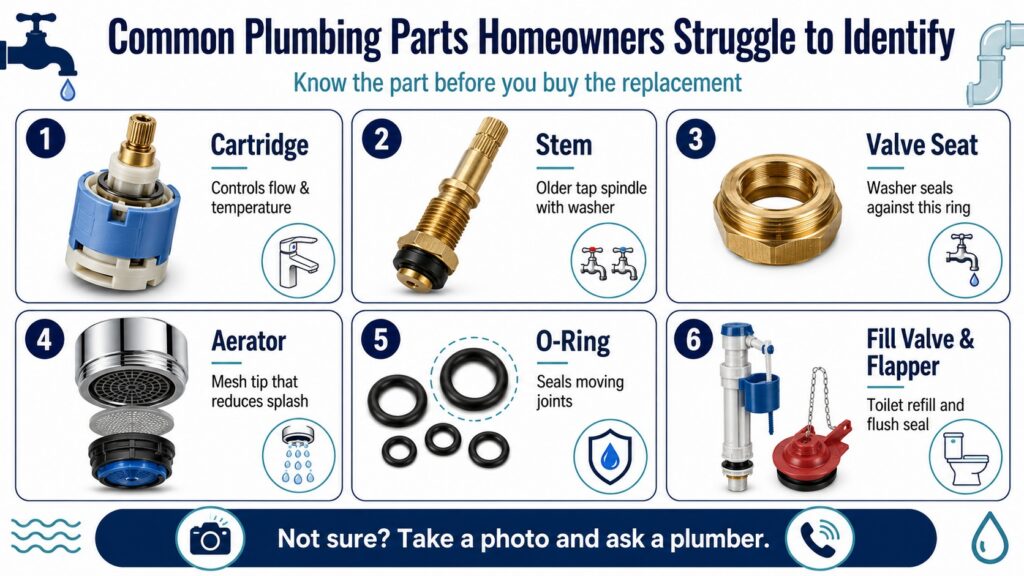
Not every component under your sink is a cartridge. Understanding the difference between stems, seals, valves, and aerators helps you search smarter and communicate clearly with suppliers.
- Cartridge: A self-contained valve unit, usually ceramic disc or pressure-balance type, that controls water flow and temperature in modern mixer taps. Cartridges slide into the tap body and are held by a retaining nut. They rarely have visible washers.
- Stem: An older valve design with a threaded spindle and a rubber or fibre washer at the tip. Turn the handle and the stem screws up or down to open or close the seat. Stems are common in separate hot and cold taps and require periodic washer replacement.
- Valve Seat: A small brass ring screwed into the tap body, against which the washer seals. Corroded or pitted seats cause drips even after you replace the washer. Seats can be resurfaced with a seat-dressing tool or replaced entirely.
- Aerator: The mesh screen at the tip of your tap spout that mixes air with water to reduce splash and save flow. Aerators unscrew by hand or with a strap wrench and often contain a flow restrictor and several washers.
- O-Ring: Rubber or silicone rings that seal joints between moving parts. O-rings come in dozens of sizes and hardness ratings. A single wrong size will leak, so measure the groove diameter and cross-section carefully.
- Fill Valve and Flapper: Toilet-specific parts. The fill valve refills the cistern after each flush; the flapper seals the flush valve opening. Both are standardised in Australia, but older dual-flush systems use button-and-cable mechanisms that vary by brand.
When you can name the part, you can search for it. When you can’t, a photo and a call to our team will get you an answer within the hour.
Tools and Resources for DIY Plumbing Part Identification
Technology and trade networks have made unknown plumbing part identification faster than ever. Here’s what works in real-world Sydney homes.
Mobile Apps and Image Recognition
The Partelligence app uses AI to match your photo against a database of tap stems and cartridges. Snap a picture, wait a few seconds, and the app suggests compatible replacements with links to online retailers. It’s not perfect—odd angles or heavy corrosion can confuse the algorithm—but it’s a solid first step for apprentices and DIYers.
Manufacturer Websites and Exploded Diagrams
Brands like Caroma, Methven, and Dorf publish technical documents and spare-parts lists on their websites. If you know the tap model, you can download a PDF showing every component and its part number. Some brands offer online chat support where you can upload a photo and get a response within business hours.
Trade Suppliers and Specialty Counters
Reece Plumbing branches across Sydney stock thousands of parts and employ staff who’ve seen it all. Bring your old component in a zip-lock bag, and they’ll cross-reference it against their system. If they don’t have it in stock, they can order it overnight. Smaller specialists like Copper Fox Plumbing focus on heritage fixtures and hard-to-find parts for older Sydney homes, especially in the Inner West and Eastern Suburbs.
Online Forums and Community Groups
Facebook groups and Reddit threads can be hit-or-miss, but posting a clear photo with measurements sometimes yields a quick answer from a retired plumber or a keen DIYer. Just verify any advice against official sources before you buy.
Professional Plumber Site Visits
When the part is buried behind tiles, integrated into a concealed valve, or part of a backflow prevention assembly, remote identification isn’t enough. Our licensed plumbers carry diagnostic tools, reference manuals, and direct supplier contacts. We’ll identify the component, explain your options, and provide an upfront fixed-rate quote for supply and installation—all during the same visit, with no call-out fee from 7am to 3pm on weekdays.
When to Stop Identifying and Call a Licensed Plumber
DIY plumbing has limits. Some jobs require licensing under NSW Fair Trading rules, and some parts demand specialised tools or compliance testing. Knowing when to hand over the wrench protects your home, your insurance, and your safety. If you’re unsure, it’s always safer to call a licensed Sydney plumber before you touch gas, backflow, or in-wall components.
Gas Appliance Components
Any part connected to natural gas or LPG—regulators, thermocouples, burner valves—must be identified, supplied, and installed by a licensed gas fitter. Mistakes can cause leaks, carbon monoxide buildup, or explosions. If you’ve pulled a mystery part from a hot water heater or cooktop, stop and call us. We hold current gas-fitting certification (NSW Lic. 210933C) and complete every gas job to AS/NZS 5601 standards, with a compliance certificate issued on completion.
Backflow Prevention Devices
Testable backflow valves, reduced-pressure zone (RPZ) assemblies, and tempering valves on hot water systems are regulated components under NSW plumbing rules. Disassembling them without proper testing equipment and certification can void your compliance and expose you to contaminated water or scalding. We carry calibrated test kits and lodge reports with Sydney Water when required.
Concealed or In-Wall Valves
If the part you need is behind tiles or inside a wall cavity, removal and replacement often involve cutting, waterproofing, and retiling. One wrong move and you’ll flood the room or crack expensive stone. Our team uses inspection cameras and moisture meters to locate concealed components, then completes the repair with minimal disruption and a clean finish.
Obsolete or Discontinued Parts
Some fixtures are so old that exact replacements no longer exist. In these cases, we source retrofit kits, machine custom adapters, or recommend a modern tap upgrade that matches your existing hole spacing. Attempting to force a near-match part into an obsolete valve body can crack brass, strip threads, or cause leaks that damage cabinetry and flooring.
High-Pressure or Commercial Systems
Cafés, strata buildings, and commercial kitchens operate at higher pressures and flow rates than domestic taps. Parts must be rated for the duty cycle and comply with AS/NZS 3500 and food-safety standards. If you manage a commercial property and face an unknown part failure, our team responds same-day with commercial-grade replacements and clear compliance documentation.
Real-World Example: Identifying a Mystery Mixer Cartridge in an Inner West Terrace
Sarah, a homeowner in the Inner West, called us after her kitchen mixer started dripping overnight. She’d removed the handle, pulled out a white plastic cartridge, and spent an hour searching online with no luck. No brand logo, no model number, just a smooth cylinder with two O-rings and a flat tab on top. She sent us a photo via SMS.
Within ten minutes, our plumber recognised it as a generic ceramic disc cartridge used in several budget mixers sold through hardware chains in the early 2010s. We confirmed the spline count—20 teeth—and cross-referenced it with our supplier. The exact part was discontinued, but a compatible upgrade cartridge was in stock at Reece Plumbing in Marrickville. We arrived the same afternoon, installed the new cartridge, tested the mixer under full pressure, and left Sarah with a lifetime labour warranty on the installation. Total time from call to completion: three hours.
That’s the value of professional identification. Sarah saved a weekend of frustration, avoided buying the wrong part three times, and gained peace of mind that the repair meets Australian Standards.
Preventing Future Unknown Part Headaches
Once you’ve solved your current mystery, take steps to make the next repair easier.
- Photograph your taps, toilets, and valves while they’re new, and store the images in a cloud folder labelled by room.
- Keep a small envelope taped inside the vanity cupboard with the brand name, model number, and purchase date written on it.
- When a plumber completes a repair, ask for the old part back and a note of the replacement part number.
- During bathroom renovations, choose fixtures from brands with strong local support and long parts availability—Caroma, Methven, and Dorf all maintain Sydney service networks.
- Schedule an annual plumbing inspection with our team. We’ll document your fixtures, flag any obsolete components, and provide a written report you can reference when parts eventually fail.
Prevention is cheaper than emergency replacement, and documentation turns unknown parts into known quantities.
Why Antons Plumbing & Gas Is Your Partner in Part Identification and Repair
We’ve spent 25 years diagnosing plumbing problems across every corner of Sydney—from heritage terraces in Balmain to new apartments in Parramatta. Our licensed plumbers (NSW Lic. 210933C) carry reference materials, maintain direct supplier relationships, and use diagnostic tools like CCTV drain cameras and acoustic leak detectors to identify components you can’t even see. When you call +61493824176 (0493 824 176), you’re not just getting a tradie with a wrench. You’re getting a team that understands Sydney’s mix of old clay pipes, modern PEX systems, and everything in between.
We provide same-day service across the Inner West, Eastern Suburbs, North Shore, Northern Beaches, Hills District, Western Sydney, South-Western Sydney, and Sutherland Shire. Our work complies with AS/NZS 3500 plumbing standards and NSW Fair Trading licensing requirements, and where relevant we report to Sydney Water. Every repair is backed by a lifetime labour warranty, and we leave your home clean and tidy. No hidden fees, no jargon, no mess left behind.
Conclusion
Unknown plumbing part identification doesn’t have to derail your weekend or drain your wallet. Clean the component, photograph it, measure carefully, and use the tools and suppliers available across Sydney. When the part is obsolete, concealed, or safety-critical, our licensed team is ready to identify it, source the replacement, and install it to Australian Standards—same day, with upfront pricing and no call-out fee from 7am to 3pm weekdays. Call 0493 824 176 or book online, and let’s solve your mystery together.
Antons Plumbing & Gas identifies mystery plumbing parts across Sydney Metro with expert diagnostics and leak detection for homes and DIY projects. Our licensed team (NSW Lic. 210933C) explains every component in plain English with upfront pricing. Contact us anytime on 0493 824 176 to learn more.
Related Articles
- Apartment Valve Moves When Neighbor Uses Water: What It Means
- How to Remove a Stuck Shower Faucet Plastic Insert Safely
- Shower Supply Rough-In Guide for Bathroom Renovation Projects
FAQs
What Are Common Unknown Plumbing Parts?
Common unknown plumbing parts include fittings like couplings, elbows, and tees, as well as valves, traps, and flanges. Understanding these components can help homeowners troubleshoot issues or communicate effectively with professionals like Antons Plumbing & Gas.
How Can I Identify A Plumbing Part?
To identify a plumbing part, examine it closely for any markings or labels that indicate size or type. Comparing it against online resources or visiting a local hardware store can also help. Our experienced team at Antons Plumbing & Gas is always available to assist with identification and advice.
Where Can I Find Plumbing Part Diagrams?
You can find plumbing part diagrams in home improvement manuals, online plumbing forums, or manufacturer websites. Antons Plumbing & Gas can provide guidance on specific diagrams and their applications, ensuring you have the right information for your needs.
What Tools Do I Need For Plumbing Part Identification?
Basic tools for plumbing part identification include a tape measure, adjustable wrench, and a torch. Additionally, a smartphone or tablet can help you access online resources. If you need assistance, our skilled plumbers at Antons Plumbing & Gas are just a call away.
Are There Online Resources For Plumbing Part Identification?
Yes, there are numerous online resources for plumbing part identification, including plumbing supply websites, DIY forums, and instructional videos. At Antons Plumbing & Gas, we can help direct you to reliable sources and offer our expert insights to ensure you get the right parts.
Do You Charge A Call-Out Fee To Identify A Plumbing Part In Sydney?
No. Antons Plumbing & Gas offers no call-out fee from 7am to 3pm on weekdays across the Sydney metro area, so you can get a mystery part identified and quoted without any upfront cost to have us attend.
Are You A Licensed Plumber In NSW?
Yes. Antons Plumbing & Gas holds NSW Lic. 210933C and is fully licensed to carry out plumbing and gas fitting work across Sydney, including repairs involving backflow devices, gas appliances, and in-wall valves that require compliance certification.
Can You Identify And Replace An Unknown Plumbing Part The Same Day?
In most cases, yes. Our plumbers carry a reference library and stock of common parts, and we have direct relationships with Sydney suppliers like Reece Plumbing, so identification, sourcing, and installation can often be completed in one same-day visit.
What Sydney Suburbs Do You Service For Plumbing Part Identification?
We provide same-day service across the Inner West, Eastern Suburbs, North Shore, Northern Beaches, Hills District, Western Sydney, South-Western Sydney, and Sutherland Shire. Call 0493 824 176 to confirm coverage for your address.
Do You Offer A Warranty On Plumbing Parts You Replace?
Yes. Every part we supply and install is backed by a lifetime labour warranty, giving you confidence that a correctly identified and fitted component won’t need revisiting down the track.
Can You Safely Identify Parts From A Gas Hot Water System Or Cooktop?
Yes, but this work must be done by a licensed gas fitter. Antons Plumbing & Gas holds current gas-fitting certification (NSW Lic. 210933C) and completes all gas-related identification and repairs to AS/NZS 5601 standards, with a compliance certificate issued on completion.
What Happens If My Plumbing Part Is Obsolete Or No Longer Made?
If an exact replacement isn’t available, we source a compatible retrofit kit, machine a custom adaptor, or recommend a suitable modern upgrade that matches your existing fixture, explaining your options and costs before we proceed.
Do You Provide Upfront Pricing Before Starting A Repair?
Yes. Once we’ve identified the part and confirmed availability, we provide a fixed-rate quote for supply and installation before any work begins, so there are no surprises on your invoice.
How Quickly Can A Licensed Plumber Attend My Home For Part Identification?
We offer same-day service across most of Sydney metro. Call 0493 824 176 and let us know your suburb and the issue, and we’ll give you a realistic arrival window for the same day.
Can You Help Identify Parts For Older Homes In The Inner West Or Eastern Suburbs?
Yes. We regularly work on heritage terraces and older fixtures across the Inner West and Eastern Suburbs, and we know which local and specialty suppliers stock parts for older Sydney plumbing systems.
Do You Handle Backflow Prevention Device Identification And Testing?
Yes. Our team carries calibrated test kits for backflow prevention devices and reduced-pressure zone assemblies, and we lodge test reports with Sydney Water when required by your property’s compliance obligations.
What Should I Do If I Can’t Identify A Plumbing Part Myself?
Take clear photos of the part with a ruler or coin for scale, then call 0493 824 176 or send the photos through our contact form. Our licensed plumbers can often identify the part remotely and book a same-day visit to fit the correct replacement.
Can I Book A Plumber Online For A Same-Day Inspection?
Yes. You can contact us online to arrange a same-day inspection, or call 0493 824 176 directly if you need urgent help identifying and replacing a plumbing part.
Do You Comply With Sydney Water And NSW Plumbing Regulations?
Yes. All identification, supply, and installation work is carried out to AS/NZS 3500 plumbing standards and NSW Fair Trading licensing requirements, with reporting to Sydney Water for regulated devices such as backflow prevention assemblies where applicable.
How Do I Book Antons Plumbing & Gas For Plumbing Part Identification And Repair?
Simply call 0493 824 176 or use our online contact form to describe the part and issue. We’ll arrange a same-day visit, with no call-out fee from 7am to 3pm on weekdays, and provide upfront pricing before any work begins.