

A blocked downpipe can quickly turn a burst of Sydney rain into a stressful overflow, sending water cascading down your brick or weatherboard walls or pooling around your foundations. Most homeowners in NSW discover the problem only when gutters spill over during a summer storm or damp patches appear on exterior walls. Fortunately, many downpipe blockages can be tackled with simple tools and a safe approach—but knowing when to call a licensed Sydney plumber can save you time, money, and potential damage to your property.
In this guide, you’ll learn how to unblock a downpipe using practical DIY methods, understand the warning signs that signal a deeper drainage issue, and discover when expert diagnosis and repair will deliver better long-term results. We’ll also share safety tips for working at height, explain how downpipes connect into Sydney Water’s stormwater network, and outline how our team at Anton’s Plumbing & Gas (NSW Lic. 210933C) can help Sydney homeowners restore proper drainage with same-day service and upfront pricing in AUD.
Key Takeaways
- Blocked downpipes often stem from leaf litter, bird nests, or silt build-up in gutter systems.
- DIY methods include flushing with a hose, using a plumber’s snake, or carefully dismantling lower sections to remove debris.
- Ladder safety is critical—always secure your ladder on firm ground and consider a spotter when working at height.
- Persistent blockages or water backing up into the home require professional CCTV inspection and targeted repair.
- Anton’s Plumbing & Gas delivers same-day blocked drain service across Sydney with no call-out fee from 7am to 3pm weekdays.
- Work affecting the stormwater connection may fall under Sydney Water and NSW Fair Trading plumbing regulations, so significant repairs should be carried out by a licensed plumber.
What Causes a Downpipe to Block?
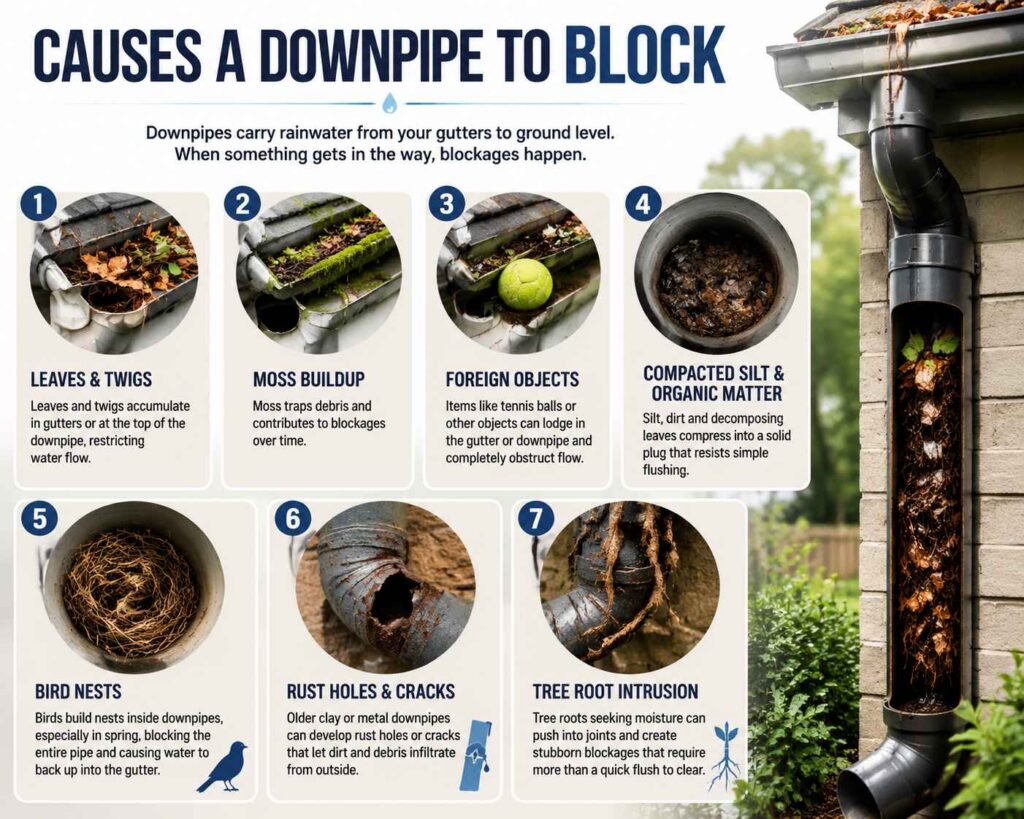
Downpipes carry rainwater from your gutters down to ground level, where it drains into stormwater systems managed jointly by property owners, local councils and Sydney Water. When leaves, twigs, moss, or even tennis balls accumulate in the gutter or at the top of the downpipe, water flow slows or stops entirely. Over time, silt and organic matter compact into a solid plug that resists simple flushing.
Bird nests are another common culprit, especially in spring when native birds seek sheltered spots to raise their young. A nest wedged inside a downpipe can block the entire diameter, forcing water to back up into the gutter and overflow at the nearest low point.
In older homes across Sydney’s Inner West and North Shore, clay or metal downpipes may develop rust holes or cracks that let dirt and roots infiltrate from outside. Tree roots seeking moisture can push into joints and create stubborn blockages that require more than a quick flush to clear.
How to Locate a Blockage in Your Downpipe
Before you climb a ladder, take a walk around your house during or just after rain. Look for gutters that overflow while nearby sections drain normally—this pattern suggests a localised blockage in the downpipe serving that gutter run. Water stains on external walls or pooling near downpipe outlets also point to restricted flow.
Once you’ve identified the problem downpipe, tap along its length with your knuckles or a wooden spoon. A hollow sound indicates an empty pipe, while a dull thud suggests debris inside. Most blockages sit either at the top (where the downpipe meets the gutter) or at a bend or elbow lower down.
If your downpipe has an inspection access point or removable shoe at the base, open it and shine a torch inside. You may spot compacted leaves or silt within arm’s reach, making removal straightforward without dismantling the entire run.
How to Unblock a Downpipe: Safe DIY Methods
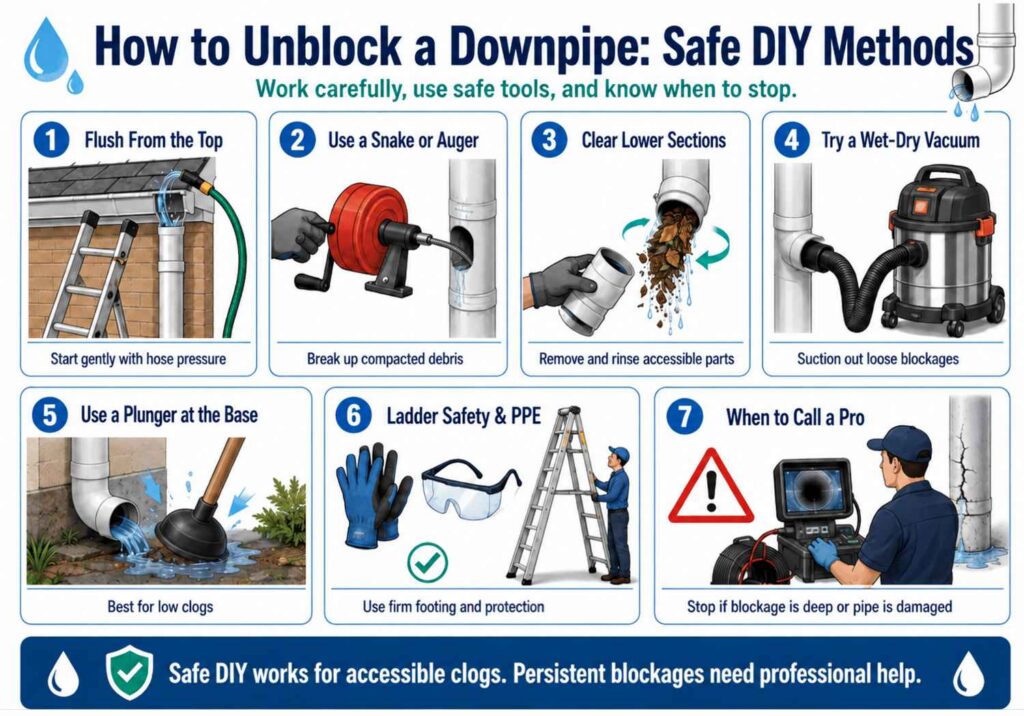
Clearing a downpipe yourself can be quick and cost-effective if the blockage is accessible and you follow basic safety steps. The key is to work methodically, protect yourself from falls, and know when to stop and call for professional help.
1. Flush From the Top With a Garden Hose
Climb your ladder and remove any visible debris from the gutter and the top of the downpipe by hand. Insert a garden hose into the downpipe opening and turn on the water at moderate pressure. If the blockage is soft or loosely packed, the flow may push it through to the outlet below. Listen for gurgling sounds that indicate water is breaking through.
Avoid using full mains pressure immediately, as this can force debris sideways into joints or split older pipes. Start gently and increase flow if needed.
2. Use a Plumber’s Snake or Drain Auger
A hand-crank drain snake (available at most Sydney hardware stores) can reach blockages several metres down. Feed the flexible cable into the downpipe from the top, rotating the handle as you push. When you feel resistance, continue cranking to break up or hook the debris, then pull the snake back slowly to retrieve it.
This method works well for compacted leaf matter or small nests. If the cable won’t advance or you feel hard resistance, stop—you may have hit a joint, elbow, or more serious obstruction that needs inspection.
3. Dismantle Lower Sections Carefully
Many downpipes are held together by brackets and push-fit joints that you can separate with gentle twisting. If your blockage sits in a lower elbow or shoe, unclip or unscrew that section and clear it by hand or with a stiff brush. Rinse the piece with a hose before reassembling.
Take a photo before you start so you remember the correct order and orientation of each part. Keep screws and clips in a small container to avoid losing them in the garden.
4. Try a Wet-and-Dry Vacuum
If the blockage is near the top or bottom opening, a shop vacuum with a hose attachment can create enough suction to pull out loose debris. Seal the vacuum nozzle against the pipe opening as best you can, switch to maximum suction, and hold for 10–15 seconds. Check the vacuum canister afterward—you may be surprised how much material comes out in one go.
5. Apply a Plunger at the Base
For blockages near the ground-level outlet, a sink plunger can sometimes dislodge the plug. Block the outlet with the plunger cup, fill the downpipe with water from the top (using a hose), then pump the plunger vigorously. The pressure change may break the blockage free, allowing water to rush through.
6. Ladder Safety and Personal Protection
Falls from ladders cause thousands of injuries each year. Always place your ladder on firm, level ground and angle it so the base is one metre out for every four metres of height. Have a second person hold the ladder steady, especially if the ground is soft or uneven. Wear gloves to protect your hands from sharp edges, and consider safety glasses if you’re flushing debris downward with a hose.
Never lean out sideways to reach a distant section—move the ladder instead. If your gutters are higher than two storeys or the roof pitch is steep, leave the job to a licensed professional with proper fall-protection equipment.
7. When to Stop and Call a Professional
If you’ve tried flushing, snaking, and dismantling accessible sections without success, the blockage may be deeper in the stormwater line or caused by structural damage. Forcing tools or excessive water pressure can crack pipes, disconnect joints, or push debris into your main drain, creating a bigger problem. At that point, a CCTV drain inspection will pinpoint the exact location and nature of the obstruction, saving you guesswork and potential repair costs. This is also the point where it’s worth calling a licensed Sydney plumber—Anton’s Plumbing & Gas (NSW Lic. 210933C) can be reached on +61 493 824 176 for a same-day assessment.
A Note on Sydney Water and NSW Plumbing Regulations
In NSW, you’re generally responsible for maintaining the downpipes and stormwater pipework on your own property, while Sydney Water and your local council manage the stormwater mains under the street. However, any work that alters or reconnects a downpipe to the stormwater system—such as replacing a cracked underground section or relining a pipe—should be carried out (or at least supervised) by a licensed plumber to ensure it complies with the NSW Plumbing and Drainage Act and AS/NZS 3500. Unlicensed work on drainage connected to the stormwater or sewer network can cause compliance issues if you ever sell your property.
Comparing DIY and Professional Downpipe Solutions
Different downpipe blockages need different solutions, and the right approach depends on how severe the blockage is and where it sits in the system. Some issues can be cleared with simple DIY methods, while others involve deeper obstructions, hidden stormwater problems, or damaged pipes that need professional equipment. Comparing DIY and professional downpipe solutions helps Sydney homeowners understand when a basic fix is reasonable and when expert help is the safer option.
| Method | Best For | Tools Required | Time | When to Choose |
|---|---|---|---|---|
| Garden hose flush | Soft leaf blockages near the top | Hose and ladder | 10–20 min | First attempt when the gutter and top of the downpipe are accessible |
| Plumber’s snake | Mid-pipe obstructions and nests | Hand auger and ladder | 20–40 min | When the blockage does not flush out and can still be reached from the top |
| Dismantle sections | Lower elbows, shoes, and visible clogs | Screwdriver and pliers | 30–60 min | Suitable for confident DIYers working with accessible joints |
| CCTV inspection + jetting | Deep blockages, tree roots, or unknown causes | Professional camera and jet rodder | 1–2 hours | Best when DIY has failed, the problem keeps returning, or multiple drains are affected |
| Pipe relining | Cracked or root-damaged stormwater lines | Epoxy liner and specialist equipment | Half day | A good long-term option when excavation is best avoided |
Starting with the least invasive option usually makes sense for minor and accessible blockages. However, recurring issues, deeper obstructions, and damaged underground sections often need professional diagnosis and more advanced repair methods to solve the problem properly. By understanding the strengths and limits of each option, Sydney homeowners can make better decisions and avoid wasting time on the wrong solution.
| Method | Best For | Tools Required | Time | When to Choose |
|---|---|---|---|---|
| Garden hose flush | Soft leaf blockages near the top | Hose and ladder | 10–20 min | First attempt when the gutter and top of the downpipe are accessible |
| Plumber’s snake | Mid-pipe obstructions and nests | Hand auger and ladder | 20–40 min | When the blockage does not flush out and can still be reached from the top |
| Dismantle sections | Lower elbows, shoes, and visible clogs | Screwdriver and pliers | 30–60 min | Suitable for confident DIYers working with accessible joints |
| CCTV inspection + jetting | Deep blockages, tree roots, or unknown causes | Professional camera and jet rodder | 1–2 hours | Best when DIY has failed, the problem keeps returning, or multiple drains are affected |
| Pipe relining | Cracked or root-damaged stormwater lines | Epoxy liner and specialist equipment | Half day | A good long-term option when excavation is best avoided |
Preventing Future Downpipe Blockages
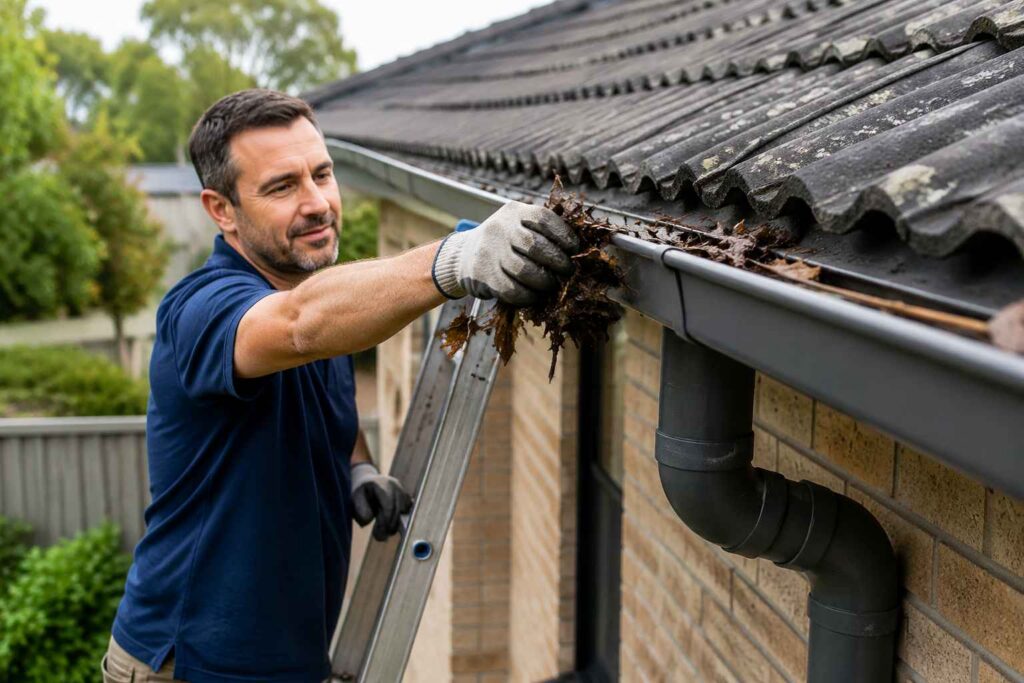
Regular gutter cleaning is the simplest way to keep downpipes flowing freely. Aim to clear leaves and debris at least twice a year—once in autumn after deciduous trees drop their leaves, and again in spring after flowering plants shed blossoms and seed pods. If your home sits under large eucalypts or near bushland (common across much of greater Sydney), you may need to clean gutters every few months.
Gutter guards—mesh or slotted covers that sit over the gutter channel—can reduce the volume of debris entering your system. They won’t eliminate blockages entirely (fine material and roof grit can still wash through), but they do extend the interval between cleanings and reduce the risk of sudden overflows during heavy Sydney downpours.
Downpipe leaf traps or strainers fit at the top of the downpipe and catch larger debris before it enters the vertical run. You’ll need to empty these traps regularly, but doing so is faster and safer than clearing a fully blocked pipe. Some designs include a transparent inspection window so you can see at a glance when the trap is full.
If tree roots have caused blockages in your underground stormwater line, consider root-barrier installation or strategic tree removal to prevent recurrence. Pipe relining creates a smooth, root-resistant inner surface that stops future infiltration without the cost and disruption of digging up your garden.
Real-World Example: Clearing a Persistent Blockage in the Inner West
Sarah, a homeowner in Sydney’s Inner West, noticed her front gutter overflowing every time it rained, even though the back of the house drained perfectly. She tried flushing the downpipe with a hose and used a plumber’s snake, but water still pooled in the gutter. Concerned about water seeping into her brick walls, she called our team for a same-day inspection.
We arrived within two hours and ran a CCTV camera down the stormwater line connected to her front downpipe. The footage revealed a section of clay pipe that had cracked under the driveway, allowing tree roots to grow inside and form a dense mat. Flushing from above had no effect because the blockage was three metres underground.
We offered Sarah two options: excavate the driveway to replace the damaged section, or use pipe relining to create a new, seamless inner pipe without digging. She chose relining to avoid the cost and disruption of breaking up her concrete driveway. We completed the reline in half a day, tested the system with a full flush, and provided her with before-and-after camera footage and a compliance certificate. Her gutters now drain freely, and the repaired pipe is backed by our lifetime labour warranty.
When to Call Antons Plumbing & Gas for Blocked Downpipes and Drains

DIY methods work well for straightforward blockages, but some situations call for licensed expertise and specialist equipment. If you’ve cleared the downpipe but water still won’t drain, if you notice foul odours or sewage backing up, or if multiple drains are slow at the same time, the problem likely extends beyond a simple leaf blockage—and it’s time to call a licensed Sydney plumber.
Our team at Anton’s Plumbing & Gas (NSW Lic. 210933C) provides same-day service across Sydney—from the Inner West and Eastern Suburbs to the North Shore, Northern Beaches, Hills District, and Western Sydney. We arrive with a fully equipped van, including CCTV drain cameras, high-pressure water jetters, and pipe-relining systems, so we can diagnose and fix most issues on the spot. There’s no call-out fee from 7am to 3pm on weekdays, and we offer 24/7 emergency response for urgent blockages that threaten your home.
Every job is carried out to Australian Standards (AS/NZS 3500) and NSW plumbing regulations, with clear communication, upfront pricing in AUD, and a lifetime labour warranty on our workmanship. We’ll show you the camera footage, explain your options—repair versus replace, dig versus reline—and tailor the solution to your property and budget. Whether you’re dealing with a single blocked downpipe or a network of aging stormwater drains, we’ll identify the root cause and deliver a repair that lasts.
Call us on +61 493 824 176 or book online for a fast quote and same-day service across Sydney.
Conclusion
Unblocking a downpipe can often be done safely at home with basic tools and careful technique. When DIY efforts don’t solve the issue, professional diagnosis and repair from a licensed Sydney plumber will protect your property and deliver lasting results. For same-day blocked drain service across Sydney, call Anton’s Plumbing & Gas (NSW Lic. 210933C) on +61 493 824 176.
Anton’s Plumbing & Gas offers expert blocked drain solutions backed by 25 years of experience. Our licensed team provides same-day service across Sydney with upfront pricing in AUD. Contact us today to get started.
Related Articles
- How to Clear a Blocked Gutter Downpipe Without Damaging Pipes
- Storm Drain Unclogging Guide for Better Property Drainage
- 5 Common Mistakes to Avoid When Dealing with Pipes Leaking
FAQs
What Are Common Causes Of A Blocked Downpipe?
Common causes of a blocked downpipe include debris such as leaves, twigs, and dirt, as well as blockages from tree roots or bird nests. Accumulated sediment and improper installation can also contribute to clogs. With over 25 years of experience, our team at Anton’s Plumbing & Gas can quickly identify and resolve these issues.
How Do You Know If Your Downpipe Is Blocked?
Signs of a blocked downpipe include water overflowing from the gutter, slow drainage during rain, or damp patches on walls and ceilings. If you notice any of these signs, it’s essential to act promptly to prevent further damage to your property. Our skilled professionals can perform a thorough inspection to confirm blockages.
Can I Unblock A Downpipe Myself?
While some homeowners may attempt to unblock a downpipe themselves using a garden hose or a plumber’s snake, it can be challenging and may lead to further damage if not done correctly. If you’re unsure or the blockage is severe, it’s best to contact our expert team at Anton’s Plumbing & Gas for safe and effective solutions.
What Tools Do I Need To Unblock A Downpipe?
To unblock a downpipe, you may need tools such as a plumber’s snake, a garden hose with a high-pressure nozzle, a bucket, and gloves. However, without the right experience, using these tools can sometimes make the problem worse. We recommend relying on our experienced team for effective and efficient service.
When Should I Call A Professional To Unblock A Downpipe?
You should call a professional if you notice persistent blockages, repeated overflow issues, or if you’re unable to resolve the blockage on your own. Our qualified team at Anton’s Plumbing & Gas is available 24/7 for emergencies and can provide the expertise needed to ensure your downpipes are functioning properly.
Is Anton’s Plumbing & Gas Licensed To Work On Downpipes And Drains In NSW?
Yes. Anton’s Plumbing & Gas holds NSW Lic. 210933C, so any downpipe, stormwater, or drainage work we carry out complies with AS/NZS 3500 and NSW plumbing regulations. You can call us directly on +61 493 824 176 to confirm details before booking.
Do You Charge A Call-Out Fee For Blocked Downpipe Jobs In Sydney?
There’s no call-out fee for jobs booked between 7am and 3pm on weekdays. Simply book a plumber online or call us to arrange a visit and get an upfront, obligation-free assessment.
Do You Offer Same-Day Blocked Downpipe Repairs Across Sydney?
Yes, we provide same-day blocked drain service across metro Sydney. Call us in the morning and, in most cases, we can have a licensed plumber at your door the same day.
Is My Downpipe Connected To Sydney Water’s Stormwater System?
Most Sydney properties drain rainwater from their downpipes into the local stormwater network, which is jointly overseen by property owners, councils, and Sydney Water. You’re generally responsible for your own downpipes and private drainage, while Sydney Water manages the mains under the street. If you’re unsure where your connection point is, our team can locate it for you during an inspection.
Do I Need Council Approval To Repair Or Replace A Downpipe In NSW?
Simple like-for-like repairs usually don’t require approval, but work that changes your stormwater connection may need to meet council and Sydney Water requirements. A licensed plumber will know what’s needed and can make sure the job is compliant, so it’s worth asking us before starting any larger repair.
What Areas Of Sydney Do You Service For Blocked Downpipes?
We service the Inner West, Eastern Suburbs, North Shore, Northern Beaches, Hills District, and Western Sydney. If you’re not sure whether we cover your suburb, give us a call and we’ll confirm straight away.
Do You Provide Emergency Blocked Drain Service Outside Business Hours?
Yes, we offer 24/7 emergency response for urgent overflow or blockage issues, including evenings and weekends. Call +61 493 824 176 any time you have a genuine emergency.
How Quickly Can You Get To My Property After I Call?
Response times vary by location and time of day, but we prioritise same-day appointments wherever possible and treat overflowing downpipes or water entering the home as urgent. The sooner you call, the sooner we can lock in a time slot for you.
Will You Provide Upfront Pricing Before Starting The Job?
Yes. We always confirm pricing in AUD and explain your options before any work begins, so there are no surprises on the invoice. If a CCTV inspection reveals extra work is needed, we’ll walk you through the footage and the cost before proceeding.
Do You Offer A Warranty On Downpipe And Drain Repairs?
Yes, our workmanship is backed by a lifetime labour warranty, giving you peace of mind that the repair is built to last, not just a quick fix.
Can You Inspect My Downpipe With A Camera Before Quoting A Repair?
Absolutely. Our vans carry CCTV drain cameras, so we can see exactly what’s causing the blockage—whether it’s leaf litter, a cracked pipe, or tree roots—before recommending a solution.
What Happens If My Downpipe Blockage Is Caused By Tree Roots?
If roots have infiltrated your stormwater line, we’ll usually recommend either pipe relining or a root-barrier installation, depending on the extent of the damage. We’ll show you the camera footage and explain the pros and cons of each option for your property.
How Do I Book A Plumber For A Blocked Downpipe In Sydney?
You can call us on +61 493 824 176 or book online through our contact page. Let us know your suburb and a brief description of the issue, and we’ll arrange a same-day visit where possible.
Do You Work On Weekends For Blocked Downpipe Emergencies?
Yes, our 24/7 emergency service includes weekends and public holidays for urgent blockages that risk water damage to your home. For non-urgent jobs, weekday bookings between 7am and 3pm come with no call-out fee.
What Should I Do If Water Is Overflowing From My Gutter Right Now?
If it’s safe to do so, avoid climbing a wet ladder in a storm. Instead, move any valuables away from walls where water is pooling and call our emergency line on +61 493 824 176. A licensed plumber from Anton’s Plumbing & Gas (NSW Lic. 210933C) can talk you through immediate safety steps and get a technician to you as soon as possible.