

Knowing how to clear a blocked gutter downpipe can help prevent a light Sydney downpour from turning into a waterfall running down your walls. When water spills over the gutters, it can soak into the fascia, pool around the footings, damage brickwork, stain render and allow damp into the roof cavity—a common issue during Sydney’s heavy summer storm season.
This guide walks you through safe, practical methods to clear a blocked gutter downpipe without cracking PVC, denting metal, or making the problem worse. You’ll learn what tools work best, how to spot hidden obstructions, and when a professional diagnosis saves you time and money. In NSW, any work on the underground stormwater connection to the Sydney Water network should only be carried out by a licensed plumber — Anton’s Plumbing & Gas holds NSW Lic. 210933C.
Key Takeaways
- Always start by clearing the gutter trough and top of the downpipe before flushing from above.
- Use a garden hose, plumbing snake, or wet-dry vacuum to dislodge blockages without applying excessive force.
- Tap the pipe gently to locate hard clogs and avoid dismantling sections unnecessarily.
- Never use high-pressure washers on older or brittle PVC downpipes as they can split joints or crack the material.
- If water still won’t flow after multiple attempts, the blockage may be underground or inside a stormwater pit connected to the Sydney Water network, which requires a CCTV inspection.
- Work on the underground stormwater connection point should only be done by a licensed NSW plumber. Call a licensed Sydney plumber (NSW Lic. 210933C) on 0493 824 176 if you’re unsure.
How to Clear a Blocked Gutter Downpipe: Step-by-Step Process
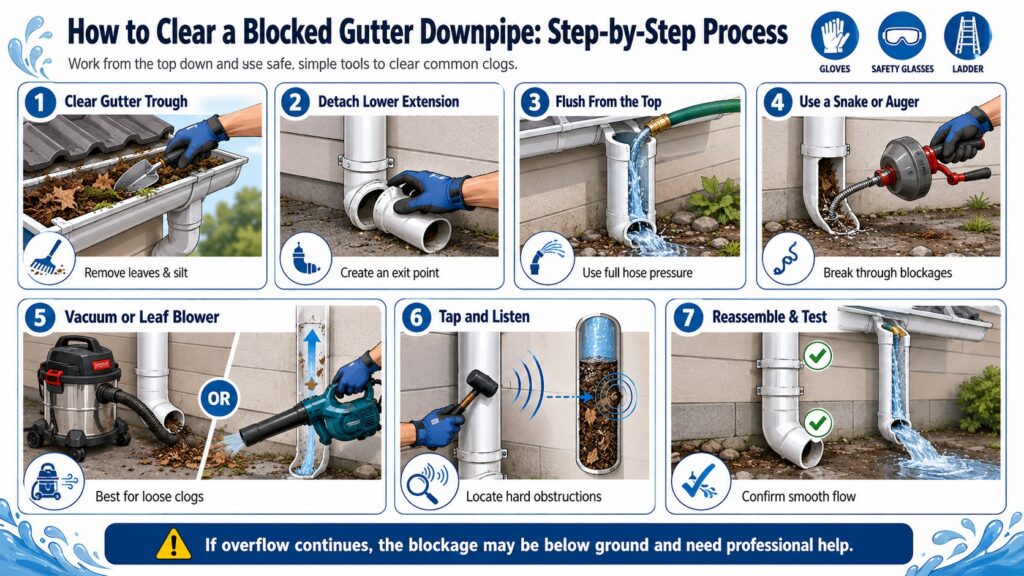
How to Clear a Blocked Gutter Downpipe: Step-by-Step Process
Clearing a blocked downpipe starts with understanding where the obstruction sits. Most clogs form at bends, joins, or just below the gutter outlet where leaves compress into a dense plug. Before you climb the ladder, put on gloves and safety glasses — decomposed leaf matter can harbour mould spores and sharp twigs.
Work from the top down whenever possible. Pushing debris up from the bottom often wedges it tighter into narrow sections.
1. Remove Debris From the Gutter Trough
Scoop out leaves, moss, and silt from the gutter channel using a small trowel or your gloved hand. A blocked trough will refill the downpipe as soon as you clear it, so this step prevents repeat blockages. Bag the debris rather than dropping it onto garden beds — it’s often slimy and sticks to paving.
2. Detach the Lower Extension or Shoe
Most downpipes have a removable elbow or extension at ground level. Unclip or unscrew it to create an exit point for flushed debris. If your downpipe connects directly to an underground stormwater line linked to the Sydney Water network, work from the top only — forcing material into a buried line can block the whole system and cause problems for your street’s drainage.
3. Flush With a Garden Hose From the Top
Feed the hose into the downpipe opening at gutter height and turn the tap to full pressure. Move the nozzle up and down to break up compacted material. Watch the lower outlet — if water flows freely, the blockage has cleared. If it backs up and overflows at the gutter, the clog is still in place.
4. Use a Plumbing Snake or Drain Auger
Feed a hand-crank plumbing snake down from the top, rotating the handle as you push. When you hit resistance, work the cable back and forth to break through. Pull the snake out periodically to remove hooked debris. For stubborn clogs, insert the auger from the bottom if you’ve removed the extension — this approach works well when the blockage sits low in the pipe.
5. Try a Wet-Dry Vacuum or Leaf Blower
A wet-dry vacuum can create suction strong enough to pull out soft blockages like matted leaves. Seal the nozzle against the lower outlet with a rag and switch to maximum power. Alternatively, a leaf blower set to high can blast air up the pipe to dislodge clogs — but only if the material is dry and loose. Wet sludge won’t budge with air alone.
6. Tap and Listen to Locate Hard Obstructions
Run your knuckles down the outside of the downpipe, tapping every 30 centimetres. A dull thud indicates a blockage at that height. If the clog is hard — perhaps a bird’s nest or compacted clay — you may need to dismantle that section by undoing the brackets and slip joints. Mark the location before you climb down so you don’t lose track.
7. Reassemble and Test Flow
Reattach all extensions, elbows, and brackets. Run the hose at full pressure into the gutter for two minutes and confirm water exits cleanly at ground level. Check every join for leaks — blockages sometimes push joints apart. If the pipe still overflows, the obstruction may be below ground or inside a concealed bend that requires professional equipment to reach.
Common Mistakes That Damage Downpipes
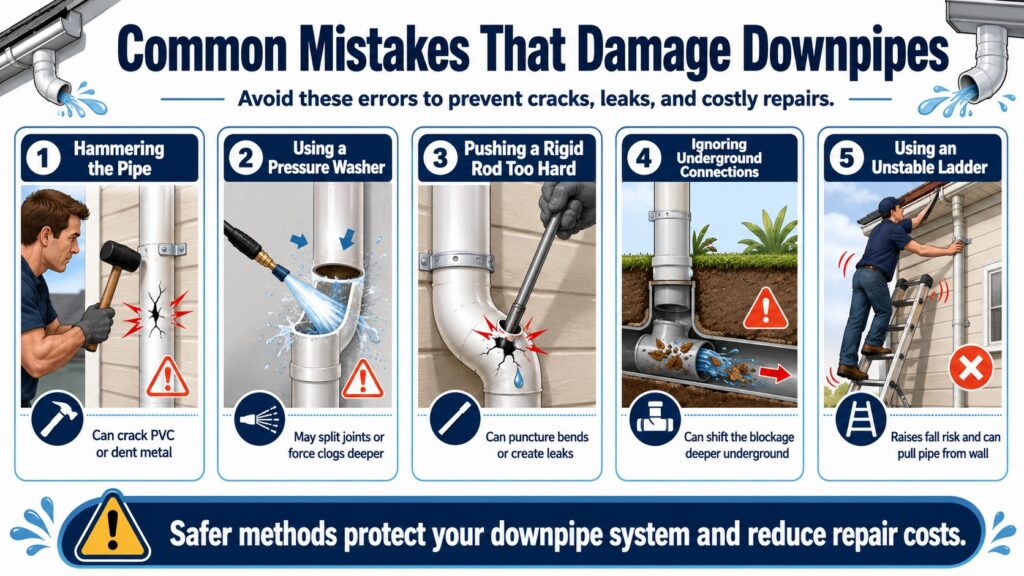
Common Mistakes That Damage Downpipes
Clearing a blocked downpipe may seem straightforward, but the wrong method can easily cause more damage than the clog itself. Older PVC downpipes can become brittle after years of Sydney sun exposure, while metal downpipes can bend, dent, or separate at the joints if too much force is applied. Understanding the most common mistakes helps homeowners protect the drainage system and avoid unnecessary repair or replacement costs.
- Hammering or striking the pipe: Hitting a downpipe with a mallet or heavy tool can crack older PVC or dent metal sections, especially near brackets and joins where the material is already under pressure.
- Using a pressure washer inside the pipe: High-pressure water can split weak PVC, blow apart slip joints, or force debris deeper into underground stormwater lines where it becomes harder to remove.
- Pushing a rigid rod too hard: Steel rods or stiff wire can puncture a bend, damage a corroded section, or create a new leak point inside the pipe.
- Ignoring underground connections: Forcing debris into a buried stormwater line without checking its condition can shift the blockage further down and create a much larger drainage problem, potentially affecting the Sydney Water network.
- Working without a stable ladder: Overreaching or losing balance while clearing a downpipe increases the risk of falls and can also pull the pipe away from the wall if used for support.
Avoiding these mistakes can make a big difference in keeping your downpipe system functional and intact. A blocked pipe is already a problem, but accidental cracks, leaks, or joint failures can turn a simple clearing job into a more expensive repair. By using safer methods and understanding the risks, homeowners can deal with blockages more carefully and know when it is better to call a professional.
When DIY Methods Won’t Clear the Blockage
Sometimes a blockage sits beyond the reach of household tools. Tree roots — common in Sydney’s leafy suburbs — can invade underground stormwater pipes through hairline cracks, forming a dense mat that snags debris. Collapsed sections, offset joins, or sediment build-up in the pit all prevent flow but show no visible sign from above.
In Sydney, most downpipes connect to your property’s stormwater system, which ties into the Sydney Water network via your council’s stormwater infrastructure. Under NSW regulations, any work on this connection point should be carried out by a licensed plumber. If you’ve tried flushing, snaking, and vacuuming without success, the problem likely requires diagnosis with a CCTV drain camera. Our team at Anton’s Plumbing & Gas (NSW Lic. 210933C) uses waterproof cameras to inspect the full length of your downpipe and underground stormwater line, identifying the exact location and cause. We provide same-day service across Sydney — Inner West, Eastern Suburbs, North Shore, and beyond — with no call-out fee between 7am and 3pm on weekdays.
Call 0493 824 176 to book a camera inspection and receive a clear diagnosis before any work begins.
Preventing Future Blockages in Gutter Downpipes
Preventing future blockages is just as important as clearing the downpipe in the first place. Without regular maintenance, leaves, dust, seed pods, and other debris can build up again quickly, especially in leafy Sydney suburbs with mature trees and heavy seasonal rain. A few simple preventative steps can reduce the risk of recurring clogs and help your gutter and downpipe system last longer.
- Install gutter guards or mesh: Fine mesh screens help block leaves and larger debris from entering the gutter while still allowing rainwater to pass through.
- Trim overhanging branches: Cutting back branches near the roofline reduces the amount of leaves, twigs, and organic matter falling directly into the gutters.
- Flush downpipes twice a year: Running water through each downpipe in autumn and spring helps clear small buildups before they harden into serious blockages.
- Check stormwater pits after heavy rain: Removing settled leaves, silt, and debris from the pit helps prevent material from washing back into the drainage system.
- Inspect joins and brackets annually: Looking for rust, cracks, loose sections, or sagging brackets helps keep the downpipe aligned and reduces the chance of leaks or snag points.
A preventative approach can save homeowners time, money, and repeated gutter cleaning problems over the long term. Small maintenance tasks done regularly are often enough to stop minor debris buildup from turning into a full blockage. By staying consistent with upkeep, you can improve drainage performance and reduce the likelihood of future downpipe issues.
Why Professional Diagnosis Saves Time and Money
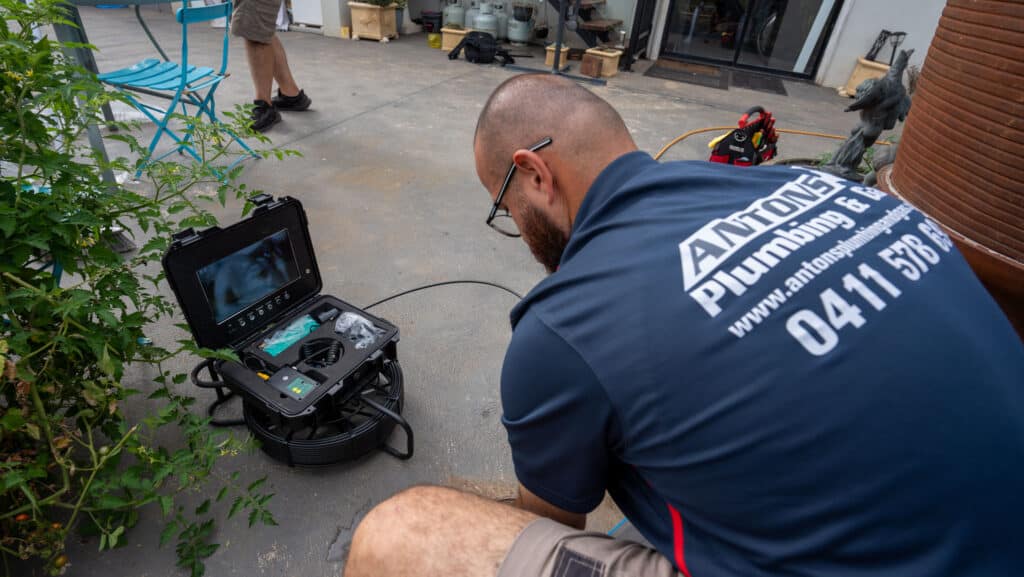
Spending a Saturday on the ladder with a hose and a snake is fine if the blockage is simple. But if the problem recurs every few months, or if water still won’t drain after multiple attempts, you’re dealing with a systemic issue — not just a handful of leaves. Tree roots, collapsed stormwater pipes, incorrect fall, or a blocked council connection all require tools and expertise beyond the average toolbox, and work on the shared stormwater system should be handled by a licensed NSW plumber.
Our CCTV drain cameras reveal the exact cause and location in minutes. You see the footage on-screen, so there’s no guesswork. We then explain your options — repair, reline, or replace — with transparent pricing and realistic timelines. Same-day service means we can often clear the blockage and complete minor repairs in a single visit, getting your drainage back to full function before the next storm.
We serve the greater Sydney region — Inner West, Eastern Suburbs, North Shore, Northern Beaches, Hills District, Western and South-Western Sydney, and Sutherland Shire. Emergency call-outs are available 24/7 on 0493 824 176, with no call-out fee for weekday jobs between 7am and 3pm. Book online or call for a fast quote, and we’ll confirm the appointment within the hour.
Conclusion
A blocked gutter downpipe is more than an inconvenience — it’s a direct threat to your walls, footings, and roof structure. Clearing it safely protects your home and avoids the cost of water damage repairs down the track. When DIY methods fall short, professional diagnosis and repair from a licensed Sydney plumber deliver results you can rely on for years to come.
Anton’s Plumbing & Gas (NSW Lic. 210933C) offers expert blocked drain solutions backed by 25 years of experience. Our licensed team uses CCTV inspections to safely diagnose and clear downpipe blockages. Get started with same-day service across Sydney Metro.
Related Articles
- Storm Drain Unclogging Guide for Better Property Drainage
- Blocked Stormwater Pipe Solutions for Better Home Drainage
- How to Unblock a Downpipe: A Simple Guide for Homeowners
FAQs
What Are The Signs Of A Blocked Gutter Downpipe?
Common signs of a blocked gutter downpipe include water spilling over the edges of the gutters during rain, slow drainage from the roof, visible debris in the gutters, and pooling water around the footings of your home. If you notice any of these issues, it’s essential to address them promptly to avoid potential damage.
How Do You Unblock A Downpipe Without A Plumber?
To unblock a downpipe without a plumber, you can start by removing any visible debris from the top of the gutter. Use a garden hose to flush water down the pipe, which can help dislodge any blockages. A plumber’s snake or a flexible brush can also be effective in clearing stubborn clogs. However, if the blockage persists, it may be time to call in professionals like Anton’s Plumbing & Gas, who have the tools and expertise to handle more complex issues safely.
Can I Use A Pressure Washer To Clear A Blocked Downpipe?
While a pressure washer can be effective for clearing debris from gutters, it may not be the best option for downpipes. High pressure can potentially damage the pipes or joints if not used carefully. It’s advisable to seek assistance from a qualified plumbing service, such as Anton’s Plumbing & Gas, to ensure the job is done safely and effectively.
What Tools Do I Need To Clear A Blocked Gutter Downpipe?
To clear a blocked gutter downpipe, you typically need a few basic tools: a ladder to access the gutters, a trowel or scoop for removing debris, a garden hose for flushing, and possibly a plumber’s snake or flexible brush for tougher clogs. If you’re unsure or uncomfortable performing this task, our experienced team at Anton’s Plumbing & Gas is ready to help.
How Often Should I Clean My Gutter Downpipes?
It’s recommended to clean your gutter downpipes at least twice a year, ideally in spring and autumn, to prevent blockages caused by leaves and debris. However, if you live in an area with many trees or experience heavy rain, more frequent cleaning may be necessary. Regular maintenance can help avoid costly repairs down the line, and our team can assist with a full inspection.
Do You Provide Blocked Downpipe Clearing Services Across Sydney?
Yes, Anton’s Plumbing & Gas (NSW Lic. 210933C) provides blocked downpipe and gutter drainage services across Sydney, including Inner West, Eastern Suburbs, North Shore, Northern Beaches, Hills District, Western and South-Western Sydney, and Sutherland Shire. Call 0493 824 176 to book a plumber today.
Are You A Licensed Plumber In NSW?
Yes, Anton’s Plumbing & Gas holds NSW Lic. 210933C, so all downpipe clearing, drain camera inspections, and stormwater connection work is carried out to NSW plumbing standards.
Do You Charge A Call-Out Fee For Blocked Downpipe Jobs?
There is no call-out fee for weekday jobs between 7am and 3pm. Call 0493 824 176 to check availability for your suburb and confirm costs for your specific job.
How Quickly Can You Attend A Blocked Downpipe Emergency In Sydney?
We offer 24/7 emergency call-outs and same-day service across Sydney Metro. Phone 0493 824 176 and we’ll confirm your appointment within the hour.
Can You Inspect My Downpipe And Stormwater Line With A Camera?
Yes, we use waterproof CCTV drain cameras to inspect downpipes and underground stormwater lines, giving you an on-screen diagnosis before any work begins. Book an inspection on 0493 824 176.
Do I Need Council Or Sydney Water Approval To Fix My Downpipe?
Most downpipe clearing doesn’t require approval, but work on the connection to the public stormwater system may fall under Sydney Water and local council rules. Our licensed team can advise whether your job needs additional approval before we start.
What If The Blockage Is In The Council Or Sydney Water Stormwater Pit, Not My Downpipe?
If our inspection shows the blockage is in the shared stormwater pit or public system, we’ll let you know so you can report it to your local council or Sydney Water, and we’ll clear anything on your side of the boundary.
Do You Provide A Free Quote Before Starting Work?
We provide transparent pricing and explain your repair, reline, or replace options before any work begins, so you know exactly what to expect. Call 0493 824 176 to arrange an assessment.
Is Your Downpipe Clearing Work Guaranteed?
Our licensed plumbers stand behind their workmanship on every downpipe clearing and repair job across Sydney.
Can A Blocked Downpipe Cause Water Damage Inside My Sydney Home?
Yes, overflowing gutters and blocked downpipes can force water into fascia, walls, and roof cavities, particularly during Sydney’s heavy summer storms. Clearing the blockage promptly reduces this risk.
Should I Attempt To Clear My Downpipe Myself Or Call A Licensed Plumber?
Simple surface blockages can often be cleared with a hose or snake. If the clog is underground, recurring, or connected to the stormwater system, call a licensed Sydney plumber like Anton’s Plumbing & Gas (NSW Lic. 210933C) on 0493 824 176.
Do You Service Homes Across All Sydney Suburbs?
Yes, we service the greater Sydney region including Inner West, Eastern Suburbs, North Shore, Northern Beaches, Hills District, Western and South-Western Sydney, and Sutherland Shire.
How Do I Book A Downpipe Clearing Appointment?
You can book online or call 0493 824 176, and we’ll confirm your appointment within the hour.
What Experience Does Your Plumbing Team Have?
Anton’s Plumbing & Gas brings 25 years of experience to blocked drain and downpipe clearing work across Sydney.
Can You Fix A Downpipe That Keeps Blocking Every Year?
Recurring blockages usually indicate an underlying issue such as tree root intrusion or incorrect pipe fall. Our CCTV inspection identifies the cause so we can recommend a lasting fix rather than a temporary clear. Call 0493 824 176 to book an inspection.