

When you install an under-sink sump pump to lift grey water from a laundry or utility sink in a lower-level room, one specification matters more than any other: head height. This single number tells you whether your pump can push water high enough to reach your home’s main drain line. Get it wrong and you will face overflows, burnt-out motors, and a flooded floor.
In this guide, we explain what under-sink sump pump head height is, how to calculate the total lift your system needs, and when to call a licensed Sydney plumber for safe installation. You will also learn how the same pressure principles apply to other devices – from a simple 12V water pump to a shower head – and why proper sizing protects your property and keeps you compliant with NSW plumbing rules.
Key Takeaways
- Head height is the vertical distance from the pump inlet to the highest point in your discharge line before it turns horizontal.
- Total dynamic head includes static lift plus friction losses from pipes, fittings, and check valves.
- A typical 1/3 HP under-sink pump offers around 7.6 metres (25 feet) of maximum head, but real-world capacity drops as lift increases.
- Undersized pumps cycle too often and burn out; oversized pumps waste energy and cost more upfront.
- Professional installation ensures correct pipe slope, check-valve placement, and compliance with Australian plumbing standards and Sydney Water requirements.
What Is Under Sink Sump Pump Head Height?
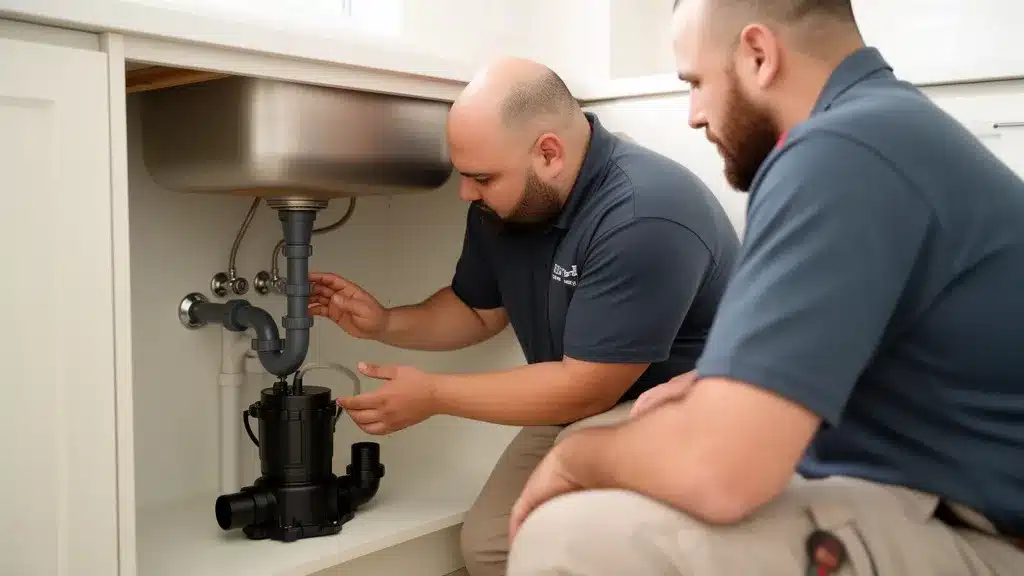
Head height measures how high a pump can push water against gravity. For an under-sink sump pump, static head is the vertical distance from the pump’s inlet to the highest point in the discharge line before the pipe turns horizontal. If your laundry sink sits three metres below the main drain connection at street level, your static head is three metres – or roughly ten feet.
Total dynamic head (TDH) adds friction losses to that static lift. Every elbow, tee, length of pipe, and check valve creates resistance. A 90-degree elbow might add the equivalent of half a metre of extra lift; a check valve near the basin lid can add another metre. Your pump must overcome both the vertical climb and these friction losses to move water reliably.
Manufacturers rate pumps by maximum head – the point at which flow drops to zero. A common 1/3 HP unit advertises a 7.6-metre (25-foot) maximum head and a flow rate of around 11,000 litres per hour at zero lift. As you add height, flow decreases along the pump’s performance curve. At 4.6 metres (15 feet) of total head, that same pump might deliver only 5,700 litres per hour. Understanding this trade-off is the key to choosing the right model.
Why Total Dynamic Head Matters More Than Static Lift Alone
Many homeowners measure only the vertical rise and assume any pump rated above that number will work. That approach ignores friction. A discharge line with multiple bends, a long horizontal run, and a check valve can easily add one to 1.5 metres of equivalent head. If your static lift is already six metres (20 feet) and friction adds another 1.5 metres, you need a pump rated for at least 7.6 metres (25 feet) – and preferably higher to maintain adequate flow.
Friction loss depends on pipe diameter, material, and length. A 40-millimetre PVC line loses less pressure per metre than a 32-millimetre line carrying the same flow. Smooth-bore pipe creates less drag than corrugated hose. Sizing your discharge line correctly reduces friction head and lets you use a smaller, more efficient pump.
We see undersized systems most often in older Sydney homes where a laundry has been added to a lower-ground-floor or converted terrace room. The main sewer line sits at street level, three or four metres above the new sink. Without a proper head calculation, the pump runs constantly, overheats, and fails within months. A quick site visit and TDH calculation prevent that costly cycle – and keeps the setup compliant with Sydney Water’s requirements for discharge into the sewer rather than the stormwater system.
How Head Height Concepts Apply Across Different Pumping Devices
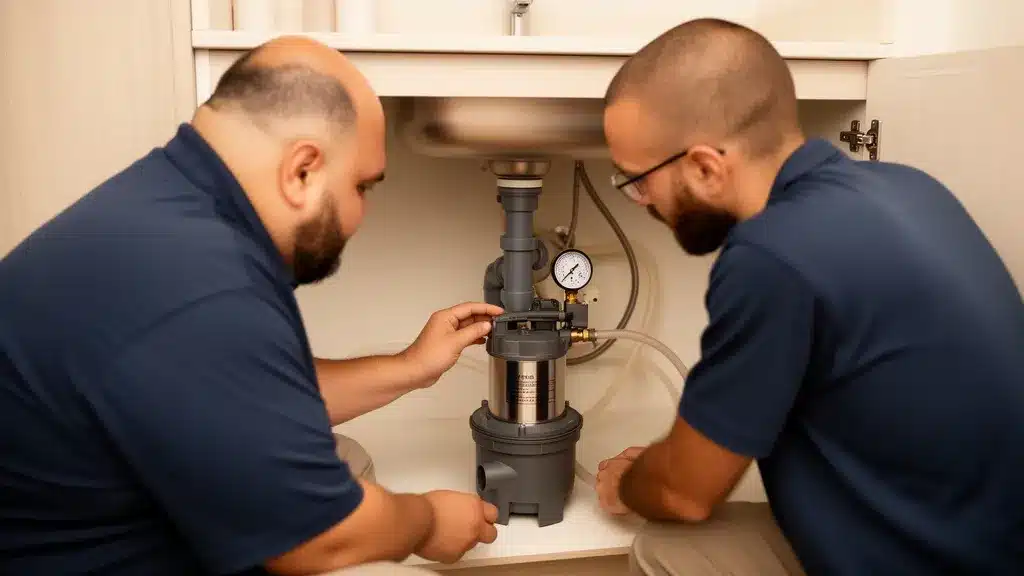
The physics of head height is not unique to sump pumps. A shower head must overcome the pressure drop from your roof tank or the street main to deliver a strong spray. A 12V water pump in a caravan or boat is rated for a maximum head – often three to six metres (ten to twenty feet) – that limits how high it can lift water from a tank to a tap. Even a balloon pump works against a pressure difference, though we measure that in pascals rather than metres.
Each device has a performance curve. Push it beyond its rated head and flow drops or stops altogether. The principle is identical whether you are moving grey water from a laundry sink or pressurising a shower line. Recognising this common thread helps you ask the right questions when a supplier quotes a maximum-head specification.
A sink plug and trap also play a role in head dynamics. If your sink lacks a proper plug, water drains continuously and the pump never builds enough pressure to lift the column efficiently. The basin should hold water until the float switch activates, allowing the pump to push a full charge up the line. Small details like a functioning sink plug make the difference between reliable operation and constant nuisance calls.
Calculating Total Dynamic Head for Your Under-Sink Installation
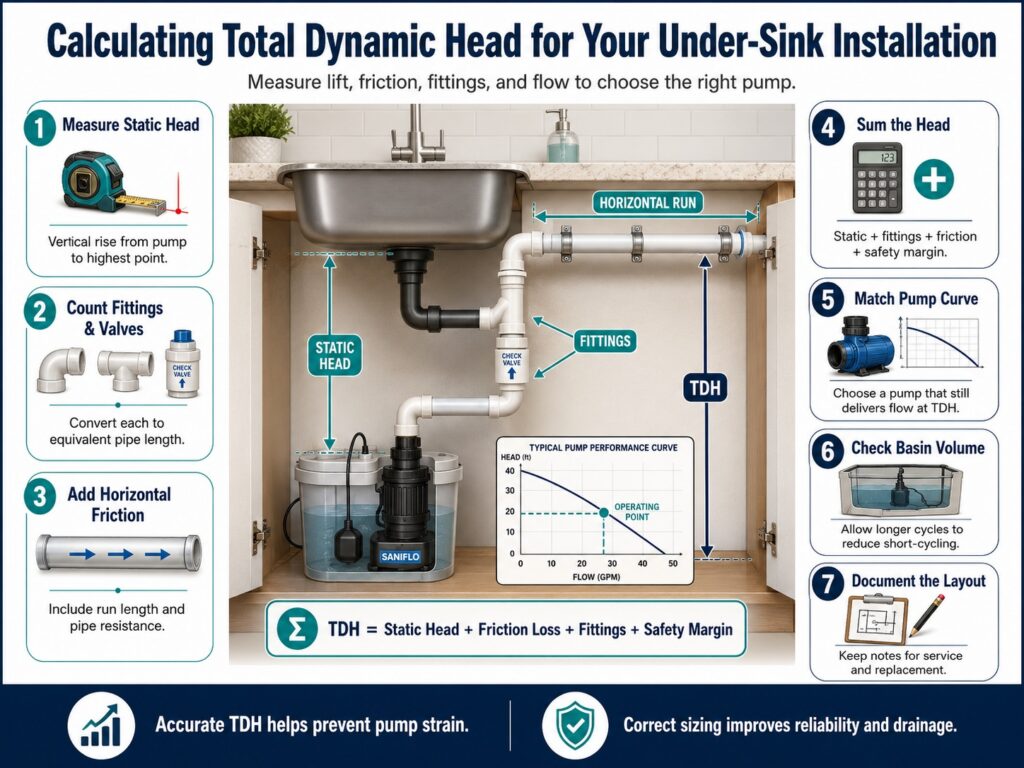
Calculating total dynamic head helps you choose the right pump for an under-sink installation. It measures the total resistance the pump must overcome, including vertical lift, pipe friction, fittings, valves, and discharge distance. Getting this calculation right helps prevent slow drainage, pump strain, short-cycling, and premature motor failure.
1. Measure Static Head
Use a tape measure or laser level to find the vertical distance from the pump inlet to the highest point in your discharge line. Include any rise inside the cabinet, up the wall, and across the ceiling before the pipe turns horizontal.
2. List Every Fitting and Valve
Count 90-degree elbows, tees, couplings, and the check valve. Refer to friction-loss tables (available from pipe manufacturers) to convert each fitting into an equivalent length of straight pipe. A typical 40-millimetre 90-degree elbow equals about 0.6 metres of pipe; a check valve can equal 1.5 metres.
3. Add Horizontal Run Friction
Measure the total length of horizontal discharge pipe and multiply by the friction-loss factor for your chosen diameter and flow rate. For example, 40-millimetre PVC at 2,000 litres per hour might lose 0.1 metres of head per ten metres of pipe.
4. Sum Static and Friction Components
Add your measured static lift to the equivalent lengths from fittings and the friction loss from horizontal runs. The result is your total dynamic head. Always round up and add a safety margin of 10 to 20 percent to account for future blockages or wear.
5. Match Pump Capacity to TDH
Check the manufacturer’s performance curve. At your calculated TDH, the pump should still deliver enough flow to empty the basin faster than water enters. For a laundry sink, 1,500 to 2,000 litres per hour is typically adequate.
6. Verify Basin Volume and Cycle Time
Your sump basin should hold three to four times the pump’s per-cycle volume. If the pump moves 20 litres per cycle, a 60 to 80-litre basin prevents short-cycling and extends motor life. Rapid on-off cycles overheat the motor and trip thermal cutouts.
7. Document Your Calculations
Keep a simple sketch showing vertical rise, pipe route, fittings, and your TDH sum. This record helps future service calls and ensures any replacement pump matches the original design criteria.
Accurate total dynamic head calculations make under-sink pump installations more reliable and efficient. By measuring the pipe route carefully and accounting for every fitting, valve, and friction point, you can choose a pump that performs properly under real conditions. If you are unsure about the calculations or pump selection, a licensed plumber can assess the setup and recommend the right solution.
Common Mistakes That Lead to Pump Failure in Sydney Homes
One frequent error is using flexible hose instead of rigid PVC for the discharge line. Corrugated hose has much higher friction loss, sometimes doubling the equivalent head. It also kinks easily, creating a bottleneck that the pump cannot overcome. We replace flexible hose with smooth-bore rigid pipe on almost every under-sink retrofit we inspect.
Another mistake is omitting the check valve or installing it upside down. Without a check valve, water flows back into the basin after each cycle, forcing the pump to re-lift the same column. An inverted valve acts as a permanent blockage. Both scenarios burn out the motor within weeks.
Undersizing the basin is the third common issue. A small basin fills quickly, the float switch activates every few seconds, and the pump never rests. We recommend a minimum 40-litre basin for most under-sink applications, rising to 60 litres if the sink drains a washing machine as well. Correct basin volume smooths out peak flows and protects the pump.
When to Call a Licensed Sydney Plumber for Under-Sink Pump Work
If your total dynamic head exceeds six metres (20 feet) or your discharge line includes more than three elbows, professional sizing and installation are worth the investment. A licensed plumber will calculate TDH accurately, select a pump with the right performance curve, and install the system to Australian Standard AS/NZS 3500. Anton’s Plumbing & Gas holds NSW Licence 210933C, so you can be confident the work meets Fair Trading and Sydney Water requirements and that your insurance cover remains intact.
We also recommend professional help if your under-sink pump ties into a shared stack or stormwater line. Under Sydney Water rules, grey water discharge must go to the sewer, not the stormwater system, and incorrect backflow prevention can contaminate drinking water or flood neighbouring properties. Our team installs testable check valves, documents the work, and provides a compliance certificate that satisfies strata requirements and council inspections.
Same-day service is available across the Sydney Metro – Inner West, Eastern Suburbs, North Shore, Northern Beaches, Hills District, Western and South-Western Sydney, and Sutherland Shire. Call us on 0493 824 176 for a fixed-rate quote in AUD, with no call-out fee between 7am and 3pm on weekdays. Emergency support runs 24/7 when a pump failure floods your laundry.
Comparing Pump Specifications: What to Look for on the Box
Reading the pump specifications carefully helps you choose a model that suits your under-sink installation. The box or product sheet should show key details such as motor power, maximum head, flow rate, outlet size, basin capacity, and float-switch type. Comparing these specifications before buying can help prevent drainage problems, short-cycling, and poor pump performance.
| Specification | Typical Range | Why It Matters |
|---|---|---|
| Motor Power | 1/4 to 1/2 HP | Higher power lifts water faster and handles greater head, but costs more to run. |
| Maximum Head | 20 to 30 feet | Must exceed your total dynamic head by at least 10 percent for reliable flow. |
| Flow at Rated Head | 1,500 to 3,000 L/h | Check the curve: flow drops as head increases; match flow to your sink’s drain rate. |
| Outlet Diameter | 32 to 40 mm | Larger outlets reduce friction; ensure your discharge pipe matches or exceeds this size. |
| Basin Capacity | 40 to 80 litres | Larger basins reduce cycle frequency and extend motor life. |
| Float-Switch Type | Vertical or tethered | Vertical switches suit narrow basins; tethered switches need more clearance but are easier to service. |
Pump specifications are not just technical details; they directly affect how well your under-sink system drains. A pump that is too small may struggle against the pipe route, while an oversized or poorly matched pump may cycle too often. By comparing the specifications against your total dynamic head, basin size, and discharge layout, you can choose a pump that works reliably and lasts longer.
Real-World Example: Basement Laundry in Sydney’s Inner West
A homeowner in the Inner West added a laundry to a lower-ground-floor room, three metres below the main sewer connection at street level. The existing 1/4 HP pump ran every 30 seconds and tripped its thermal cutout twice a day. We measured a static head of 3.2 metres, then traced the discharge line: four 90-degree elbows, one check valve, and eight metres of 32-millimetre pipe.
Friction from the elbows added 2.4 metres of equivalent head; the check valve contributed another 1.5 metres; and the horizontal run added 0.8 metres. Total dynamic head came to 7.9 metres – well beyond the old pump’s 6-metre rating. We replaced the system with a 1/3 HP model rated for 7.6 metres (25 feet) and upsized the discharge line to 40 millimetres, dropping friction by 40 percent. The new pump cycles every eight minutes under peak load and has run without fault for two years.
That job also required a larger 60-litre basin to handle simultaneous washing-machine discharge. We installed a testable double-check valve to meet strata backflow rules and Sydney Water requirements, and provided a compliance certificate for the owner’s records. The fixed-rate quote covered all materials, labour, and clean-up, with our lifetime labour warranty protecting the installation long-term.
Maintenance Tips to Keep Your Under-Sink Sump Pump Running
Regular maintenance helps your under-sink sump pump work reliably and prevents small issues from becoming costly plumbing problems. Since the pump handles wastewater from sinks or laundry fixtures, lint, soap scum, debris, and worn parts can affect performance over time. A simple maintenance routine can extend motor life, reduce blockages, and help the system drain properly.
- Test the float switch monthly: pour a bucket of water into the basin and confirm the pump starts and stops cleanly.
- Inspect the check valve annually: remove the valve, flush out any debris, and ensure the flapper moves freely.
- Clear the basin of lint and soap scum: laundry discharge carries fibres that settle in the basin and clog the pump inlet screen.
- Check discharge-line slope: sections that sag or run uphill create air pockets and reduce effective head.
- Listen for unusual noise: grinding or rattling suggests a worn impeller or bearing; call for service before the motor seizes.
- Keep the sink plug in good condition: a leaking plug lets water trickle into the basin continuously, forcing the pump to run more often than designed.
Keeping your under-sink sump pump maintained helps protect your home from slow drainage, overflow, and unexpected pump failure. Monthly checks, annual valve inspections, basin cleaning, and early attention to unusual noises can make the system more dependable. If the pump runs too often, struggles to drain, or shows signs of wear, a licensed plumber can inspect the setup and recommend the right repair or replacement.
Booking Your Under-Sink Pump Installation or Repair
If you need a new under-sink sump pump installed, an existing system serviced, or a head-height assessment for a planned renovation, call us on 0493 824 176 or book online. We offer same-day service across greater Sydney, from the Inner West and Eastern Suburbs to the North Shore, Northern Beaches, Hills District, and Sutherland Shire. Our qualified plumbers carry diagnostic tools, spare pumps, and common fittings on every van, so most jobs are completed in a single visit.
We start with a free site assessment: measure static head, count fittings, inspect your existing discharge line, and calculate total dynamic head. You receive a clear explanation of what is needed, why it matters, and how much it will cost in AUD – all in plain English, with no obligation. If you approve the quote, we proceed immediately or schedule a convenient time. Every job is left clean, tested, and documented, with a compliance certificate when required.
Whether you are adding a laundry, replacing a failed pump, or simply want peace of mind that your system is sized correctly, our team is ready to help. We combine 25 years of Sydney plumbing experience with transparent pricing, quality parts, and a commitment to work that meets Australian Standards. As a licensed NSW plumber (Lic. 210933C), we can sign off on compliance paperwork strata and council may require. Reach out today and let us protect your home from the frustration and expense of an undersized or poorly installed under-sink sump pump.
Conclusion
Under-sink sump pump head height determines whether your system can lift grey water reliably to your main drain. Calculate total dynamic head by adding static lift and friction losses, then choose a pump whose performance curve delivers adequate flow at that height. Professional installation ensures compliance with AS/NZS 3500 and Sydney Water rules, prevents costly failures, and gives you long-term confidence in your laundry or utility-room drainage.
Anton’s Plumbing & Gas provides expert leak detection and drainage solutions across Sydney Metro for residential and commercial properties. Our licensed team (NSW Lic. 210933C) diagnoses sump pump issues with precision, ensuring compliant installations tailored to your space. Contact us on 0493 824 176 to learn more.
Related Articles
- Do You Need a Sump Pump Pit? Signs Your Home Is at Risk of Water Damage
- What to Do When a Garbage Disposal Drain Is Too Low
- ProPress Fitting Has Play: Is It Normal or a Plumbing Problem?
FAQs
What Is The Ideal Head Height For An Under-Sink Sump Pump?
The ideal head height for an under-sink sump pump typically ranges from 3 to 4.6 metres (10 to 15 feet), depending on the specific model and application. It’s crucial to choose a pump that meets the demands of your Sydney home’s plumbing system to ensure efficient drainage and prevent overflow issues.
How Do You Measure The Head Height For A Sump Pump?
To measure the head height for a sump pump, you need to determine the vertical distance from the pump’s discharge point to the highest point where the water must be lifted. This measurement is critical in selecting the right pump for your needs, ensuring optimal performance and longevity.
Can An Under-Sink Sump Pump Handle High Head Heights?
Yes, many under-sink sump pumps are designed to handle high head heights, but it’s essential to select a pump specifically rated for your required height. Consulting with a professional can help you choose the right pump that can efficiently manage the demands of your plumbing system.
What Factors Affect The Head Height Of A Sump Pump?
Several factors affect the head height of a sump pump, including the pump’s design, the diameter of the discharge pipe, the number of bends in the pipe, and the overall vertical distance to the discharge point. Understanding these factors can help in selecting the most effective pump for your plumbing needs.
What Is The Maximum Head Height For A Typical Sump Pump?
The maximum head height for a typical sump pump can vary widely, usually ranging from 6 to 9 metres (20 to 30 feet). However, it’s essential to refer to the manufacturer’s specifications for precise information. At Anton’s Plumbing & Gas, we can help you assess your requirements and recommend the best solution tailored to your Sydney plumbing system.
Do I Need A Licensed Plumber To Install An Under-Sink Sump Pump In NSW?
Yes. Any plumbing work that connects to your home’s drainage or sewer system in NSW should be carried out or signed off by a licensed plumber. Anton’s Plumbing & Gas holds NSW Licence 210933C, so your installation is compliant, insurable, and backed by a proper paper trail if you ever need it for a strata or council inspection.
How Much Does It Cost To Install An Under-Sink Sump Pump In Sydney?
Cost depends on your head height, pipe run, basin size, and whether backflow devices or a compliance certificate are required. We provide a fixed-rate, obligation-free quote in AUD after a short site assessment, so you know the exact cost before any work begins – with no call-out fee for standard weekday hours.
Can You Come Out The Same Day If My Sump Pump Has Failed?
Yes, we offer same-day service across the Sydney Metro, including the Inner West, Eastern Suburbs, North Shore, Northern Beaches, Hills District, and Sutherland Shire. If your pump has already flooded your laundry, our 24/7 emergency team can respond outside standard hours too.
Does Sydney Water Have Rules About Where My Sump Pump Can Discharge?
Yes. Grey water from an under-sink sump pump generally needs to discharge to the sewer, not the stormwater system, and any connection must include proper backflow prevention. Our licensed plumbers install testable check valves and can provide the compliance certificate strata or council may ask for.
What Suburbs Do You Service For Sump Pump Installation And Repair?
We cover greater Sydney, including the Inner West, Eastern Suburbs, North Shore, Northern Beaches, Hills District, Western and South-Western Sydney, and Sutherland Shire. Call 0493 824 176 to check availability for your suburb and book a visit.
My Pump Cycles Every Few Seconds – Can You Fix That?
Rapid short-cycling almost always points to an undersized basin, a missing or faulty check valve, or an incorrectly calculated head height. We diagnose the cause on site, recalculate your total dynamic head, and either resize the basin or replace the pump so it runs properly.
Do You Provide A Compliance Certificate After The Work Is Done?
Yes. For jobs that require it – such as backflow prevention or strata-related plumbing – we document the installation and provide a compliance certificate that satisfies council inspections and strata requirements.
Can I Install An Under-Sink Sump Pump Myself?
You can purchase and place a pump yourself, but any permanent connection into your home’s drainage or sewer system should be done by a licensed plumber to remain compliant with AS/NZS 3500 and Sydney Water rules, and to keep your home insurance valid. We’re happy to review a DIY setup and correct anything that’s out of spec.
What Warranty Do You Offer On Sump Pump Installations?
We back our installations with a lifetime labour warranty, alongside the manufacturer’s warranty on the pump itself. If anything related to our workmanship fails, call us and we’ll come back to make it right.
How Do I Book A Plumber For A Sump Pump Assessment?
Call us on 0493 824 176 or book online any time. We’ll arrange a free site assessment, measure your static head and pipe run, calculate total dynamic head, and give you a fixed-rate quote before any work starts.
What Happens If My Sump Pump Fails Outside Business Hours?
Emergency support runs 24/7 for pump failures that risk flooding your laundry or lower-level rooms. Call 0493 824 176 and we’ll dispatch a licensed plumber to stop the flooding and get your system working again.
Do You Handle Sump Pump Compliance For Strata Properties?
Yes, we regularly install and service under-sink pumps in strata buildings across Sydney, including testable backflow devices and the compliance documentation owners corporations typically require.
What Pump Brands Or Types Do You Install?
We install pumps sized to your specific head height and flow requirements rather than pushing one brand. During your assessment we’ll recommend a model with a performance curve that comfortably covers your calculated total dynamic head.
Is There A Call-Out Fee To Get A Quote?
There’s no call-out fee for quotes booked within our standard weekday hours of 7am to 3pm. We’ll assess your system, explain what’s needed in plain English, and provide a fixed-rate quote in AUD before starting any work.
Why Should I Choose Anton’s Plumbing & Gas For My Sump Pump Job?
We’re a licensed Sydney plumbing business (NSW Lic. 210933C) with 25 years of local experience, fixed-rate pricing, a lifetime labour warranty, and same-day availability across Sydney Metro. Call 0493 824 176 to book your assessment today.