

Tank leaking, rusty water, or a system that’s finally given up? We’ll tell you honestly whether it’s worth repairing first — and if it isn’t, help you choose a replacement that suits the household you have now.

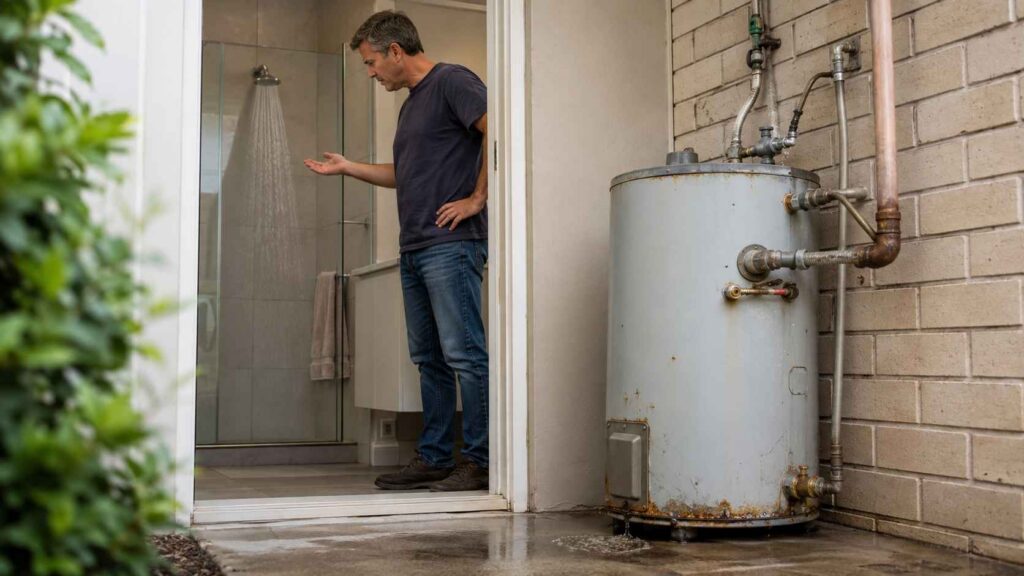
Most hot water systems don’t fail gracefully. There’s a puddle on the garage floor one morning, or the water comes through rusty, or a unit that’s been struggling for months finally stops heating altogether. By then the decision has usually made itself.
The two findings that make replacement the only real option are a tank leaking from its body and rusty or discoloured hot water. Both mean the tank is corroding from the inside, and there’s no repair for that — a new element in a rusting tank is money spent on a system that’s going to fail again shortly.
The more interesting question is what to put in its place. The right answer depends on how many people are in the house now, what energy you have connected, where the unit sits, and what you want your running costs to look like. That’s worth ten minutes of conversation rather than simply swapping like for like.
If any of these sound familiar, it’s worth booking rather than waiting.
If the unit is under about eight years old and a single component has failed, get a repair quote first. Replacement isn’t automatically the answer, and we’ll tell you when it isn’t.
Some faults are repairable and some aren’t. These are the ones that point firmly at replacement.
Not a fitting or a valve — the tank itself. There is no repair for this.
Internal corrosion. The tank is failing from the inside out.
Components failing in sequence is what an ageing system looks like.
Past the point where most storage systems start failing in earnest.
Often a sizing problem rather than a fault — and a repair won't change it.
Heavy sediment reducing capacity and efficiency, common very late in life.
Older units heat inefficiently, and the difference shows on the bill.
Discontinued models eventually reach the point where a repair isn't possible.
This is the part worth getting right. A system that suits the house next door may not suit yours.
The single biggest factor. A system sized for two people won’t keep up with four, and no amount of adjustment fixes that — it’s a capacity question.
Natural gas, LPG, electricity, or solar exposure. Not every option is available at every property, particularly in parts of the outer north west without natural gas.
Storage heats a tank and holds it; continuous flow heats on demand and never runs out but has a flow-rate limit. Which suits you depends on how the household actually uses hot water.
Where the existing unit sits, whether the space suits a different type, and access for installation. Heat pumps in particular have clearance and noise considerations.
Heat pump and solar systems cost more to install and generally less to run. How that trades off depends on your usage and how long you plan to stay.
Government incentives for efficient systems change periodically. Current availability: [confirm before publishing].
Planned replacement and emergency replacement are very different experiences.
Tell us the brand, age and symptom and we’ll advise on the options.
No guesswork and no surprise bills. Every job runs the same way, so you know what’s happening and what it costs before work begins.
Type, age, size, location and condition — and confirm whether repair is genuinely off the table.
Household size, usage patterns, energy available and where the unit can sit. This is the conversation that gets the sizing right.
Usually two or three sensible choices with the trade-offs explained: upfront cost, running cost and practical differences.
Isolated, drained and taken away for disposal — no leaving the old tank on the driveway.
To Australian Standards, including the relief valve, tempering valve and any pressure limiting valve required.
The system is filled, tested and set to a safe temperature, and we walk you through operating it and what maintenance it needs.
Straightforward, widely available, lower upfront cost.
Faster recovery where natural gas is connected.
Endless hot water, compact, no standing losses.
High efficiency, lower running costs, rebate eligible.
Roof collectors with gas or electric boosting.
Direct replacement where the current type suits.
Moving from electric to heat pump, gas or solar.
Where the household has outgrown the system.
Moving the unit as part of a renovation.
Required scald protection on new installations.
Where mains pressure would shorten the new unit's life.
Isolated, drained and taken away.
Most replacements follow a failure, but the best ones happen just before. If your system is past twelve years and still working, that’s the ideal time to plan — you get to choose properly rather than take what’s on the truck.
Hot water is an essential service under a residential tenancy, so these move quickly. We can attend, assess, and provide repair and replacement options with costs so the owner can make one decision without a second callout.
Cafes, salons, gyms and childcare have both volume requirements and, in some cases, tempering compliance obligations. Sizing matters more here than anywhere. After-hours availability: [confirm].

There’s no universally best system — there’s the one that suits your energy, your space and your household. Here’s the honest comparison.
Electric storage
Lower upfront budget, no gas connected
Cheapest to install, but generally the highest running cost of the options.
Gas storage
Natural gas connected, larger household
Faster recovery than electric, so it copes better with back-to-back showers.
Continuous flow gas
Gas connected, variable demand, limited space
Never runs out and takes up little room, though flow rate limits simultaneous use.
Heat pump
Willing to spend more upfront to cut running costs
Very efficient, often rebate eligible, but needs clearance space and makes some noise.
Solar hot water
Good roof orientation, longer-term ownership
Lowest running cost over time; higher upfront and needs a booster for poor weather.
Upsized version of what you have
Nothing wrong with the type, just the capacity
The simplest fix when the household outgrew the system rather than the system failing.
We’ll narrow it to two or three genuine options for your property rather than walking you through a catalogue.
Replacement cost has two halves: the unit itself, and what’s involved in installing it.
The largest single variable — types differ substantially in unit cost.
Swapping the same type is simplest. Changing type may need new electrical, gas or drainage work.
Ground-level garage is straightforward. Roof spaces, balconies and tight cupboards add labour.
Tempering valves, relief valves and pressure limiting valves where the installation requires them.
Included as standard — but worth knowing it's part of the job.
Efficient systems may attract incentives. Current availability: [confirm]
Commonly completed the same day where a suitable unit is available.
Longer — may involve electrical, gas or drainage changes.
Usually a same-day job where the gas supply is adequate.
Allow additional time for positioning, clearances and condensate drainage.
Scheduled work involving roof access — not same-day.
If something on site changes the picture, we tell you before we keep going — not after.
NSW plumbing licence 210933C — all work to Australian Standards.
We size on how many people live there now, not on what the old unit happened to be.
You approve the price before any work starts.
If your existing system is worth repairing instead, we'll tell you that first.
The Hills, North West, Northern Sydney and the Hawkesbury.
One team for owners, landlords, agents and businesses.
Confirm before publishing.
Confirm before publishing.
Confirm before publishing.
The Hills District, North West, Northern Sydney, the Hawkesbury and greater metro.
Written as a real conversation with the plumber — your question, our answer.
Age and the nature of the fault decide it. Under about eight years with one failed component, repair almost always wins. Over twelve with repeat faults, or any sign the tank itself is leaking or the water’s gone rusty, you’re replacing — and we’ll tell you that plainly rather than taking a repair job we know won’t last.
Often yes for a like-for-like storage swap, where a suitable unit is available. Changing to a different type usually takes longer because there may be electrical, gas or drainage work involved. Solar involves roof access and gets scheduled properly rather than squeezed in.
How many people are in the house and how you actually use hot water — back-to-back showers are the thing that catches undersized systems out. Then what energy you’ve got connected, where the unit can sit, and what clearances that spot allows. That’s what turns a catalogue into two or three real options.
Only if it still suits you. Plenty of people replace like-for-like and that’s the right call. But if the household has grown, or you’d rather cut running costs, or you’ve got gas now that you didn’t have then, it’s worth looking at the alternatives while you’ve got the chance.
It depends on your usage and how long you’re staying. They cost more upfront and considerably less to run, so the longer you’re in the house the better the trade-off looks. They also need clearance space and do make some noise, so where the unit sits matters — we’d look at that before recommending one.
A straightforward storage swap is commonly done within the day. Continuous flow is usually same-day where the gas supply is adequate. Heat pumps need extra time for positioning and condensate drainage, and solar is scheduled work involving the roof.
Find the brand, model and rough age on the plate on the side of the unit. Have a think about peak usage — how many people shower in the same hour — because that’s what drives sizing. And clear the path we’ll need to carry the old tank out; they’re heavier and more awkward than people expect.
The unit itself is the biggest part, and types differ a lot. After that it’s whether we’re swapping like-for-like or changing type, since a changeover can involve new electrical, gas or drainage work. Access matters too — a garage at ground level is a very different job from a roof space or a balcony.
Yes, but generally just to the unit. Water is isolated at the unit’s valve, and for an electric system the circuit comes off at the switchboard. For gas the supply is isolated and then tested before it goes back on. You’ll be without hot water for the duration, so it’s worth planning showers around it.
Usually yes — cold runs on a separate path, so taps, toilets and cold-water appliances keep working normally. There may be a short window where the whole supply is off while we make the final connections, and we’ll give you warning before that happens.
Yes, that’s part of the job. The old unit gets isolated, drained and removed — we don’t leave a tank sitting on your driveway for you to deal with. Disposal is included rather than an add-on.
It’s driven by peak demand rather than the number of bedrooms. The question we ask is how many people realistically shower within the same hour, plus whether you run a dishwasher or washing machine on hot at the same time. Undersizing is the most common mistake, and it’s the one you can’t fix afterwards without replacing again.
There have been various incentives for heat pump and solar systems, and the details change periodically — so we’d confirm what’s current at the time rather than promise something that’s since closed. Ask us when we quote and we’ll tell you what applies to your situation.
Hot water is an essential service under a residential tenancy, so these jobs move quickly. We can attend, assess and provide both the repair option and the replacement options with costs, so the owner or agent can make one decision without needing a second visit. Just tell us at booking who’s authorising the work.
Have the sacrificial anode checked at the manufacturer’s interval — that single thing does more for tank life than anything else. Beyond that, get the relief and tempering valves checked periodically, fit a pressure limiting valve if your mains pressure runs high, and don’t set the thermostat hotter than you need. And keep the warranty paperwork somewhere you’ll find it.
Don’t wait on a form, call now for 24/7 priority response.