

Stop guessing at what’s wrong with your drains. A camera down the line shows the exact cause, the exact location and the condition of the pipe — so you only pay to fix what’s actually broken.

If a drain keeps blocking no matter how many times it’s cleared, something structural is going on that clearing alone won’t solve. It might be roots through a joint, a cracked section of old earthenware, a belly in the line where waste sits, or simply a build-up that never gets fully removed.
A drain camera settles it. We feed a camera down the line and watch on screen — the cause, how far along it sits, and the condition of the pipe either side of it. No opening up the yard to find out, and no quoting based on assumption.
People book inspections for three main reasons: a recurring blockage they want explained, a property they’re about to buy, or a dispute about where a fault sits in a strata building. In all three, footage beats an opinion.
If any of these sound familiar, it’s worth booking rather than waiting.
If you’ve had the same drain cleared twice in a year, an inspection usually saves money rather than costing it — it turns a repeating bill into a one-off fix.
These situations are where guessing is expensive and footage is cheap.
The same drain blocking every few months means a structural cause that clearing won't fix.
Drainage is invisible in a building inspection. Older homes with mature trees are worth checking.
Knowing the exact location and depth means targeted digging instead of exploratory trenching.
Footage with distance measurements establishes whose pipework the fault is on.
Confirming why it happened, and whether the pipe was damaged in the process.
Insurers generally want evidence of the fault, not a description of it.
Tracing a suspected broken drain without opening up the ground.
Checking that building debris hasn't been left in the lines.
Most inspections come back with one of a fairly short list of causes — but which one it is changes everything about the fix.
The most common serious finding. The camera shows how far the roots extend and, crucially, where they entered — which is the part that needs repairing if you want it to stop.
Common in older earthenware. The footage shows the extent, which determines whether a point repair, relining or replacement is appropriate.
Sections that have shifted with ground movement, creating a lip that catches everything passing.
A low section where water and waste pool instead of flowing away. It causes recurring blockages that clearing never permanently solves.
Coating the pipe wall and narrowing it. Visible as a reduced diameter well before it blocks completely.
Anything from wipes to building rubble left in the line during construction.
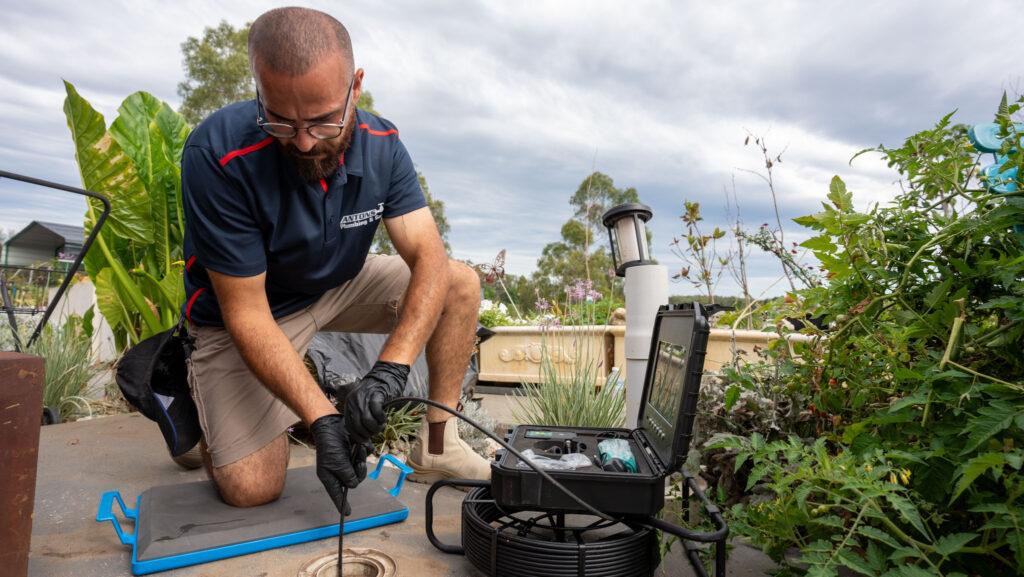
Working without footage means paying for assumptions.
An inspection tells you why, once, instead of clearing it repeatedly.
No guesswork and no surprise bills. Every job runs the same way, so you know what’s happening and what it costs before work begins.
Which fixtures, how often it blocks, the age of the property and whether there are large trees nearby.
Inspection openings, gullies or an appropriate fixture — whichever gives clean access to the affected line.
A line packed solid needs partial clearing before the camera can travel. That's explained and quoted first.
You can watch on screen with us. We record as we go, noting distances so faults can be located from the surface.
Where there's damage, the position is marked on the surface so any future excavation is targeted.
What was found, where, and what your options are — with footage and a written summary where you need one.
The main line from the house to the connection point.
Downpipes, pits and yard drainage.
Individual runs from kitchens, bathrooms and laundries.
Where a pan keeps backing up.
Shared drainage between lots.
Before you commit to a property.
Locating a fault before anything is dug.
Confirming the work actually resolved it.
Finding debris left in new lines.
Larger lines and grease-affected runs.
Evidence of a fault for a claim.
Extent, entry points and severity.
Usually a recurring blockage someone wants explained properly, or a homeowner about to spend money on a repair who wants to know it’s the right one. Older homes with mature trees are the most common candidates.
A pre-purchase inspection covers the one part of a property a building report doesn’t see. For strata, footage with distance measurements is generally what resolves the question of whether a fault sits on common property or inside a lot.
Commercial kitchens with grease-affected lines benefit from periodic inspection rather than waiting for a shutdown. We can work around trading hours where access allows. After-hours availability: [confirm].

The value of an inspection is that it converts a guess into a decision. Here’s how the common findings map to action.
Build-up only, pipe wall sound
Clearing is enough
Nothing structural — jetting and better habits will hold it.
Fine roots at a single joint
Clear, then monitor or repair that joint
Roots regrow through the same gap; the entry point decides how soon.
Crack or fracture at a located point
Point repair or relining of that section
Targeted work, no need to replace an entire run.
Multiple defects along the run
Reline or replace the run
Repairing one of several faults leaves the others waiting.
A belly or sag in the line
Section replacement to restore fall
No amount of clearing fixes a low point where waste pools.
Collapsed section
Excavation and replacement
There's no pipe left to clear or line.
You see the same footage we do, so the recommendation isn’t something you have to take on trust.
Inspections are more predictable than most drain work, but a few things still affect the price.
A single branch drain is quicker than surveying the full sewer run.
A clear inspection opening is simple. No accessible opening means more work to get the camera in.
A line packed solid must be partially cleared before a camera can travel.
A verbal explanation on site differs from a written report with footage for an insurer or strata.
Sewer and stormwater are separate systems and separate surveys.
Standard hours differ from after-hours attendance. Policy: [confirm]
Usually straightforward and completed quickly on site.
Allow around an hour depending on length and access.
Add the clearing time before the survey can begin.
Longer — more of the system is covered to be useful.
Delivered after the visit; turnaround confirmed at booking.v
If something on site changes the picture, we tell you before we keep going — not after.
NSW plumbing licence 210933C — all work to Australian Standards.
The findings aren't something you have to take on trust — you see the same screen we do.
You approve the price before any work starts.
If the footage shows clearing is all you need, that's what we'll recommend.
The Hills, North West, Northern Sydney and the Hawkesbury.
One team for owners, landlords, agents and businesses.
Confirm before publishing.
Confirm before publishing.
Confirm before publishing.
The Hills District, North West, Northern Sydney, the Hawkesbury and greater metro.
Written as a real conversation with the plumber — your question, our answer.
The clearest signal is repetition. If the same drain has been cleared twice in a year and blocked again, something structural is causing it and clearing will keep being a temporary fix. At that point an inspection usually saves you money, because it turns a recurring bill into a one-off repair.
We can, but the line usually needs partial clearing first — a camera can’t travel through a solid blockage. In practice we often clear it and then run the camera through, which also shows us the pipe condition once it’s open. We’ll explain and quote that clearing before we do it.
We start with which fixtures are affected and where the drainage runs, then find the right access point — an inspection opening, a gully, or a suitable fixture. From there the camera goes down the line and we survey it, noting the distance to anything we find so it can be located from the surface later.
Yes, and we’d encourage it — you’re welcome to watch the screen with us as it goes. It’s much easier to understand a recommendation when you’ve seen the crack or the root mass yourself. If you need a copy of the footage or a written report, tell us at booking so we set up for it.
Yes. The camera records distance travelled, so we can tell you how far along the line a fault sits and mark that position on the surface above it. That’s the difference between excavating a single targeted spot and trenching around hoping to find it.
A single branch drain is usually quick. A full sewer line survey typically takes around an hour depending on length and access. If the line needs clearing before the camera can travel, add that time on top, and a pre-purchase inspection takes longer because we cover more of the system.
Clear access to your outside inspection openings and gullies — pots, furniture and stored items often end up sitting right over them. Have a think about which fixtures are affected and how often it happens. And if you’ve had drain work done before, dig out the invoice or report; it’s genuinely useful context.
How much line we’re surveying, how easy the access is, and whether the drain needs clearing before the camera can get through. Reporting matters too — a verbal explanation on site is different from a written report with footage prepared for an insurer or a strata committee. Sewer and stormwater are separate systems, so surveying both is two jobs.
No, on both counts. That’s rather the point of a camera inspection — it looks inside the drainage without excavation, and your water supply is unaffected because we’re working on the waste side. We’ll ask you not to run water into the line while the camera’s in it.
Not into the line we’re surveying — anything you flush or drain comes straight down onto the camera. It’s usually only a short window, and we’ll tell you when we’re in and when we’re clear. Other parts of the house on a different line are generally fine.
In our view, yes, particularly for an older property with big trees near the boundary. Drainage is one of the few significant systems a standard building inspection doesn’t see, and it’s also one of the more expensive things to put right after settlement. Finding out beforehand either gives you peace of mind or gives you something to negotiate with.
It’s usually what settles it. The footage records the distance from the access point to the fault, which establishes whether the problem sits inside your lot or on common property. We provide that as evidence rather than an opinion, which is a much stronger position to take to a strata manager or committee.
Yes. Let us know at booking that it’s for a claim and we’ll record the survey and prepare a written summary of what was found and where. Insurers generally want to see the defect rather than read a description of it, so footage tends to move a claim along considerably faster.
Usually, and that’s the best time to find them. Early root intrusion shows up as fine strands through a joint long before it becomes a mat that blocks the line. Catching it at that stage means a straightforward clear and a decision about sealing the entry point, rather than an emergency and a possible excavation.
It depends what we find, and that’s the value of doing it. If it’s build-up, it’s mostly habits — grease in the bin, strainers on the wastes, only toilet paper down the loo. If it’s roots or a cracked joint, the real prevention is repairing the entry point, and then a follow-up inspection every year or two to make sure it’s stayed sealed.
Don’t wait on a form, call now for 24/7 priority response.