


Blocked drains are a frustration every Sydney homeowner knows too well. Hair and soap scum slowly build up inside pipes, creating stubborn clogs that slow water flow and create unpleasant odours. While many homeowners reach for chemical drain cleaners, there are safer, more effective methods to dissolve these blockages without damaging your plumbing. Understanding how to dissolve hair and soap scum in pipes can save you time, money, and the hassle of a complete drain failure.
This guide walks you through five practical, tested techniques to break down hair and soap buildup using everyday household items. You’ll also learn when DIY methods reach their limit and when it’s time to call in professional help from a licensed Sydney plumber — Antons Plumbing & Gas, NSW Lic. 210933C.
Key Takeaways
- Boiling water and dish soap can melt soap scum and loosen hair clogs quickly.
- Baking soda and vinegar create a fizzing reaction that breaks down organic buildup.
- Hot water flushes help prevent future blockages when used regularly.
- DIY methods work best on minor clogs, not severe or recurring blockages.
- Professional CCTV drain inspection identifies root causes that home remedies can’t fix.
Understanding Why Hair and Soap Scum Clog Your Pipes

Hair and soap scum combine to create one of the most common drain blockages in Sydney homes. Hair naturally sheds during showers and washing, collecting in the drain trap and pipe bends. Soap scum forms when soap mixes with hard water minerals, creating a sticky residue that clings to pipe walls. Over time, this residue traps more hair, grease, and debris, narrowing the pipe diameter and slowing water flow.
The combination is particularly troublesome in bathroom drains. Soap scum acts like glue, binding hair strands together into dense clumps that water alone cannot dislodge. Left untreated, these clogs grow larger and can completely block your pipes.
Many Sydney properties, especially older homes in the Inner West and Eastern Suburbs, have older piping that makes buildup worse. Corroded or rough interior surfaces provide more places for soap scum to attach. Understanding this process helps you choose the right cleaning method, prevent future blockages, and know when a licensed plumber (or Sydney Water) needs to get involved.
Five Proven Tips on How to Dissolve Hair and Soap Scum in Pipes
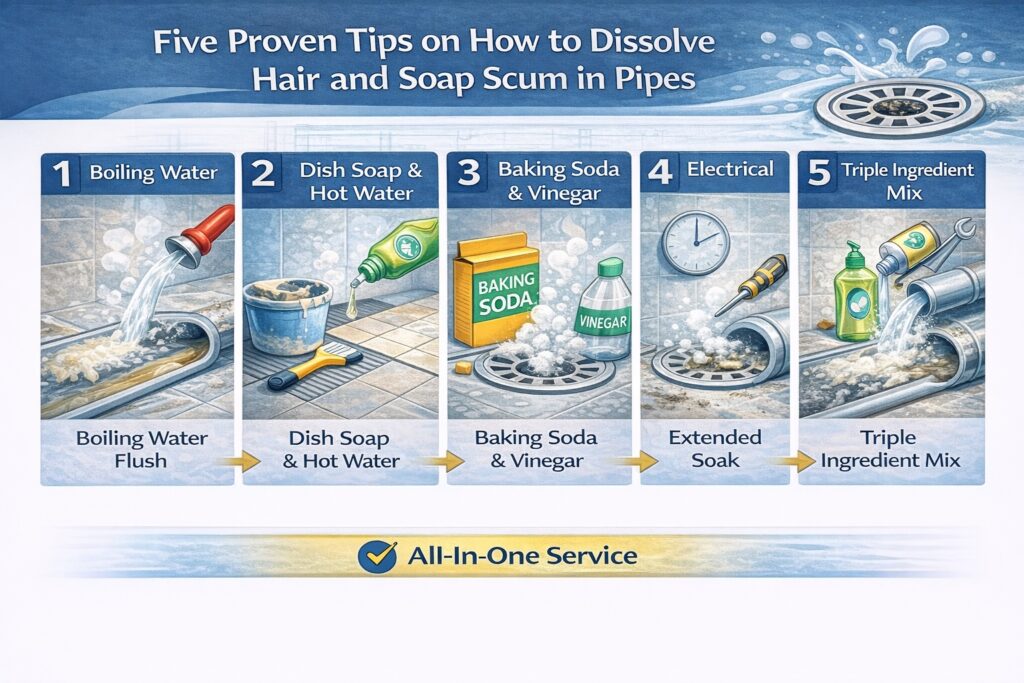
These methods use common household products to break down hair and soap buildup safely. Each technique targets different aspects of the clog, from dissolving soap scum to loosening tangled hair strands. You can try these in order, starting with the simplest approach and moving to stronger methods if needed.
1. Boiling Water Flush
Boiling water is the simplest first step to dissolve soap scum and soften hair clogs. Heat melts the fatty acids in soap scum, allowing it to wash away and release trapped hair. Pour a full kettle of boiling water directly down the drain in a steady stream, not all at once. Wait five minutes, then run hot tap water for two minutes to flush loosened debris.
This method works best on fresh clogs or as regular maintenance. It’s safe for metal pipes but avoid using boiling water on PVC pipes, which can soften or warp under extreme heat. If you’re unsure about your pipe material, use very hot tap water instead.
2. Dish Soap and Hot Water Combination
Dish soap cuts through grease and soap scum buildup effectively. Squirt a generous amount of liquid dish soap into the drain, then slowly pour boiling water down the pipe. The soap acts as a lubricant, helping hair and debris slide through the pipe while breaking down oily residue. Follow with a cold water flush to solidify any remaining grease so it can be washed away.
This technique is particularly useful for kitchen sinks where grease contributes to clogs. For bathroom drains, the soap helps dissolve soap scum while the hot water loosens hair. Repeat the process if water drains slowly after the first attempt.
3. Baking Soda and Vinegar Reaction
The baking soda and vinegar method creates a fizzing chemical reaction that breaks down organic material. Pour half a cup of baking soda directly into the drain, followed by one cup of white vinegar. Cover the drain opening with a plug or wet cloth to contain the fizzing action inside the pipe. Let the mixture sit for 15 to 20 minutes, then flush with boiling water.
This reaction helps dislodge hair clumps and dissolve soap scum without harsh chemicals. The fizzing action creates pressure that can push debris through the pipe. For stubborn clogs, let the mixture sit for up to an hour before flushing. You can repeat this process weekly as preventive maintenance.
4. Extended Baking Soda and Vinegar Soak
For more stubborn blockages, use a stronger version of the baking soda and vinegar method. Pour a full cup of baking soda into the drain, followed by one to two cups of vinegar. Immediately cover the drain to trap the reaction inside the pipe. Leave the mixture overnight or for at least eight hours before flushing with hot water.
The extended contact time allows the solution to penetrate deeper into the clog and break down compacted hair and soap buildup. This method is safe for most pipe types and won’t damage your plumbing. If water still drains slowly after this treatment, the blockage may be too severe for home remedies.
5. Dish Soap, Vinegar, and Baking Soda Triple Action
Combine all three ingredients for maximum dissolving power. Start by pouring dish soap down the drain, then add one cup of vinegar and half to one cup of baking soda. The dish soap breaks down grease and soap scum, while the vinegar and baking soda create fizzing action to loosen hair. Let the mixture work for five to ten minutes, then flush with boiling water.
This combination tackles multiple clog components at once. The soap provides lubrication, the acid in vinegar dissolves mineral deposits and soap scum, and the baking soda scrubs pipe walls. Finish with a hot water rinse to carry all loosened debris out of the pipe.
Comparing DIY and Professional Drain Cleaning

DIY drain cleaning can work well for light buildup when you catch the problem early. The key is matching the method to the clog type, because some blockages — like compacted hair, deep obstructions, or recurring backups — won’t respond to household remedies. This comparison shows what each option is best for, where it falls short, and when professional help delivers the safest long-term fix.
| Method | Best For | Limitations | Cost |
|---|---|---|---|
| Boiling Water | Minor soap scum buildup | Won’t clear hair clogs or deep blockages | Free |
| Baking Soda & Vinegar | Light to moderate clogs | Limited effectiveness on compacted hair | Under $5 |
| Dish Soap & Hot Water | Grease and soap scum | Doesn’t remove solid obstructions | Under $5 |
| Chemical Drain Cleaners | Not recommended | Can damage pipes, ineffective on hair | $10–$20 |
| Professional Water Jetting | Severe clogs, recurring blockages | Requires licensed plumber | Fixed rate, varies by job |
| CCTV Inspection | Diagnosing root cause | Requires professional equipment | Fixed rate, varies by job |
Start with the gentlest DIY methods when drainage is only slightly slow and there’s no sign of deeper issues. If the clog returns quickly, affects multiple fixtures, or doesn’t improve after a couple of safe attempts, a CCTV inspection and professional jetting usually solve it properly. Choosing the right approach early helps you avoid pipe damage, wasted effort, and emergency callouts later.
Preventing Hair and Soap Scum Buildup

Prevention is always easier than dealing with a blocked drain. Installing a hair catcher or drain screen in your shower and bathroom sinks traps hair before it enters the pipe. Empty these screens regularly to maintain water flow. Simple mesh screens cost just a few dollars and can save you from major clogs down the line.
Flushing your drains weekly with hot water helps dissolve soap scum before it hardens. Run hot tap water for two to three minutes after every shower or bath. This simple habit keeps pipes clear and prevents gradual buildup. You can also use the baking soda and vinegar method monthly as preventive maintenance, even when drains are flowing normally.
Be mindful of what goes down your drains. Avoid washing hair clippings down the sink after haircuts, and never flush wipes or cotton products down the toilet, even if the packet says they’re flushable. These items don’t break down like toilet paper and can combine with soap scum to create severe blockages that may also breach Sydney Water’s trade waste guidelines for what can enter the sewer system.
When DIY Methods Stop Working

Home remedies work well for minor clogs caused by recent hair and soap buildup. They’re less effective when blockages are severe, deep in the pipe system, or caused by other issues like tree roots or collapsed pipes. If water backs up completely, drains slowly after multiple treatments, or you notice foul odours that don’t improve, it’s time to call a professional.
Recurring clogs in the same drain often signal a deeper problem. The blockage may be located beyond your drain trap, in the main sewer line, or caused by pipe damage. Pouring more chemicals or repeating home remedies won’t solve structural issues and can sometimes make problems worse by pushing debris deeper into the system.
It’s also worth knowing where responsibility for a blockage sits under NSW rules. Sydney Water generally manages and maintains the main sewer line, while everything from your fixtures back to the boundary trap on your property is your responsibility as the homeowner. Any plumbing work connected to the water supply or sewer system in NSW must be carried out by a licensed plumber in line with NSW Fair Trading licensing requirements — it isn’t a job for guesswork or an unlicensed handyman. If you’re unsure whether a blockage sits on your side of the boundary trap or further down the line, our licensed team (NSW Lic. 210933C) can inspect and advise.
Our team at Antons Plumbing & Gas uses CCTV drain inspection to pinpoint the exact location and cause of persistent blockages. A camera inserted into your pipe provides a live video feed, showing whether the problem is hair buildup, tree root intrusion, pipe corrosion, or something else entirely. This diagnosis helps us recommend the right solution, whether that’s high-pressure water jetting, pipe relining, or drain repair.
When to Call Antons Plumbing & Gas

Knowing when to stop trying DIY fixes and call a professional can save you from bigger problems and higher repair costs. If you’ve tried multiple home remedies and water still drains slowly, the blockage is likely too severe or too deep for household methods. Repeated clogs in the same drain suggest an underlying issue that needs professional diagnosis.
Emergency situations require immediate professional help. If water backs up into multiple drains, you notice sewage odours, or water floods from your drains, call us right away at 0493 824 176. As a fully licensed and insured Sydney plumbing business (NSW Lic. 210933C), we offer 24/7 emergency service across Sydney with same-day response and no call-out fee. Our team arrives equipped to diagnose and fix the problem quickly, preventing water damage to your home.
We serve all Sydney regions, including the Inner West, Eastern Suburbs, North Shore, Northern Beaches, Hills District, and Western Sydney. Every job is completed to Australian Standards (AS/NZS 3500) and NSW Fair Trading licensing requirements, with upfront, fixed-rate pricing in AUD. Our work is backed by a lifetime labour warranty, giving you confidence that repairs will last. Whether you need a simple drain cleaning or complex pipe relining, we diagnose the root cause and present clear options tailored to your situation and budget.
Conclusion
Learning how to dissolve hair and soap scum in pipes with simple household methods can keep your drains flowing and prevent minor clogs from becoming major problems. When home remedies reach their limit, our licensed team (NSW Lic. 210933C) is ready to provide professional drain cleaning, CCTV inspection, and long-term pipe solutions across Sydney. Call 0493 824 176 anytime for same-day service, fixed-rate pricing in AUD, and work that’s done right the first time.
Antons Plumbing & Gas offers expert blocked drain solutions backed by 25 years of experience. Our licensed team uses CCTV inspections and proven techniques to clear stubborn blockages. Call 0493 824 176 to get started today.
Related Articles
- 5 Proven Tips for Your DIY Clogged Shower Drain Fix
- Top 5 Reasons Your Shower Drain Stopped Up and How to Fix It
- What You Need to Know: Will Vinegar Dissolve Toilet Paper?
FAQs
What Is The Best Way To Dissolve Hair Buildup In Pipes?
The best way to deal with hair buildup is usually to remove as much of the hair as possible with a drain tool or plumber’s snake rather than relying only on liquids. Hot water may help loosen light residue, but thick hair clumps often need to be pulled out or cleared mechanically. If the drain keeps slowing down, Antons Plumbing & Gas can clear the pipe properly and check whether soap scum or deeper buildup is also causing the blockage.
How Do I Remove Soap Scum From Bathroom Plumbing?
Soap scum can often be reduced by flushing the drain with warm water and using baking soda and vinegar for light buildup. However, once soap scum mixes with hair, oils, and grime, it can stick to the inside of the pipe and become harder to clear. A plumber can remove the buildup safely if the drain smells bad, drains slowly, or keeps blocking.
Can Vinegar And Baking Soda Really Dissolve Hair And Soap Scum?
Vinegar and baking soda may help loosen minor soap scum and freshen the drain, but they usually will not fully dissolve a thick hair clog. Hair often needs to be physically removed because it can wrap together and trap other debris inside the pipe. If the blockage does not improve after a simple clean, Antons Plumbing & Gas can inspect and clear the drain with the right equipment.
What Chemicals Can Dissolve Hair And Soap Scum In Drains Safely?
Some chemical drain cleaners claim to dissolve hair and soap scum, but they can be harsh on pipes, fittings, and seals if used too often or left sitting in a blocked drain. They can also create safety risks if they splash back or mix with other products. For stubborn or recurring clogs, mechanical drain clearing is usually the safer long-term option.
How Often Should I Clean Hair And Soap Scum From Bathroom Pipes?
It is a good idea to clean visible hair from drain covers weekly and flush bathroom drains with warm water regularly to reduce soap scum buildup. Monthly light maintenance may help, especially in showers and bathroom sinks used every day. If drains keep slowing down even with regular cleaning, Antons Plumbing & Gas can check for deeper buildup, poor drainage flow, or a larger plumbing issue.
How Much Does Professional Drain Cleaning Cost In Sydney?
Costs depend on the severity of the blockage, the equipment required, and access to the pipe, so we don’t quote a flat figure without seeing the job. What we can promise is a fixed-rate, upfront price in AUD before any work begins — no surprise call-out fees or hidden charges. Call 0493 824 176 for an obligation-free quote for your Sydney property.
Do You Charge A Call-Out Fee For Blocked Drains In Sydney?
No. Antons Plumbing & Gas doesn’t charge a call-out fee, even for after-hours or emergency jobs across Sydney. You’ll get a fixed-rate quote in AUD before we start, so you know exactly what you’re paying.
Is Antons Plumbing & Gas Licensed To Work On Sydney Water Connections?
Yes. We operate under NSW Lic. 210933C and comply with NSW Fair Trading licensing requirements and Australian Standard AS/NZS 3500 on every job, including work that connects to Sydney Water infrastructure. Always check that any plumber you hire in NSW holds a current licence before letting them touch your water or sewer connections.
How Quickly Can A Plumber Come To My Sydney Home For A Blocked Drain?
We offer same-day response for blocked drains across Sydney, including the Inner West, Eastern Suburbs, North Shore, Northern Beaches, Hills District, and Western Sydney. Call 0493 824 176 and we’ll arrange the earliest available appointment.
Do You Offer Emergency Plumbing Services Outside Business Hours?
Yes, we run a 24/7 emergency service for urgent issues like sewage backups, flooding, or complete blockages. If you’re dealing with an overflow or bad odours late at night, don’t wait — call 0493 824 176 straight away.
Which Sydney Suburbs Do You Service For Blocked Drains?
We service properties across greater Sydney, including the Inner West, Eastern Suburbs, North Shore, Northern Beaches, Hills District, Western Sydney, Carlingford, and Ryde. If you’re unsure whether we cover your suburb, give us a call on 0493 824 176 and we’ll confirm straight away.
Will You Use A CCTV Camera To Inspect My Blocked Drain?
Yes, where appropriate we use CCTV drain inspection to see exactly what’s causing a blockage — whether that’s hair and soap scum buildup, tree root intrusion, or pipe damage. This lets us recommend the right fix the first time instead of guessing, saving you money on repeat callouts.
Is A Warranty Included With Your Drain Cleaning Services?
Yes, our work is backed by a lifetime labour warranty, so you can be confident the fix will last. Ask our team for the details relevant to your specific job when you book.
Do I Need Council Or Sydney Water Approval To Fix A Blocked Drain Myself?
Minor DIY maintenance like flushing hot water or using vinegar and baking soda on your own fixtures generally doesn’t require approval. However, any work on pipework connected to the water supply or sewer system must be carried out by a licensed plumber under NSW law, and blockages beyond your boundary trap may fall under Sydney Water’s responsibility rather than yours. Our licensed team (NSW Lic. 210933C) can identify where the fault lies and handle any compliant repairs required.
Can DIY Chemical Drain Cleaners Damage My Pipes?
Repeated or prolonged use of harsh chemical drain cleaners can damage seals, fittings, and older pipework, particularly in established Sydney homes. If a chemical cleaner hasn’t worked after one careful attempt, avoid repeated dosing and call a licensed plumber instead of risking further damage.
What Happens During A Professional Water Jetting Service?
High-pressure water jetting uses a controlled jet of water to clear compacted hair, soap scum, grease, and other stubborn debris from inside the pipe walls, restoring full flow without the harsh chemicals of a DIY drain cleaner. It’s typically used once a CCTV inspection has confirmed the blockage type and location.
How Do I Book A Plumber For A Blocked Drain In Sydney?
Booking is simple — call us on 0493 824 176 or use our online booking page to arrange a same-day appointment. Let us know your suburb and a brief description of the issue, and we’ll confirm a time and a fixed-rate quote before we arrive.
Do You Provide Fixed-Rate Pricing Before Starting Work?
Yes, we always provide an upfront, fixed-rate price in AUD before starting any job, so there are no surprises on your invoice. This applies to standard drain cleaning as well as CCTV inspections and water jetting.
What Should I Do If Sewage Smell Keeps Coming Back After DIY Cleaning?
A persistent sewage smell that returns after DIY cleaning often points to a blockage further down the line, a venting issue, or a problem beyond your property’s boundary trap. Don’t keep pouring more chemicals down the drain — call Antons Plumbing & Gas on 0493 824 176 so we can inspect with a CCTV camera and fix the actual cause.
Are Your Plumbers Fully Licensed And Insured For Plumbing And Gas Work In NSW?
Yes, Antons Plumbing & Gas operates under NSW Lic. 210933C and our team is fully licensed and insured for plumbing and gas work across Sydney. Always confirm a tradesperson’s licence before engaging them for work connected to your water, sewer, or gas system in NSW.