


When your drain blocks or your toilet backs up, the real problem is often hidden deep inside your pipes. Guessing the cause can lead to wasted time, unnecessary digging, and repairs that miss the mark. That’s where CCTV drain inspection technology comes in—a small waterproof camera that travels through your plumbing to show exactly what’s wrong, where it’s wrong, and how to fix it.
In this guide, you’ll learn what CCTV drain inspections are, how the technology works, and why our team at Antons Plumbing & Gas recommends it for accurate, non-invasive diagnosis of drainage issues across Sydney and greater NSW.
Key Takeaways
- CCTV drain inspection uses a high-resolution camera to identify blockages, cracks, tree roots, and pipe damage without digging up your yard.
- The technology provides real-time video footage, helping plumbers diagnose root causes quickly and recommend targeted repairs.
- CCTV inspections reduce property disruption, save money on unnecessary excavation, and support long-term plumbing solutions like pipe relining.
- Our licensed team uses professional-grade CCTV equipment to deliver clear reports, upfront quotes in AUD, and compliant repairs across the Sydney Metro.
- For anything beyond a simple look, it’s essential to book a fully licensed Sydney plumber (NSW Lic. 210933C) rather than attempt DIY diagnosis on your sewer or stormwater lines.
What Is CCTV Drain Inspection?

CCTV stands for Closed-Circuit Television, a technology originally developed for security and surveillance. In plumbing, CCTV refers to a specialised waterproof camera mounted on a flexible rod or crawler that feeds through your drains, sewer lines, or stormwater pipes. The camera transmits live video to a monitor above ground, allowing our plumbers to see inside your pipes in real time—without breaking concrete, digging trenches, or removing fixtures.
The camera head is small enough to navigate bends and junctions, and it’s equipped with high-intensity LED lights to illuminate dark pipe interiors. Most systems record the footage and timestamp each frame with distance markers, so we can pinpoint the exact location of a blockage, crack, or root intrusion. Think of it as an X-ray for your drainage system—precise, non-invasive, and designed to reveal what’s really going on beneath your Sydney property.
While consumer-grade security cameras are built for home monitoring above ground, CCTV drain cameras are purpose-built for harsh underground conditions. They’re waterproof, impact-resistant, and calibrated to capture detail in low-light, wet environments where standard cameras would fail.
How Does CCTV Drain Inspection Technology Work?
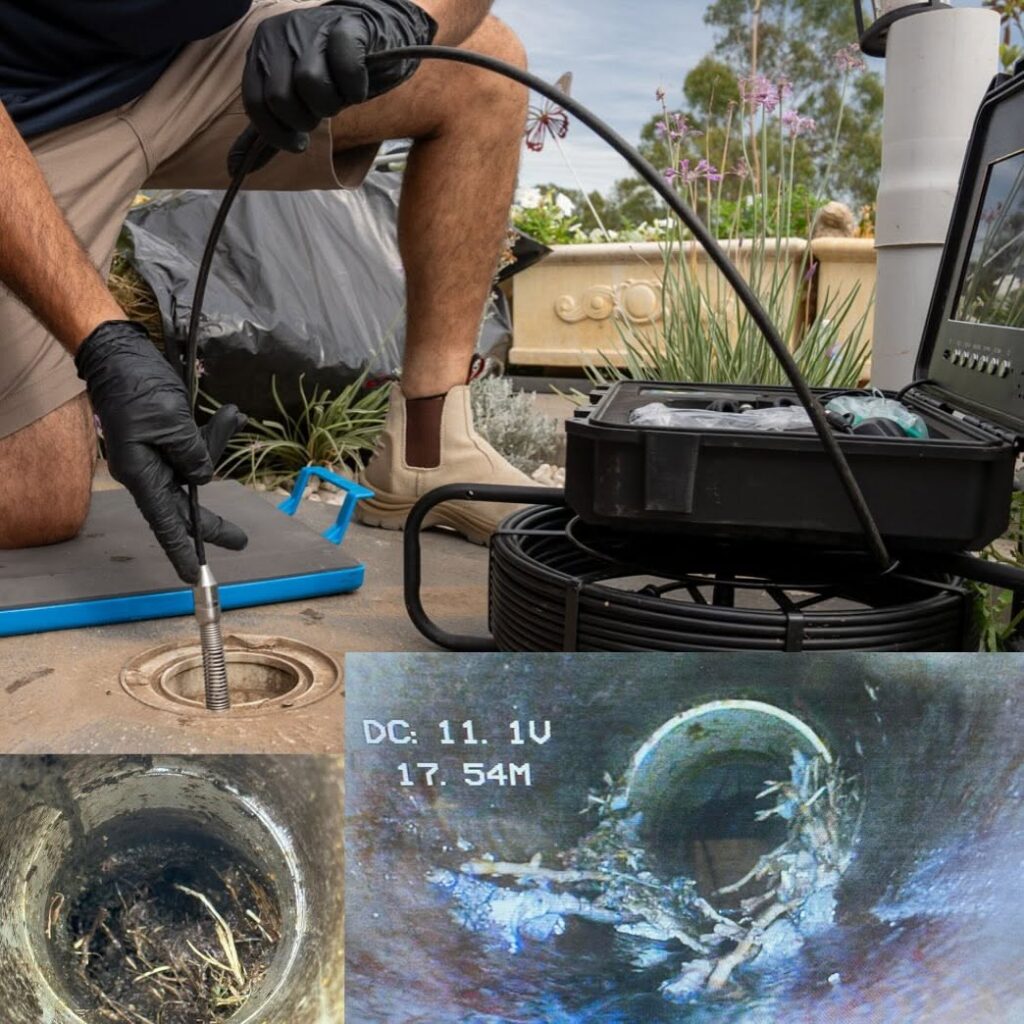
The process begins when one of our licensed plumbers inserts the camera head into an access point—usually an inspection opening, cleanout, or the drain itself. The camera is attached to a semi-rigid push rod or a motorised crawler unit, depending on the pipe diameter and length. As the camera advances, it sends a live video feed to a portable monitor or tablet, which our technician watches in real time.
The camera lens is surrounded by bright LED lights, illuminating the pipe walls and revealing debris, cracks, corrosion, tree roots, collapsed sections, or foreign objects. Modern CCTV systems also include a sonar transmitter that emits a locating signal, allowing us to trace the camera’s position from above ground using a handheld receiver. This means we can mark the exact spot on your driveway, garden, or floor slab where the fault is located—no guesswork, no trial-and-error digging.
Once the inspection is complete, we review the footage with you, explain what we found, and provide a written report with still images, video clips, and GPS coordinates if needed. This documentation is especially valuable for strata managers, real estate transactions, insurance claims, and pre-purchase building inspections here in NSW.
Common Issues CCTV Drain Inspections Reveal
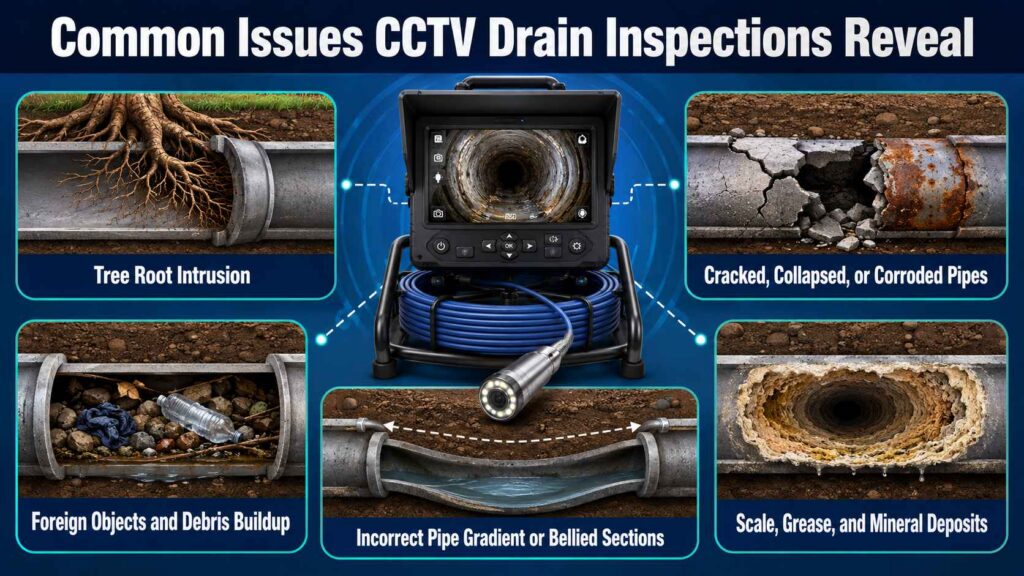
Over 25 years of plumbing across Sydney, we’ve used CCTV to diagnose thousands of drainage faults. Some are straightforward. Others are hidden deep underground, invisible to the naked eye until the camera reveals them.
Here are the most common culprits our CCTV inspections uncover.
Tree Root Intrusion
Tree roots seek out moisture and nutrients, and your sewer line is an ideal target. Roots enter through tiny cracks or joints, then expand inside the pipe, creating a dense blockage that traps debris and causes recurring backups—a common issue on older, leafy Sydney blocks. CCTV shows us the size, location, and severity of the root mass, so we can choose between high-pressure jetting, mechanical cutting, or pipe relining to restore flow and prevent regrowth.
Cracked, Collapsed, or Corroded Pipes
Clay pipes, common in older Sydney homes, can crack under ground movement, tree pressure, or age. Metal pipes corrode from the inside out. CCTV reveals hairline fractures, offset joints, and full collapses that would otherwise go unnoticed until sewage leaks into your yard or foundation. Once we’ve mapped the damage, we can recommend targeted relining or replacement in line with AS/NZS 3500.
Foreign Objects and Debris Buildup
Toys, sanitary products, wet wipes, and construction debris can lodge in bends and junctions, creating partial or total blockages. CCTV lets us see exactly what’s stuck and where, so we can retrieve it with the right tool—whether that’s a drain snake, jetter, or manual extraction—without damaging your pipes.
Incorrect Pipe Gradient or Bellied Sections
Drainage pipes rely on gravity and a consistent fall (typically 1:60 to 1:100) to move wastewater. If a section has settled, sagged, or been installed incorrectly, water and solids pool in a low spot called a belly. Over time, this creates a permanent blockage. CCTV inspection reveals the gradient issue, and we can plan a dig-and-relay or relining solution to restore proper flow.
Scale, Grease, and Mineral Deposits
Hard water, soap scum, cooking grease, and mineral buildup can coat the inside of your pipes, narrowing the diameter and slowing drainage. CCTV shows the thickness and location of the deposits, helping us decide whether high-pressure water jetting or chemical treatment is the best approach.
Why Antons Plumbing & Gas Recommends CCTV for Sydney Properties

We’ve been serving Sydney homeowners, strata managers, and commercial clients for over 25 years, and CCTV drain inspection has become one of our most requested services. It’s not just about finding the problem—it’s about giving you confidence in the solution.
Our CCTV equipment is professional-grade, regularly calibrated, and operated by licensed plumbers who understand Sydney’s unique drainage challenges. From heritage clay pipes in the Inner West to modern PVC systems in the Hills District, we’ve seen it all. Every inspection is documented, every fault is explained in plain English, and every quote is upfront and fixed in AUD—no surprises, no hidden fees.
We also integrate CCTV with our other diagnostic tools—acoustic leak detection, smoke testing, and dye tracing—to give you a complete picture of your plumbing health. If we recommend pipe relining, hot water system replacement, or backflow testing, it’s because the camera showed us the evidence. You get to see the same footage we do, and you make the final call on how to proceed.
Sydney Water and NSW Compliance
In NSW, responsibility for drainage is split: Sydney Water generally owns and maintains the sewer main up to your property’s boundary trap, while everything from the boundary trap into your house—including internal drains, gully traps, and stormwater connections—is your responsibility as the owner. CCTV inspection helps establish exactly where a fault sits, which matters if you need to lodge a claim with Sydney Water or clarify who pays for the repair.
Any plumbing or drainage work carried out on your property must comply with the Plumbing and Drainage Act 2011 (NSW), AS/NZS 3500, and be carried out by a plumber licensed with NSW Fair Trading. Antons Plumbing & Gas operates under NSW Lic. 210933C, and our CCTV reports are formatted to be accepted by Sydney Water, strata committees, and insurers where required.
When Should You Book a CCTV Drain Inspection?
You don’t need to wait for a full blockage to benefit from CCTV. Here are the scenarios where we recommend scheduling an inspection.
- Recurring blockages: If your drains keep blocking despite regular clearing, there’s likely a structural issue or root intrusion that needs addressing.
- Slow drainage: Persistent slow flow in sinks, showers, or toilets can indicate a partial blockage, gradient problem, or buildup inside the pipe.
- Foul odours: Sewer smells in your yard or bathroom may signal a cracked pipe, broken seal, or venting issue that CCTV can pinpoint.
- Pre-purchase building inspections: Before buying a property, a CCTV drain inspection reveals the condition of underground plumbing and helps you avoid costly surprises after settlement.
- Strata and commercial compliance: Regular CCTV inspections support preventative maintenance schedules, trade waste compliance, and backflow prevention requirements under NSW regulations.
- Post-renovation or construction: After major works, CCTV confirms that new drains were installed correctly and that no debris or damage occurred during the build.
DIY Check vs Calling a Licensed Sydney Plumber
| Situation | What you can check yourself | When to call a licensed Sydney plumber |
|---|---|---|
| Slow-draining sink | Clear visible hair/debris from the grate | If it recurs after clearing, or affects multiple fixtures |
| Bad smell from a gully trap | Check the trap has water in it | If smell persists—may indicate a cracked pipe or venting fault |
| Buying a property | Ask the vendor for any past plumbing reports | Book an independent CCTV drain inspection before settlement |
| Recurring sewer backups | Avoid pouring grease or wipes down drains | Book CCTV immediately—likely root intrusion or collapse (NSW Lic. 210933C required for any repair) |
How CCTV Inspections Support Long-Term Plumbing Solutions

CCTV isn’t just a diagnostic tool—it’s the foundation for smarter, more durable repairs. When we know the exact condition of your pipes, we can recommend solutions that last. Pipe relining, for example, is a trenchless technology that inserts a resin-lined sleeve inside your damaged pipe, creating a new, seamless inner wall without digging up your garden. But relining only works if the pipe structure is still sound enough to support the liner—and CCTV tells us whether that’s the case.
Similarly, if we’re planning a hot water system upgrade or bathroom renovation, a CCTV inspection of your waste lines ensures we’re not building on top of a failing drainage system. It’s about doing the job right the first time, with full transparency and no shortcuts.
Our team operates under NSW Fair Trading licensing (Lic: 210933C) and follows Australian Standards for plumbing and drainage (AS/NZS 3500). Every CCTV report we issue is compliance-ready, and every repair we recommend is backed by our lifetime labour warranty. We don’t just fix symptoms—we solve root causes, so you can enjoy long-term peace of mind.
Serving Sydney Metro: Where We Bring CCTV Expertise

We’re proud to serve the entire Sydney region, from the Inner West and Eastern Suburbs to the North Shore, Northern Beaches, Hills District, Western Sydney, South-Western Sydney, and the Sutherland Shire. Whether you’re managing a heritage terrace in Balmain, a modern townhouse in Ryde, a café in Bondi, or a strata block in Parramatta, our CCTV-equipped vans are ready to respond.
Same-day service is our standard, and 24/7 emergency support means you’re never left waiting when a drain backs up or a pipe bursts. Call us on +61 4 9382 4176 or book online, and we’ll get a licensed Sydney plumber (NSW Lic. 210933C) to your door—fast, clean, and ready to solve the problem at its source.
Conclusion
CCTV drain inspection is the clearest, fastest, and most reliable way to diagnose hidden plumbing faults. It saves you time, money, and the hassle of unnecessary digging—while giving you confidence that the repair will actually fix the problem. When you choose Antons Plumbing & Gas, you’re choosing precision, transparency, and workmanship backed by 25 years of Sydney experience, an upfront fixed quote in AUD, and a lifetime labour warranty.
Antons Plumbing & Gas offers expert CCTV drain inspections to pinpoint blockages and pipe damage fast. Our licensed team (NSW Lic. 210933C) serves all of Sydney with same-day availability. Learn more today.
Call now for a fast plumbing fix on +61 4 9382 4176.
Related Articles
- Simple Steps for Homeowners on How to Unclog Shower Drains Fast
- Help! I Have a High Water Bill—What Should I Do?
FAQs
What Does CCTV Stand For?
CCTV stands for Closed-Circuit Television. It refers to a system of cameras and monitors used to transmit video footage to a specific set of monitors, primarily for surveillance and monitoring purposes.
How Does CCTV Work?
CCTV systems consist of cameras that capture video footage, which is then transmitted to monitors or video recorders. The footage can be viewed in real-time or recorded for later analysis, making it an effective tool for detecting leaks or blockages in plumbing systems.
What Are The Benefits Of CCTV?
The benefits of CCTV include enhanced security, real-time monitoring, and the ability to investigate issues without intrusive methods. In plumbing, CCTV inspections help identify problems such as blockages or pipe damage, allowing for more precise and efficient repairs.
What Is The Difference Between CCTV And Security Cameras?
CCTV is a specific type of security camera system designed for surveillance and monitoring, often connected to a closed network. In contrast, security cameras may refer to any camera used for security purposes, including those that are publicly accessible or connected to the internet.
Is CCTV Legal?
Yes, CCTV is legal in most places, including Australia, as long as it is used in compliance with privacy laws and regulations. At Antons Plumbing & Gas, we ensure that our CCTV drain inspections are conducted ethically and with respect to your privacy.
How Much Does A CCTV Drain Inspection Cost In Sydney?
Cost depends on factors like pipe length, number of access points, and site complexity. We always provide an upfront, fixed quote in AUD before any work begins, so there are no surprises. Call us for an obligation-free quote for your Sydney property.
How Long Does A CCTV Drain Inspection Take?
Most residential inspections take around one to two hours, depending on the length and condition of your drainage system. We’ll give you a time estimate when you book.
Do You Offer Same-Day CCTV Drain Inspections In Sydney?
Yes. Same-day service is our standard across the Sydney Metro area, and we also offer 24/7 emergency callouts for urgent blockages and backups.
Is A CCTV Drain Inspection Compulsory Before Selling A Property In NSW?
It’s not legally compulsory, but it’s strongly recommended as part of a pre-purchase or pre-sale building inspection to avoid disputes over hidden drainage faults after settlement.
Do I Need A Licensed Plumber To Carry Out A CCTV Drain Inspection?
Any diagnostic work that may lead to repairs on your sewer, stormwater, or gas lines should be carried out by a plumber licensed with NSW Fair Trading. Antons Plumbing & Gas holds NSW Lic. 210933C.
What Suburbs Does Antons Plumbing & Gas Service For CCTV Drain Inspections?
We service the entire Sydney Metro, including the Inner West, Eastern Suburbs, North Shore, Northern Beaches, Hills District, Western Sydney, South-Western Sydney, and the Sutherland Shire.
Can You Fix The Problem On The Same Visit As The CCTV Inspection?
In many cases, yes—if the fault is a straightforward blockage, our plumber can jet, cut roots, or clear debris on the spot. Larger repairs like relining or pipe replacement are quoted separately and scheduled at your convenience.
Will My CCTV Inspection Report Be Accepted By Sydney Water Or My Strata Manager?
Yes. We provide a documented report with footage, images, and location data that is formatted to be accepted by Sydney Water, strata committees, insurers, and conveyancers.
Do You Provide 24/7 Emergency CCTV Drain Inspections?
Yes, our licensed plumbers are available around the clock for urgent drainage issues anywhere across Sydney.
How Do I Book A CCTV Drain Inspection With Antons Plumbing & Gas?
You can call us directly on +61 4 9382 4176 or book online, and we’ll arrange a licensed plumber to attend your property, often the same day.
What’s The Difference Between A Sydney Water Sewer Main Issue And A Private Drain Issue?
Sydney Water is generally responsible for the sewer main up to your property’s boundary trap. Everything from the boundary trap into your home is your responsibility. A CCTV inspection helps identify exactly where a fault sits, so you know who to contact.
Do You Provide Obligation-Free Quotes For CCTV Inspection And Repair Work?
Yes, every quote we provide is upfront, fixed, and given in AUD before we start any work—no hidden fees.
How Often Should I Get My Drains Inspected With CCTV In Sydney?
This depends on your property’s age, tree coverage, and plumbing history. Older homes with clay pipes or established trees nearby generally benefit from more frequent checks—ask our team for a maintenance recommendation specific to your property.
Can CCTV Drain Inspections Identify Stormwater Problems As Well As Sewer Issues?
Yes. Our CCTV equipment can inspect both sewer and stormwater lines, identifying blockages, cracks, or incorrect connections in either system.
Is There A Warranty On Repairs Recommended After A CCTV Inspection?
Yes, all repair work we carry out following a CCTV inspection is backed by our lifetime labour warranty for extra peace of mind.
What Should I Do Right Now If I Suspect A Blocked Or Damaged Drain?
Call Antons Plumbing & Gas on +61 4 9382 4176 or book online. Our licensed Sydney plumbers (NSW Lic. 210933C) can arrange a CCTV drain inspection, often the same day, to diagnose the issue and give you an upfront fixed quote for the fix.