

A drain plunger can clear many minor blockages when used correctly, but the wrong technique can make the clog worse or damage your pipes. The trick is choosing the right plunger for the job and applying steady, even pressure rather than forcing the blockage further down the line. Plenty of Sydney homeowners have a go at clearing a slow sink or dunny before ringing a plumber, and that’s fine for simple, surface-level clogs on your side of the boundary — just remember that anything connected to the Sydney Water mains beyond your property is not a DIY job.
This guide covers safe plunging techniques, when a DIY attempt makes sense, and the clear warning signs that mean it’s time to call in professional drain clearing services. You’ll learn about the different plunger types, step-by-step instructions for toilets, sinks and showers, and how our team at Antons Plumbing & Gas approaches stubborn blockages that won’t shift with a standard plunger.
Key Takeaways
- Cup plungers work best on flat sink and shower drains, while flange plungers are made for toilets.
- Create a proper seal around the drain opening before applying gentle, rhythmic pressure.
- Stop plunging immediately if water backs up into other fixtures — that usually points to a main line issue, not a simple clog.
- A professional CCTV drain inspection identifies root causes that plunging can’t fix, such as tree roots common in older Sydney sewer lines.
- Same-day emergency service from a licensed Sydney plumber stops a minor clog turning into major pipe damage.
Understanding Different Types of Drain Plungers
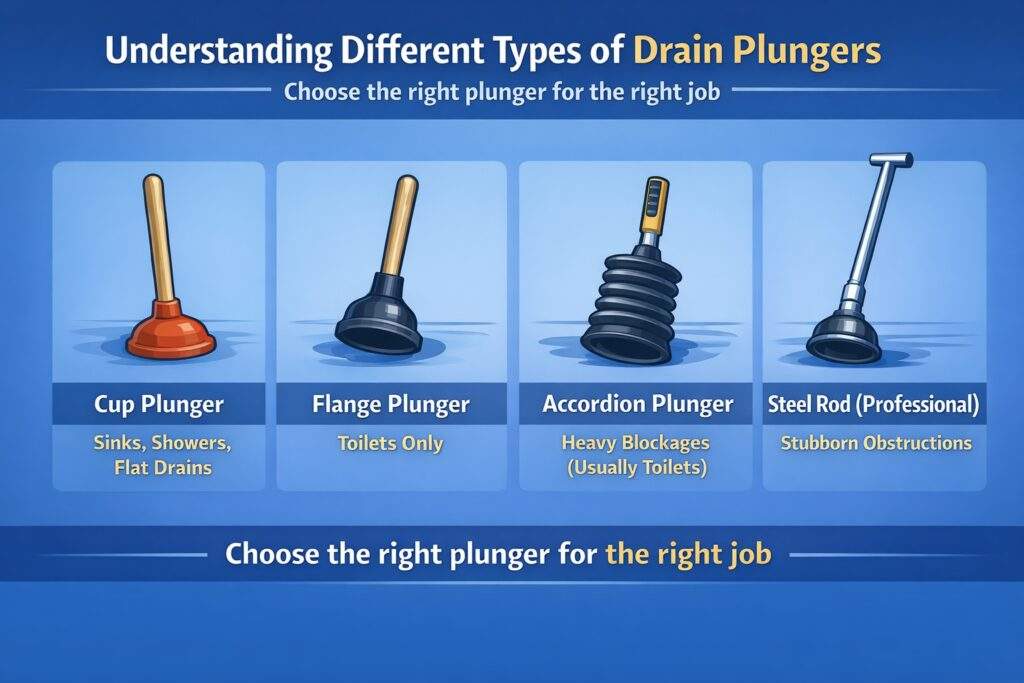
Choosing the right drain plunger makes the difference between a quick clear and repeated, messy attempts that go nowhere. Each plunger type is built to seal against a specific drain shape, which is why toilets, basins, and heavier blockages often call for different designs. The table below breaks down the main options so you can match the tool to the fixture and avoid wasted effort.
| Plunger Type | Best Applications | Seal Method |
|---|---|---|
| Cup Plunger | Basins, showers, flat drains | Flat surface contact |
| Flange Plunger | Toilets only | Extended sleeve insertion |
| Accordion Plunger | Heavy blockages (usually toilets) | Bellows compression |
| Steel Rod (Professional) | Professional use for stubborn obstructions | Direct contact/pipe access |
A cup plunger is ideal for flat drain openings because it seals against smooth surfaces and builds pressure efficiently when the clog is close. A flange plunger is the best choice for toilets because the sleeve fits into the outlet, creating a tight seal that a cup plunger can’t achieve in a curved bowl. For severe or recurring clogs, accordion plungers and professional-grade steel rod tools can be effective, but they take more skill and can damage pipework if used incorrectly — that’s where a licensed Sydney plumber earns their keep.ffective, but they require more skill and can cause damage if used incorrectly.
Step-by-Step Drain Plunger Technique
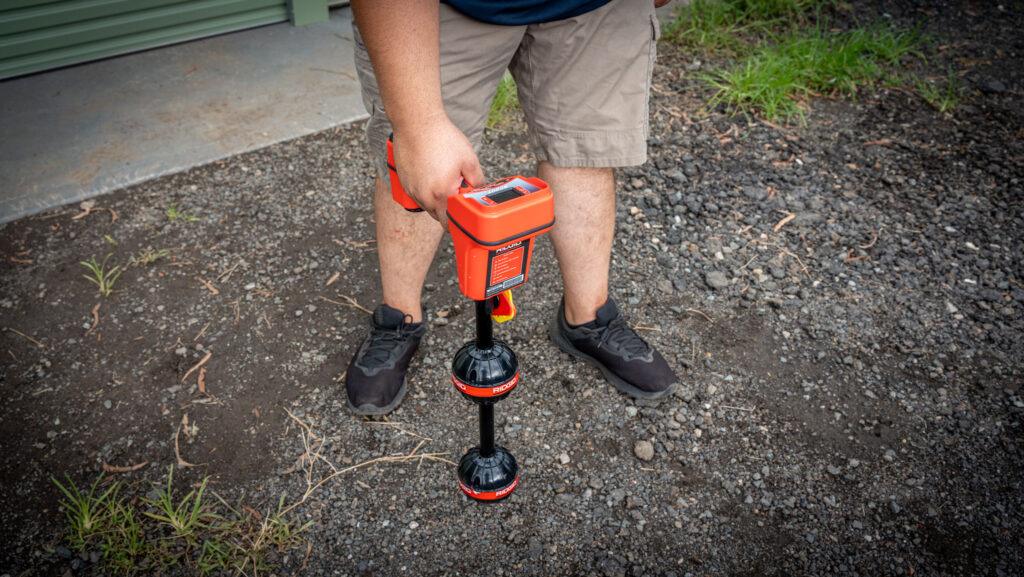
Different drains need slightly different plunger set-ups, even though the basic push-pull motion stays the same. The key is getting a tight seal and stopping air escaping, because it’s that pressure which shifts the clog. Below are the step-by-step techniques for toilets, basins, and baths/showers.
Key Rule: Match the Plunger to the Drain
Use a flange plunger for toilets because the inner rubber ring fits into the curved toilet outlet and creates a tight seal where it matters. For basins, baths and showers, use a cup plunger with a flat-bottom bell that seals best on flat surfaces. For hygiene, keep separate plungers for the toilet and the basin/sink — don’t cross-use the same tool between the bathroom and the kitchen.
Toilet Plunger Technique
- Set water level: Bowl about half full, enough to cover the rubber bell (bail out or add water as needed).
- Set up the plunger: Extend the flange, insert it into the drain opening, and submerge the bell.
- Start gently: Do one gentle push to expel trapped air.
- Plunge properly: Use quick, strong thrusts for 20–30 seconds, keeping the seal intact.
- Check progress: Pull the plunger away sharply — if the water drops or flushing improves, you’ve moved the clog.
- Repeat if needed: Work in sets until the toilet drains normally.
Bathroom / Kitchen Sink Plunger Technique
- Remove obstructions: Take out the stopper/strainer so the cup sits flat on the drain.
- Add water: Fill until the cup is covered by 2–3 cm of water.
- Seal the overflow (bathroom basin): Cover the overflow hole with a wet rag.
- Seal the second bowl (double kitchen sink): Plug the other drain with a wet rag or a second plunger.
- Plunge in sets: Quick, short strokes for 15–30 seconds with a tight seal.
- Recheck drainage: Pause, test flow, then repeat 2–4 sets if needed.
Bath / Shower Plunger Technique
- Remove the cover: Take off the drain cover or hair catcher so the cup seals flat.
- Add water: Keep a few centimetres of water in the bath/pan to cover the cup.
- Block the overflow: Seal the overflow opening with a wet rag (or a second plunger).
- Seal the drain: Place the cup over the drain and press down to lock in the seal.
- Pump vigorously: Plunge for 20–30 seconds, maintaining contact and seal.
- Check and repeat: Test drainage, then repeat in sets if it’s still slow.
A tight seal and sealed overflow openings are what make plunging effective — without them, pressure escapes and the clog stays put. If several proper sets don’t improve drainage, the blockage is likely deeper in the line and may need a drain snake, jetting, or a professional diagnosis. Stopping before overflow happens can save you a lot of mess and a much bigger repair bill.
Warning Signs to Stop Plunging
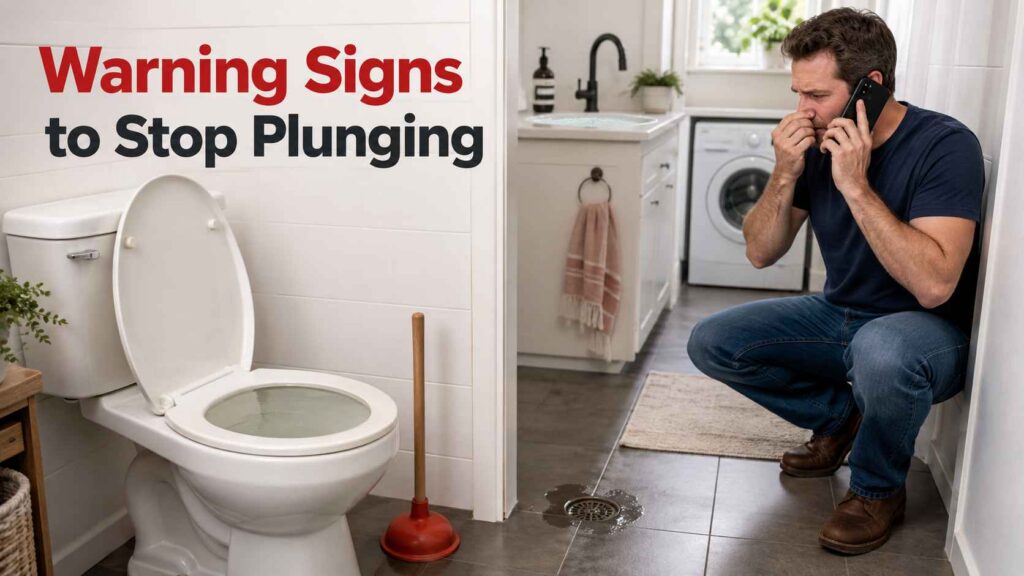
Plunging is effective for plenty of simple clogs, but there are situations where carrying on can make things worse or trigger water damage. If the problem seems to be affecting more than one fixture, or is behaving unpredictably, it’s often deeper than a household plunger can reach. Knowing when to stop protects your pipes, saves a mess, and stops a minor clog turning into a major repair.
- Multiple fixture backups: If your kitchen sink, bathroom drain, or laundry outlet backs up at the same time as the toilet, the blockage is likely in the main line — not the toilet trap — so plunging won’t reach it.
- Sewage odours: Foul smells while plunging can mean sewer gas is escaping through the drainage system, which is a health and safety issue that needs professional attention.
- Water level rising: If the water rises instead of dropping, you may be pushing the clog into a worse position or backing water up behind a deeper blockage.
- Gurgling from other drains: Gurgling from nearby or distant fixtures signals air displacement through connected drain lines, often linked to venting issues or a main line restriction.
- Recurring blockages: If the clog returns within days or weeks, the cause is usually structural or system-related (tree roots, pipe damage, poor fall, or grease buildup — all common in older Sydney terraces and federation homes) and won’t be fixed by repeated plunging.
Stopping at the right time can save you overflows, pipe damage, and an expensive emergency call-out. If you’re seeing any of these warning signs, it’s smarter to switch from DIY to a professional diagnosis than to keep forcing the blockage deeper. Call a licensed Sydney plumber — Antons Plumbing & Gas is fully licensed (NSW Lic. 210933C) to identify the root cause and clear the line safely with the right gear, on the right side of NSW plumbing regulations.
Preventing Future Drain Blockages
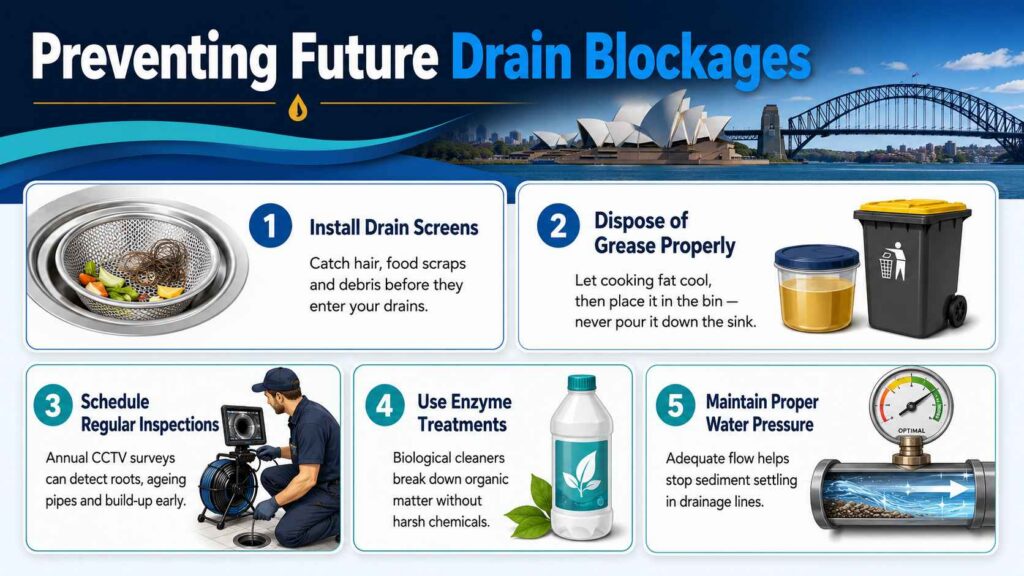
Regular maintenance prevents most drainage problems that end in emergency plunging or a call-out. Simple habits like using drain screens, keeping grease out of the sink, and the odd hot water flush keep pipes flowing freely. Knowing what causes blockages helps you protect your drainage system from avoidable damage.
- Install drain screens: Mesh covers catch hair, food scraps, and debris before they enter your drainage system, where they combine with soap residue to form stubborn blockages.
- Dispose of grease properly: Cooking fat solidifies in drain lines and traps other material, creating persistent blockages that standard plunging won’t shift.
- Schedule regular inspections: Annual CCTV drain surveys pick up tree root intrusion, pipe deterioration, and build-up before they cause a full blockage or an expensive repair — particularly useful in older Sydney suburbs with ageing clay pipework.
- Use enzyme treatments: Biological drain cleaners break down organic matter naturally, without damaging pipes or creating chemical hazards for your household.
- Maintain proper water pressure: Adequate flow keeps sediment from settling and helps drainage lines stay clear over time.
Professional maintenance schedules pick up developing problems before they become emergencies that disrupt your day.
Professional Drain Clearing Solutions

Licensed plumbers use specialised equipment that clears blockages safely without risking pipe damage or pushing obstructions further down the line. CCTV drain inspection cameras pinpoint the exact blockage location and underlying cause — tree roots, pipe collapse, or grease build-up are all common across Sydney’s mix of old and new housing stock. Hydro-jetting removes stubborn build-up that resists conventional clearing methods entirely.
Our team at Antons Plumbing & Gas approaches every blocked drain with diagnostic equipment that reveals the root cause rather than just treating the symptom. Same-day service across Sydney stops a minor blockage escalating into a major pipe failure that needs expensive excavation or replacement work.
It’s worth knowing where responsibility sits: you’re generally responsible for the plumbing on your property up to the boundary, while Sydney Water looks after the mains beyond it. If a blockage turns out to be on Sydney Water’s side, we can advise you on the right next step and, where it’s on your property, carry out the repair as your licensed plumber.
Our drain cleaning service includes a full inspection, targeted clearing, and preventive maintenance advice. We document our findings with a detailed report so you understand your drainage system’s condition and potential improvement options. Fixed-rate pricing means you know the cost upfront, in AUD, before any work starts — no surprise charges for extra work.
Emergency response means help arrives quickly when a drainage problem threatens property damage or a health hazard. Our licensed technicians carry commercial-grade equipment that handles everything from a simple hair clog to a complex sewer line obstruction. Every job complies with the AS/NZS 3500 plumbing and drainage standards used across Australia, including NSW, and includes a lifetime labour warranty for your peace of mind. As with any plumbing work in NSW, this job must be carried out by a licensed practitioner — our team operates under NSW Lic. 210933C.
Conclusion
The right drain plunger technique clears many minor blockages safely, provided you choose the correct tool and apply proper pressure. It’s time to call a professional when multiple drains back up, odours appear, or the blockage keeps returning despite successful plunging. Call 0493 824 176 (NSW Lic. 210933C) for same-day drain clearing across Sydney that diagnoses the root cause and prevents costly pipe damage.
When plunging doesn’t clear your drain, Antons Plumbing & Gas offers professional blocked drain solutions across Sydney Metro. Our 25+ years of experience means we fix stubborn blockages right the first time, in line with NSW plumbing regulations and Sydney Water requirements.
Related Articles
- Toilet Won’t Flush Properly? Common Causes and Fixes
- Is Emergency Plumbing Covered by Home and Contents Insurance?
- How to Use a Plunger to Unclog Your Toilet
FAQs
How Do You Use A Drain Plunger?
To use a drain plunger effectively, make sure there’s enough water in the sink or bath to cover the plunger’s rubber cup. Position the cup over the drain and create a tight seal. Push down firmly to build suction, then pull up quickly. Repeat this motion several times to dislodge the clog. Our experienced team at Antons Plumbing & Gas can help with stubborn clogs if plunging doesn’t do the trick.
What Type Of Plunger Is Best For Drains?
The best type of plunger for drains is a cup plunger, which has a flat rubber cup designed to seal over flat surfaces like sinks and baths. For toilets, a flange plunger works better thanks to its extended rubber flap that fits into the toilet outlet. If you’re facing a persistent drain issue, our skilled plumbers can provide a tailored solution.
Can A Drain Plunger Unclog A Toilet?
Yes, a drain plunger can unclog a toilet, but you need to use a flange plunger designed specifically for toilets. Position the flange inside the toilet outlet, create a seal, then pump vigorously. If the clog remains after several attempts, Antons Plumbing & Gas can help resolve the issue efficiently.
How Do You Unclog A Sink With A Plunger?
To unclog a sink with a plunger, first make sure there’s enough water to cover the cup. Place the plunger over the drain, create a tight seal, then push down firmly before pulling up quickly. Repeat this a few times. For persistent clogs, our experienced team is ready to help.
What Is The Difference Between A Sink Plunger And A Toilet Plunger?
The main difference is the design. A sink plunger has a flat rubber cup, ideal for flat surfaces, while a toilet plunger has a flange that extends from the cup so it fits securely in the toilet bowl. If you’re dealing with a trickier plumbing issue, Antons Plumbing & Gas is here to help with expert solutions.
How Much Does It Cost To Call A Plumber For A Blocked Drain In Sydney?
Cost depends on the type and location of the blockage, so we don’t quote a figure sight unseen. What we do offer is fixed-rate pricing in AUD, confirmed with you before any work starts, so there are no surprises on the invoice. Call 0493 824 176 for an obligation-free quote.
Do You Offer Same-Day Blocked Drain Service Across Sydney?
Yes, we offer same-day and emergency drain clearing across Sydney Metro. If a blockage is affecting more than one fixture in your home, don’t wait — call us and we’ll get a licensed plumber out to diagnose and fix it before it becomes a bigger problem.
Are Antons Plumbing & Gas Plumbers Licensed In NSW?
Yes. Antons Plumbing & Gas operates under NSW Lic. 210933C, so every job — from a simple plunger job that’s gone wrong to a full sewer line repair — is carried out to NSW plumbing regulations and AS/NZS 3500 standards.
What Sydney Suburbs Do You Service?
We service Sydney Metro, including areas such as Carlingford, Kellyville, and South Western Sydney suburbs. If you’re unsure whether we cover your area, give us a call on 0493 824 176 and we’ll confirm straight away.
Is A Blocked Drain Considered A Plumbing Emergency?
It can be. If water is backing up into multiple fixtures, you can smell sewage, or the toilet won’t stop overflowing, treat it as an emergency and call us immediately rather than continuing to plunge.
What Happens If The Blockage Is In The Sydney Water Main, Not My Pipes?
Sydney Water is responsible for the main sewer line beyond your property boundary, while you’re responsible for the plumbing on your property. If our inspection shows the blockage is on Sydney Water’s side, we’ll let you know and point you in the right direction; if it’s on your property, we can clear and repair it as your licensed plumber.
Do I Need A Licensed Plumber For Drain Work In NSW, Or Can I DIY It?
Simple plunging of a sink, bath, or toilet is fine to attempt yourself. However, any work involving pipework, fittings, or connections to the water or sewer system must be carried out by a licensed plumber under NSW regulations. If plunging doesn’t work, that’s your cue to call a licensed professional rather than reaching for tools.
How Do I Book A Plumber With Antons Plumbing & Gas?
You can book online through our booking page or call us directly on 0493 824 176 for same-day and emergency appointments across Sydney.
What Should I Do While I Wait For The Plumber To Arrive?
Stop plunging if you’ve noticed any of the warning signs above, avoid running more water or flushing the toilet, and if you can, locate your water shut-off valve in case the situation worsens before we arrive.
Do You Provide CCTV Drain Inspections In Sydney?
Yes, we use CCTV drain cameras to pinpoint the exact location and cause of a blockage — tree roots, pipe damage, or build-up — which is especially useful for older Sydney homes with ageing clay pipework. Ask us about a CCTV inspection when you book.
Is Hydro-Jetting Safe For Older Sydney Homes?
Hydro-jetting is generally safe and effective, but pipe condition matters, particularly in older homes with ageing or fragile pipework common across Sydney’s established suburbs. Our licensed plumbers assess your pipes first, often with a CCTV inspection, before recommending jetting.
What’s The Difference Between A Blocked Drain And A Blocked Toilet?
A blocked toilet usually only affects that fixture and often clears with a flange plunger. A blocked drain can affect multiple fixtures at once and points to an issue further down the line, which is a sign to call a licensed plumber rather than keep plunging.
Can Tree Roots Cause Blocked Drains In Sydney Homes?
Yes, tree root intrusion is a common cause of recurring blockages in Sydney, especially in older suburbs with established trees near ageing clay or earthenware pipes. A CCTV inspection can confirm this, and we can advise on clearing and longer-term repair options.
Do You Offer After-Hours Emergency Plumbing In Sydney?
Yes, we offer emergency plumbing response for urgent blockages and other plumbing issues across Sydney. If your drain problem can’t wait until business hours, call 0493 824 176 and we’ll arrange help.
How Can I Prevent Blocked Drains In My Sydney Home?
Fit drain screens, keep grease out of the sink, avoid flushing wipes or sanitary items, and book an annual CCTV drain inspection, particularly if you’re in an older home with mature trees nearby. If you’d like us to set up a maintenance schedule, get in touch and we’ll tailor one to your property.